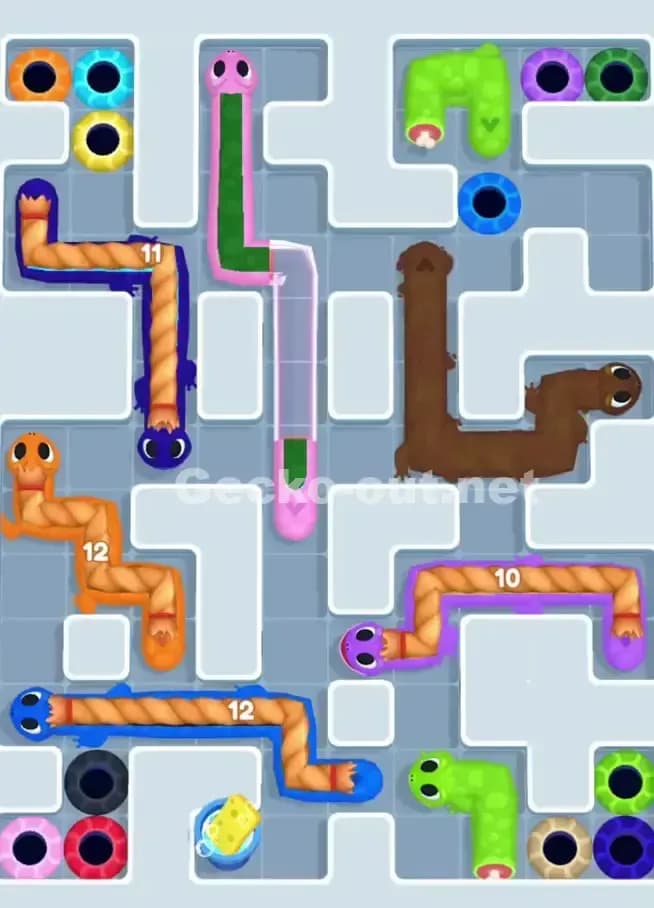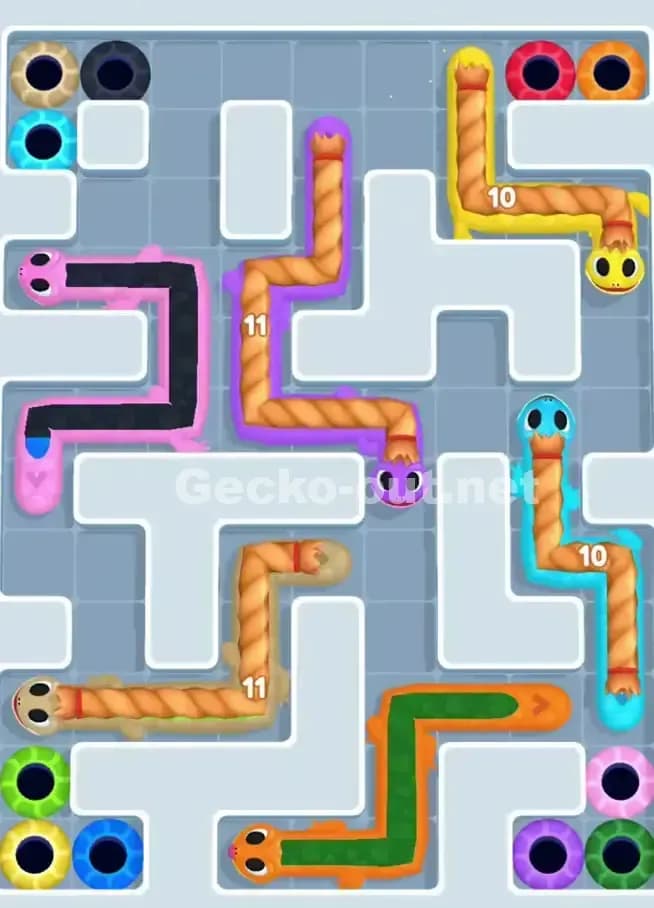
Gecko Out Level 1022 Solution Walkthrough | Gecko Out 1022 Answer
How to solve Gecko Out level 1022? Get step by step solution & cheat for Gecko Out level 1022. Solve Gecko Out 1022 easily with the answers & video walkthrough.
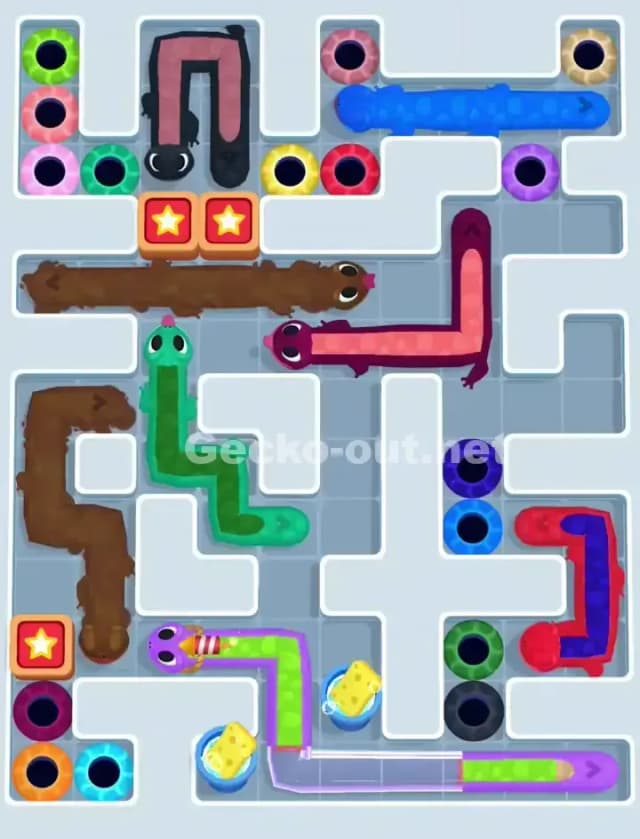
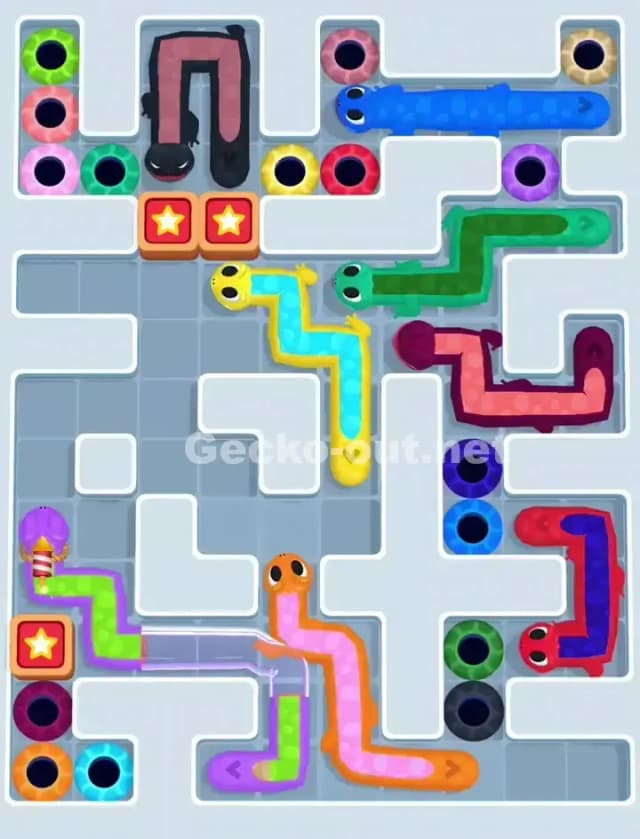
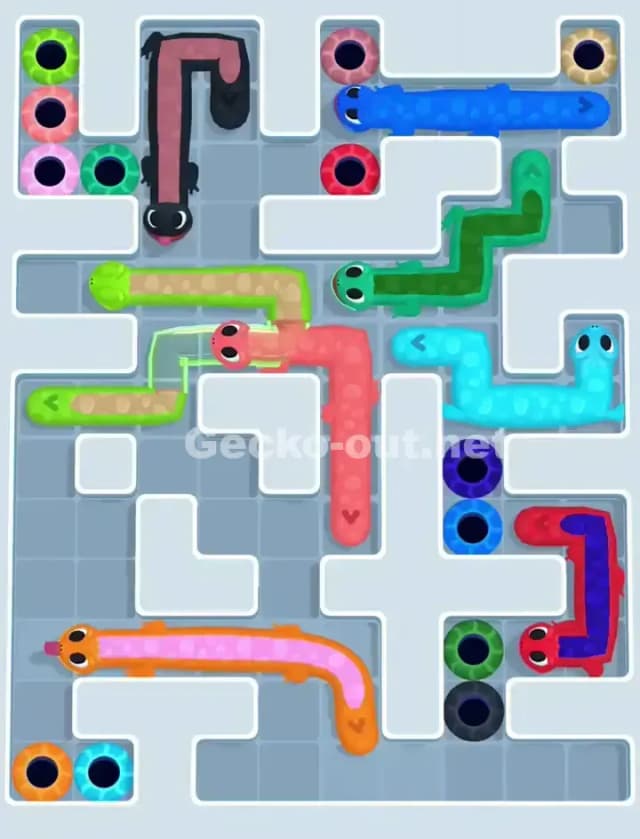
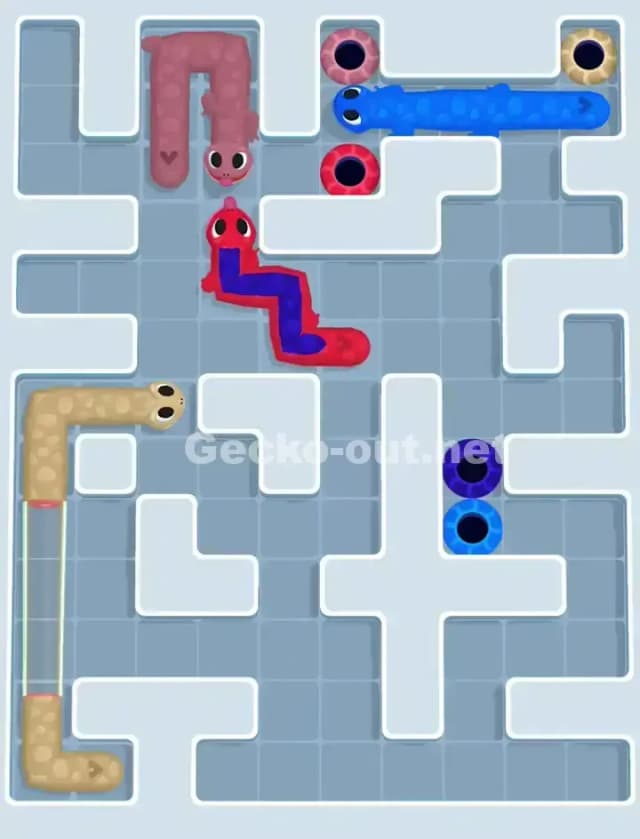
Gecko Out Level 1022: Board Layout, Rules, and Win Condition
Starting Board: Geckos, Colors, and Obstacles
Gecko Out Level 1022 is a densely packed puzzle that'll test your spatial reasoning and drag-path precision. You're working with a total of nine geckos spread across multiple colors: green, pink, yellow, red, purple, blue, orange, and cyan. The board is a sprawling maze of interconnected corridors with several long, winding geckos already positioned in tight quarters. What makes this level particularly tricky is that you've got two brown gang geckos (linked together and moving as one unit), two yellow warning holes that don't lead anywhere, two star-marked toll gates that require careful sequencing, and a blue booster gecko stretched horizontally across the upper-middle section of the board. The walls form a complex labyrinth with multiple choke points, and the exits are scattered around the perimeter—some easy to reach, others buried behind layers of other geckos.
Win Condition and Timer Pressure
To beat Gecko Out Level 1022, every single gecko must reach its matching-colored hole before the timer runs out. The timer is your constant pressure; it's not generous, and it forces you to think ahead rather than trial-and-error your way through. Because movement is path-based—meaning the gecko's body follows the exact route you drag its head—you can't just yank geckos around willy-nilly. Every drag creates a permanent trail that the body must follow, so if you drag a head through a corridor that another gecko's body is occupying, you'll jam the board and waste precious seconds undoing the move. This is why Gecko Out Level 1022 demands a clear, logical exit sequence before you start dragging anything.
Pathing Bottlenecks and Logical Traps in Gecko Out Level 1022
The Critical Bottleneck: The Brown Gang Gecko
The single biggest bottleneck in Gecko Out Level 1022 is the brown gang gecko on the left side of the board. This isn't just one gecko—it's two linked geckos moving as a single unit, which means it occupies a massive amount of space. The brown gang is coiled up in the left-center area, and its exit path is relatively narrow. Here's the problem: almost every other gecko on the board has to pass through or around the space that the brown gang currently occupies. If you don't move the brown gang early and decisively, you'll find yourself unable to route other geckos without creating impossible overlaps. The brown gang's exit is on the left side, but getting it there requires clearing a specific corridor first, which means you need to move at least two other geckos out of the way before you can even think about the brown gang's final path.
Subtle Trap #1: The Blue Booster Gecko's Horizontal Stretch
The blue booster gecko runs horizontally across the top-right portion of the board, and it's deceptively blocking. Because it's so long and positioned high up, you might think it's out of the way—but it's not. Several geckos need to route upward or rightward to reach their exits, and the blue gecko's body is sitting right in those lanes. If you drag a head upward without first moving the blue gecko, you'll create a collision that forces you to undo and rethink. The trick is to move the blue gecko to its exit early, even though it might not seem urgent. Clearing that horizontal lane opens up multiple pathways for other geckos.
Subtle Trap #2: The Yellow Warning Holes and Toll Gates
The two yellow warning holes are decoys—they look like exits but they're not. If you accidentally drag a yellow gecko toward one of these, you'll waste time and potentially jam your path. Similarly, the two star-marked toll gates require you to pass through them in a specific order or with specific geckos; if you route a gecko through a toll gate at the wrong moment, you might lock yourself out of a critical corridor. These traps are designed to punish hasty dragging, so you need to study the board and identify which geckos actually need to use the toll gates and in what sequence.
Subtle Trap #3: The Green Gecko's Tight L-Shape
The green gecko is bent into a tight L-shape in the lower-left area, and its exit is on the bottom-left corner. The problem is that the green gecko's body is wrapped around a corner, and if you drag its head without first clearing the adjacent corridors, you'll create a knot that's nearly impossible to untangle. The green gecko needs a clear, unobstructed path from its current position all the way to its exit, and that means you need to move the purple gang gecko and the orange gecko out of the way first.
Personal Reaction: When the Solution Clicked
I'll be honest—my first three attempts at Gecko Out Level 1022 were frustrating. I kept dragging geckos without thinking, and I'd end up with a board so tangled that I had to restart. But then I took a step back and traced each gecko's potential exit path with my finger before touching anything. That's when it clicked: I realized the brown gang gecko had to go first, the blue gecko second, and then the rest would cascade into place. Once I saw the sequence, Gecko Out Level 1022 went from impossible to challenging-but-doable. The frustration turned into satisfaction because the puzzle actually has an elegant solution—you just have to find it before you start moving.
Turn-by-Turn Path Strategy to Beat Gecko Out Level 1022
Opening: Clear the Blue Gecko and the Brown Gang
Start by moving the blue booster gecko to its exit on the right side of the board. Drag its head rightward and downward, following the corridor that leads to the blue hole in the upper-right area. This move takes about 5–7 seconds, but it's crucial because it clears the horizontal lane at the top of the board. Once the blue gecko is out, you've opened up pathways for the yellow, red, and purple geckos that need to route upward or rightward.
Next, tackle the brown gang gecko. Drag its head leftward and downward, guiding it through the corridor toward the brown hole on the left side. The brown gang is long, so you'll need to be patient and deliberate with your drag—make sure you're not accidentally routing it through a space where another gecko's body is sitting. Once the brown gang is out, you've freed up a massive amount of board real estate, and the remaining geckos will have much more room to maneuver.
Mid-Game: Untangle the Left Side and Route the Long Geckos
After the blue and brown geckos are out, focus on the left-side geckos: the green, purple, and orange. The green gecko needs to go next because its L-shaped body is blocking the lower-left corridor. Drag the green gecko's head downward and leftward toward the green hole at the bottom-left. Make sure you're not routing it through any space occupied by the orange or purple geckos' bodies.
Once green is out, move the purple gang gecko (the one in the lower-center area). Drag its head downward and rightward, routing it toward the purple hole on the right side of the board. The purple gecko is also fairly long, so take your time and ensure the path is clear before committing to the drag.
Now move the orange gecko. Drag its head leftward and downward toward the orange hole at the bottom-left corner. By this point, the left side of the board should be mostly clear, so this move should be straightforward.
End-Game: Exit the Remaining Geckos in Rapid Succession
With the long geckos and gang geckos out of the way, you're left with the yellow, red, pink, and cyan geckos. These are shorter and more maneuverable, so you can move them more quickly. Start with the yellow gecko—drag it toward the yellow hole (not the warning holes!) on the right side. Then move the red gecko toward the red hole, the pink gecko toward the pink hole, and finally the cyan gecko toward the cyan hole.
If you're running low on time, don't panic. The remaining geckos are small enough that you can drag them in quick, confident motions. Avoid second-guessing yourself; if you've cleared the board properly, the paths should be obvious. If you find yourself with only 10–15 seconds left and one or two geckos still on the board, use a time booster if you have one available. It's better to use a booster in the final seconds than to fail the level.
Why This Path Order Works in Gecko Out Level 1022
Head-Drag Pathing and the Body-Follow Rule
The reason this sequence works is that it respects the fundamental rule of Gecko Out Level 1022: the body follows the exact path the head is dragged. By moving the longest and most spatially demanding geckos first (blue, brown, green, purple, orange), you're clearing the board progressively, which means each subsequent gecko has more room to move without colliding with other bodies. If you tried to move the short geckos first, you'd end up with their bodies scattered across the board, blocking the long geckos' exit paths and forcing you to undo multiple moves. The sequence I've outlined is the reverse of that mistake—it's the optimal untangling order.
Timer Management: Pause, Read, Commit
Gecko Out Level 1022 gives you enough time to complete it if you're efficient, but not if you're indecisive. Here's my recommendation: spend the first 10–15 seconds pausing and tracing each gecko's path with your eyes. Don't touch anything yet. Once you've mentally mapped out the sequence, commit to the moves and execute them without hesitation. Dragging is fast; undoing is slow. If you're confident in your path, drag decisively. If you're unsure, pause for a moment and re-examine. The timer is forgiving enough that a few seconds of strategic pausing won't hurt you, but constant undoing will.
Boosters: Optional but Helpful
Gecko Out Level 1022 doesn't strictly require boosters if you execute the strategy perfectly, but a time booster is a good safety net. If you find yourself with 20 seconds left and three geckos still on the board, a time booster will give you an extra 30 seconds to finish. Alternatively, if you make a mistake and need to undo a move, a hint booster can help you see the correct path for a tricky gecko. I'd recommend having a time booster in your inventory before attempting Gecko Out Level 1022, just in case.
Mistakes, Fixes, and Logic You Can Reuse in Other Gecko Out Levels
Mistake #1: Moving Short Geckos First
Many players start by moving the small, easy geckos because they seem quick and low-risk. This is a trap. In Gecko Out Level 1022, moving short geckos first leaves their bodies scattered across the board, blocking the long geckos' paths. Fix: Always identify the longest and most spatially demanding geckos first, and move them out before touching the short ones.
Mistake #2: Not Tracing Paths Before Dragging
Players often drag a gecko's head without thinking about where the body will end up. In Gecko Out Level 1022, this leads to collisions and forced undos. Fix: Before you drag anything, trace the path with your finger or your eyes. Make sure the entire route—from head to tail—is clear of other gecko bodies and walls.
Mistake #3: Confusing Warning Holes with Real Exits
The two yellow warning holes in Gecko Out Level 1022 look like exits, but they're not. Players sometimes drag a yellow gecko toward a warning hole, only to realize it's a dead end. Fix: Study the board legend or color-coding carefully. Real exits are usually marked differently from warning holes. In Gecko Out Level 1022, the real exits are the colored circles that match the gecko colors.
Mistake #4: Ignoring the Toll Gates' Sequencing
The two star-marked toll gates in Gecko Out Level 1022 have a specific order or requirement. If you route a gecko through a toll gate at the wrong time, you might lock yourself out of a critical corridor. Fix: Before moving any gecko near a toll gate, understand what the toll gate requires. Does it need a specific gecko to pass through first? Does it have a time limit? Plan your sequence accordingly.
Mistake #5: Rushing the Final Geckos
With only a few geckos left and the timer ticking, players often panic and drag carelessly. This leads to last-second collisions and failed attempts. Fix: Even in the final moments, drag deliberately. The remaining geckos are usually short and maneuverable, so you have more time than you think. Take a breath, identify the clearest path, and execute it confidently.
Reusing This Logic on Similar Levels
The strategy I've outlined for Gecko Out Level 1022 applies to any level with gang geckos, long geckos, or complex knots. The key principle is: move the spatially demanding geckos first, clear the board progressively, and save the short geckos for last. This approach works on levels with frozen exits, linked geckos, and tight choke points. Whenever you encounter a level that feels tangled and impossible, step back, identify the longest gecko or the biggest bottleneck, and start there. Nine times out of ten, that's the key to untangling the puzzle.
Final Encouragement
Gecko Out Level 1022 is genuinely tough—it's a level that separates casual players from strategic thinkers. But it's absolutely beatable with a clear plan and deliberate execution. The puzzle isn't unfair; it's just demanding. Once you understand the sequence and commit to it, you'll beat Gecko Out Level 1022 with time to spare. And when you do, you'll have unlocked a problem-solving approach that'll carry you through dozens of future levels. So take a deep breath, trace those paths, and get those geckos out. You've got this.