Gecko Out Level 656 Solution Walkthrough | Gecko Out 656 Answer
How to solve Gecko Out level 656? Get step by step solution & cheat for Gecko Out level 656. Solve Gecko Out 656 easily with the answers & video walkthrough.
Gecko Out Level 656: Board Layout, Rules, and Win Condition
Starting Board and Gecko Count
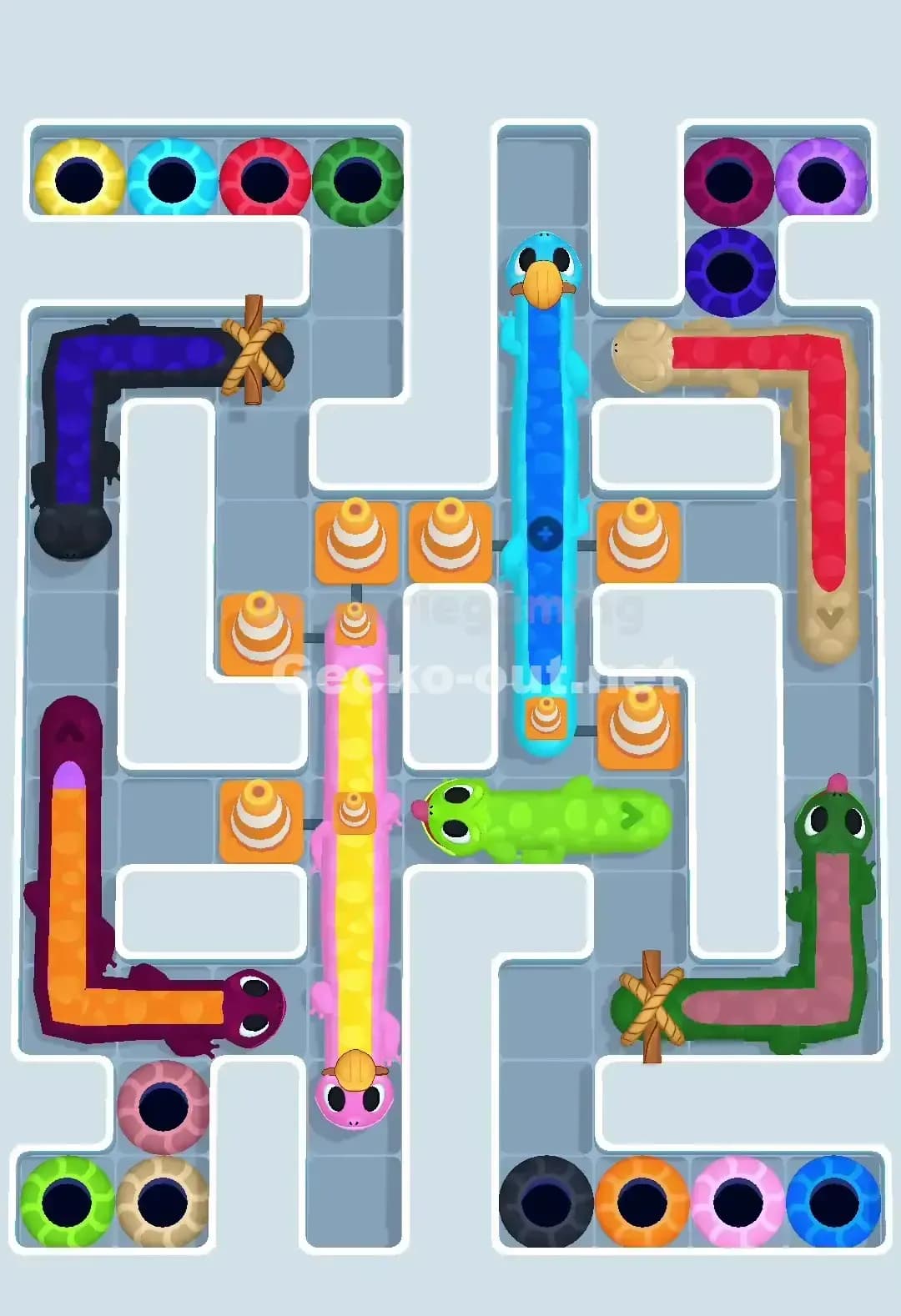
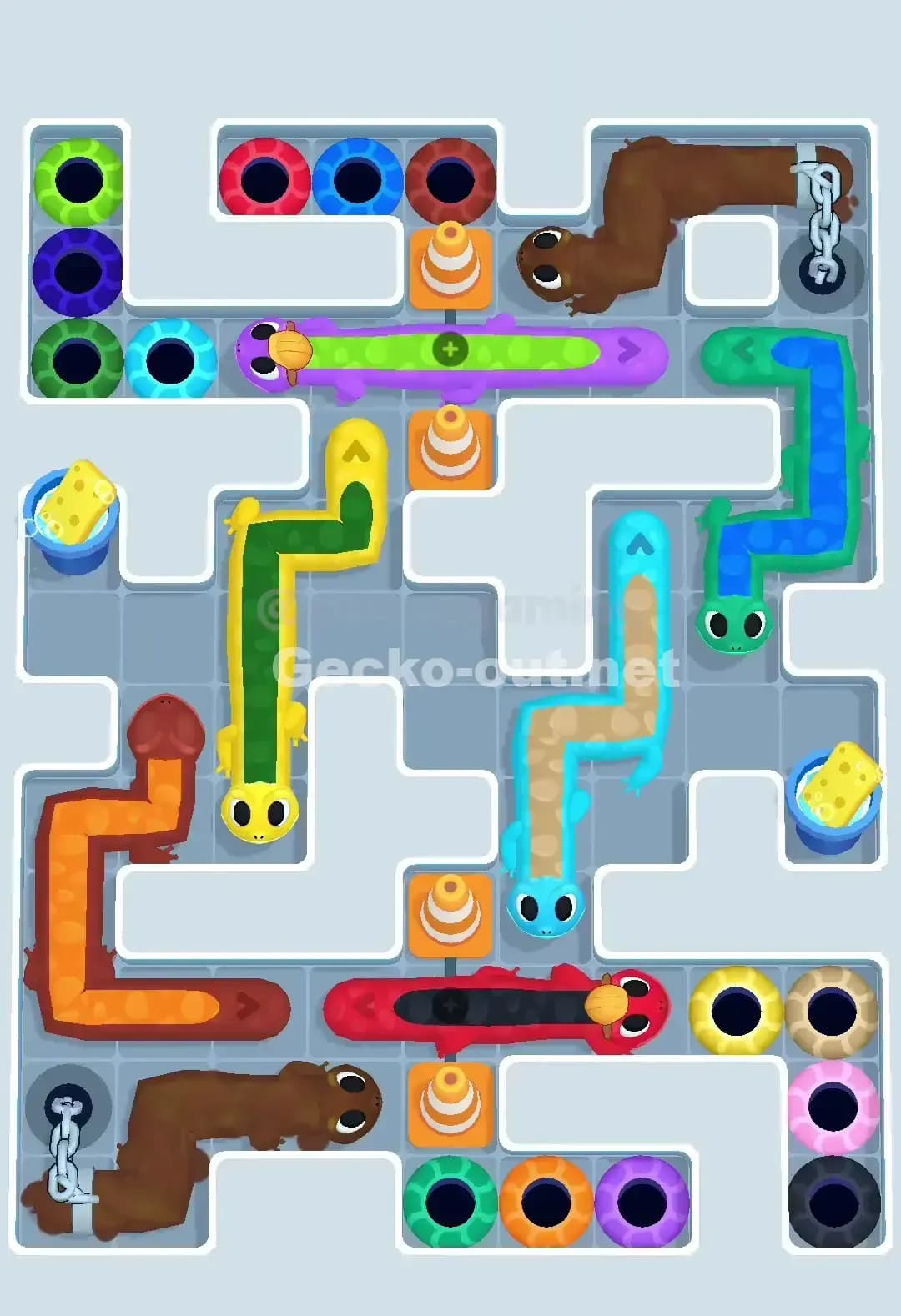
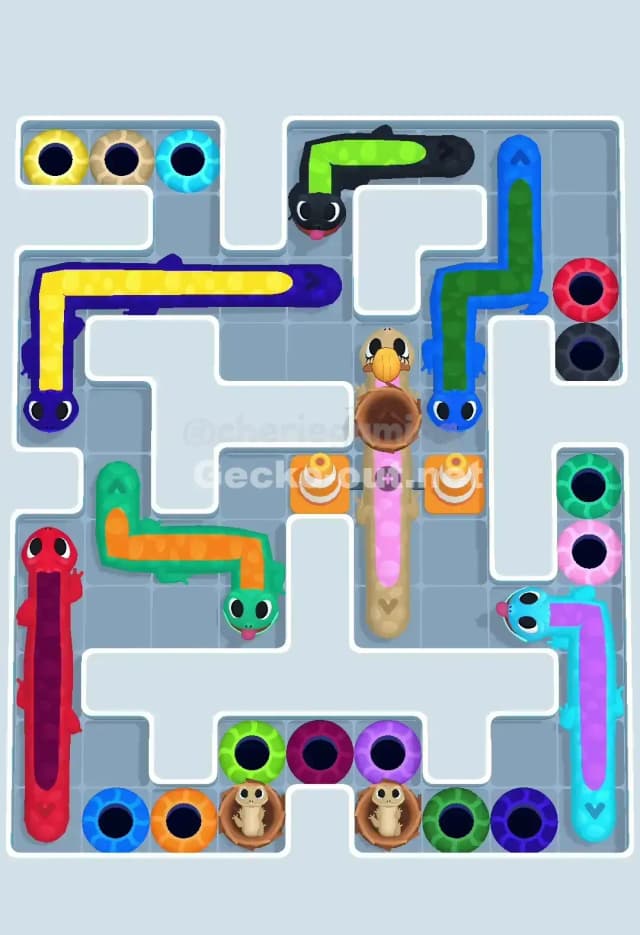
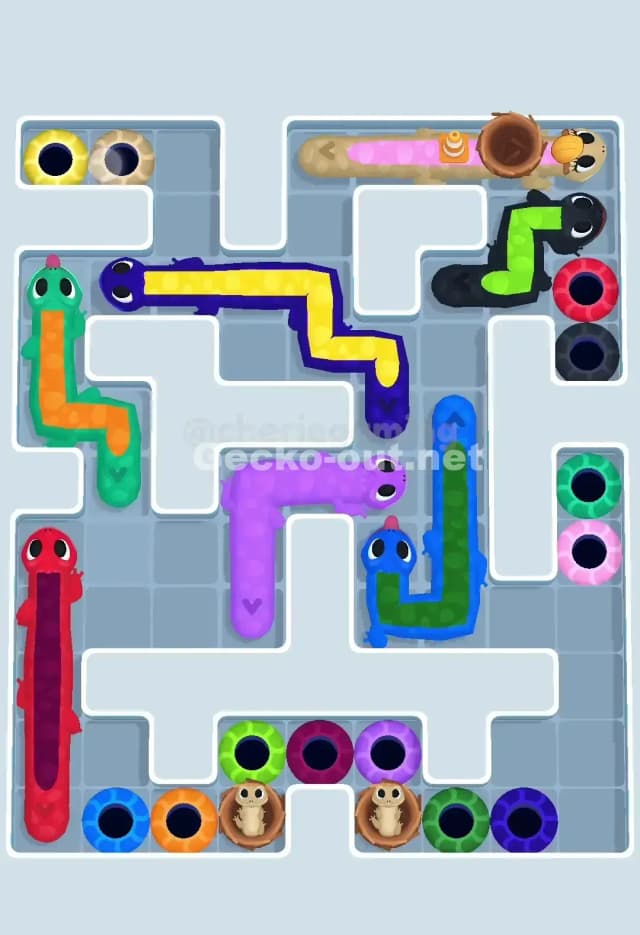
Gecko Out Level 656 presents you with a complex, multi-gecko puzzle featuring eight distinct geckos spread across the board in a tightly wound configuration. You've got a yellow gecko, a tan gecko, a cyan gecko, a blue gecko, a green gecko, an orange gecko, a magenta gecko, and a red gecko all competing for escape routes. The board itself is a maze-like grid with thick white walls creating narrow corridors and bottlenecks throughout. What makes Gecko Out 656 particularly demanding is that these geckos aren't just scattered randomly—they're arranged in long, snaking body chains that immediately overlap with each other and with critical pathways. The layout forces you to think several moves ahead because moving one gecko often locks or unlocks routes for multiple others.
Understanding the Win Condition and Timer Pressure
Your goal in Gecko Out Level 656 is straightforward: get every single gecko to its matching-colored exit hole before the timer runs out. However, the timer is tight, and the board layout is deceptive. Because each gecko's body follows the exact path you drag its head through, you can't just yank geckos around willy-nilly. Every drag action must account for the body trailing behind, which means long geckos become obstacles themselves the moment you start moving them. The win condition forces you to think about sequencing: which gecko leaves first, which gets temporarily "parked" to keep lanes open, and which must exit last when most of the board is finally clear. This isn't a level where you can brute-force your way through with random drags; Gecko Out 656 demands patience and planning.
Pathing Bottlenecks and Logical Traps in Gecko Out Level 656
The Central Vertical Corridor Bottleneck
The single biggest chokepoint in Gecko Out Level 656 is the central vertical corridor running down the middle of the board. This narrow lane is where multiple geckos need to pass, yet the space is barely wide enough for one full-length gecko body at a time. The magenta gecko in particular occupies this space in a way that creates a stranglehold on movement. If you try to move any other gecko through this corridor before carefully routing the magenta gecko out of the way, you'll create an immediate collision that halts your progress. I found myself stuck here for several attempts before realizing that the magenta gecko had to be the very first gecko to move, even though it's not the closest to an exit. Once I committed to that sequencing, the rest of the board suddenly opened up.
Secondary Trap: The Upper-Left Gang Cluster
The upper-left corner houses three geckos (yellow, tan, and cyan) crammed together in what feels like a gang unit. These three share the same general area and have exit holes nearby, but their initial overlapping positions mean you can't just drag them individually without tangling their bodies. The cyan gecko, in particular, has a head positioned in a way that makes it look like it should move first, but doing so actually traps the yellow gecko's path. The real trick is recognizing that the tan gecko must be extracted first to create the space for the other two to move.
The Lower-Red and Blue Intersection Problem
At the bottom of the board, the red gecko's long body intersects with the blue gecko's starting position in a way that creates visual confusion. You might assume these two are locked together, but they're actually separate geckos that need different routes. The danger here is wasting precious seconds trying to move them as if they're chained when, in fact, a slight repositioning of the red gecko's head opens an entirely new path for the blue gecko. This is one of those subtle traps where the board's visual layout lies to you about what's actually blocking what.
My Moment of Breakthrough
Honestly, Gecko Out Level 656 frustrated me at first. I kept trying to move the geckos that looked most "stuck" or closest to exits, which only made things worse. But then I stepped back, studied the central corridor, and realized the order wasn't about proximity—it was about liberation. Once I understood that moving the magenta gecko first would create a cascade of available paths for everyone else, everything clicked. That's when I knew I could beat Gecko Out 656 with a methodical, sequenced approach.
Turn-by-Turn Path Strategy to Beat Gecko Out Level 656
Opening: The Magenta Gecko Liberation Move
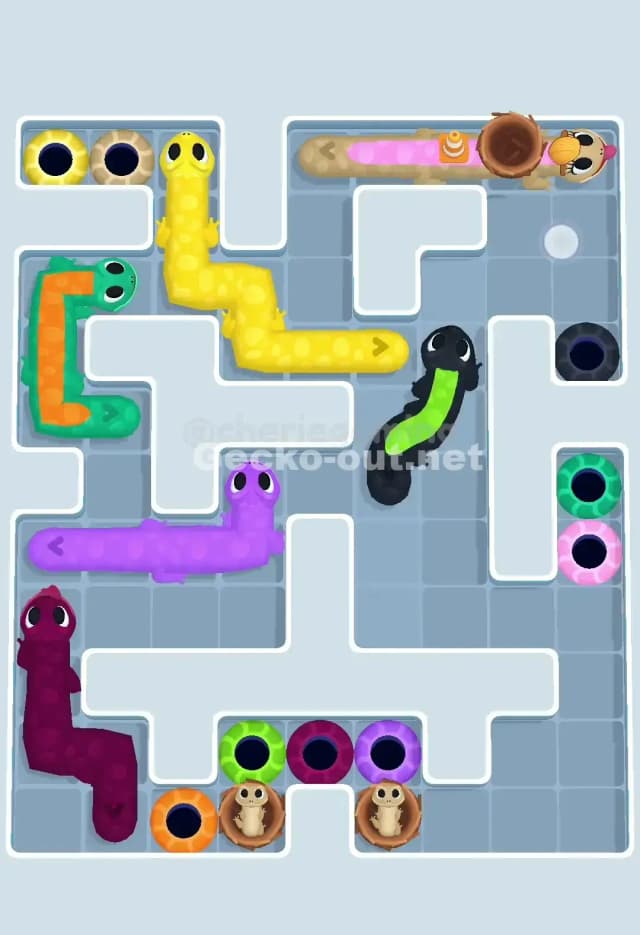
Start by dragging the magenta gecko's head upward and to the left, steering it out of the central corridor entirely. This gecko is long and awkward, so don't rush the drag—trace a careful path that avoids the walls and keeps its body from wrapping around other geckos. Once the magenta gecko is safely parked in a clear area on the left side of the board, it's no longer blocking anyone else's vertical movement. This single action transforms Gecko Out 656 from a tangled mess into something with actual room to maneuver. Your reward for this opening move is that the central corridor is now clear, and you've bought yourself time and space for the rest of the puzzle.
Mid-Game: Sequential Extraction of the Upper Cluster
Next, address the upper-left gang of three (yellow, tan, cyan). Begin with the tan gecko, dragging it to its matching-colored exit hole on the right side of the board. Route it carefully through the now-unobstructed central area, being mindful not to bump into the magenta gecko's parked position. Once the tan gecko is out, the yellow gecko has breathing room. Move the yellow gecko next, following a similar path upward and to the right toward its yellow exit hole. Finally, extract the cyan gecko, which now has clear lanes to reach its cyan hole in the upper-right region. This trio takes up roughly the first third of your available time, but getting them out of the way unlocks almost the entire lower half of the board.
Mid-Game Continued: The Green and Orange Pair
After the upper cluster is clear, focus on the green and orange geckos lurking in the lower-middle section. The green gecko should move first, as it's more compactly coiled than the orange gecko. Drag the green gecko's head down and to the left, routing it through the now-spacious corridors toward its green exit hole at the bottom-left area. The orange gecko, being longer and more sprawling, should follow, but take care to avoid the path the green gecko just took—you want to use different routes to prevent body collisions. Stagger these two moves with a mental pause between them to ensure each gecko's body has fully settled before you initiate the next drag.
Mid-Game: The Tan and Red Extended Bodies
Don't forget about the long red gecko occupying the left side of the board and the additional tan-colored gecko at the bottom. The red gecko needs to move down and then left to reach its red exit hole at the bottom-left corner, but its length means it'll consume most of that corridor. Time this move carefully—ideally, wait until most other geckos are already out so there's minimal interference. The bottom-area tan geckos should be among your last three or four geckos to move, since they're positioned close to their respective exit holes and don't significantly block others.
End-Game: The Blue and Cyan Final Push
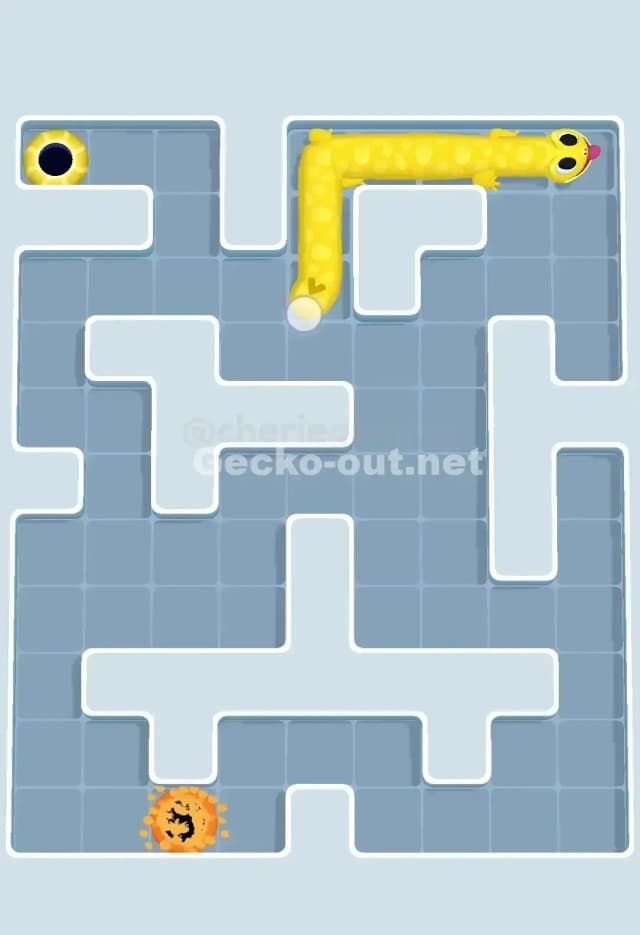
By the end-game phase, you should have only the blue gecko and possibly one or two stragglers remaining. The blue gecko occupies the right side and needs a path down to its blue exit hole at the bottom-right region. Since most of the board should be clear by now, drag it confidently downward, then left along the bottom corridor. Your final geckos should slide into their holes almost effortlessly if you've sequenced everything correctly. However, if you're running low on time (say, under 20 seconds remaining), don't second-guess your drags—commit to the moves and trust that the clear board will guide your remaining geckos home.
Why This Path Order Works in Gecko Out Level 656
Head-Drag Pathing and the Body-Follow Rule
The beauty of this sequential approach in Gecko Out Level 656 is that it respects the fundamental body-follow rule. When you drag a gecko's head, its body traces that exact path as a rigid chain, which means every subsequent gecko benefits from the space the previous one has vacated. By moving the magenta gecko first, you're not solving its own puzzle—you're solving the puzzle for everyone else. Each gecko you extract permanently removes obstacles from the board, making the remaining geckos' paths shorter and clearer. This is why brute-force, random-order approaches fail on Gecko Out 656; they ignore the compounding benefit of strategic sequencing. You're essentially untangling a knot by removing the threads in the right order, rather than trying to yank all the threads at once.
Timer Management: Pause, Read, and Commit
Gecko Out Level 656 tests not just your spatial reasoning but your confidence under time pressure. Here's my advice: spend the first 10–15 seconds simply studying the board without moving any gecko. Identify the bottleneck (the central corridor), trace potential paths in your mind, and decide on your first three moves. Once you've done that mental work, commit and move quickly—don't pause between each drag unless you're genuinely confused. Hesitation wastes more time than a slightly imperfect drag path. If you finish in under 30 seconds with everyone out, you've done it right. If you're cutting it to the final 5 seconds, you've likely spent too much time second-guessing.
Boosters: Optional, Not Essential
For Gecko Out Level 656, boosters like extra time or hint tools are absolutely optional. The level is difficult but solvable with pure logic and planning. That said, if you're struggling after three or four attempts, a 30-second time extension booster can ease the pressure and let you focus on execution rather than clock-watching. A hint booster would tell you to move the magenta gecko first, which you already know from this guide. I'd recommend saving your booster currency for tougher levels and beating Gecko Out 656 with skill alone—it's absolutely doable and far more satisfying.
Mistakes, Fixes, and Logic You Can Reuse in Other Gecko Out Levels
Common Mistake #1: Moving Closest Geckos First
Many players assume the gecko nearest to an exit hole should move first, which is backward logic. In Gecko Out Level 656, proximity to an exit is irrelevant if that gecko is blocking three others from moving at all. Fix: Always identify the gecko that occupies the most critical shared space (like the central corridor) and move that one first, even if it's far from its exit. This principle applies to any Gecko Out level with a bottleneck.
Common Mistake #2: Dragging Long Geckos Without Considering Body Wrap
Long geckos in Gecko Out 656 can wrap their bodies around corners and walls in unexpected ways if you drag their heads too aggressively. Many players make sharp turns with long gecko heads, only to have the body collide with a wall halfway through the path. Fix: Always trace long, smooth paths for long geckos, avoiding sharp 90-degree turns. Gentle curves are safer than quick pivots. Test this habit on Gecko Out 656 by moving the red or magenta geckos with deliberate slowness to see how their bodies respond.
Common Mistake #3: Forgetting to "Park" Geckos in Safe Zones
Sometimes a gecko needs to move early not because it needs to exit soon, but because it's in the way. However, moving it all the way to its exit hole might waste space or corner the gecko inefficiently. Fix: Identify safe, empty zones on the board where you can temporarily park a gecko's head while keeping its body out of traffic. In Gecko Out Level 656, the upper-right area serves as a parking zone for the magenta gecko while others use the central corridor.
Common Mistake #4: Miscalculating Body Length
A gecko that looks like it's "only two tiles long" might actually be four or five tiles once you start dragging it. This misjudgment causes collisions late in the path that undo all your progress. Fix: Before dragging, count the gecko's body segments or visually trace its full length. In Gecko Out 656, the red gecko is deceptively long—it's easy to underestimate.
Common Mistake #5: Panicking and Moving Randomly in the Final Seconds
When the timer hits 10 seconds and you still have two geckos to move, the temptation to drag frantically is strong. Ironically, this almost always leads to collision and failure. Fix: Keep your cool. If you've planned correctly (like in Gecko Out 656's sequenced approach), the final geckos should have clear, direct paths. Trust your earlier work and drag the last few geckos calmly and deliberately, even if the timer is ticking down.
Reusable Logic for Similar Levels
The sequencing strategy you've learned from Gecko Out Level 656 transfers directly to any puzzle with multiple long geckos, central bottlenecks, or overlapping starting positions. Whenever you encounter a level where geckos are stacked or intertwined, ask yourself: "Which gecko, if removed, would open the most paths for the others?" That gecko moves first, regardless of where it starts or where it needs to go. This logic has saved me countless times on gang-gecko levels and tight-corridor puzzles throughout the Gecko Out series.
Encouragement and Final Thoughts
Gecko Out Level 656 is genuinely tough—there's no shame in struggling with it. But I promise you, it's absolutely beatable with the sequenced approach outlined here. Once you move that magenta gecko and watch the board transform from a tangled nightmare into a solvable puzzle, you'll have a breakthrough moment that makes all the frustration worthwhile. The skills you build conquering Gecko Out 656 will make dozens of future levels feel manageable. You've got this.