Gecko Out Level 669 Solution Walkthrough | Gecko Out 669 Answer
How to solve Gecko Out level 669? Get step by step solution & cheat for Gecko Out level 669. Solve Gecko Out 669 easily with the answers & video walkthrough.
Gecko Out Level 669: Board Layout, Rules, and Win Condition
Starting Board: Geckos, Colors, and Critical Obstacles
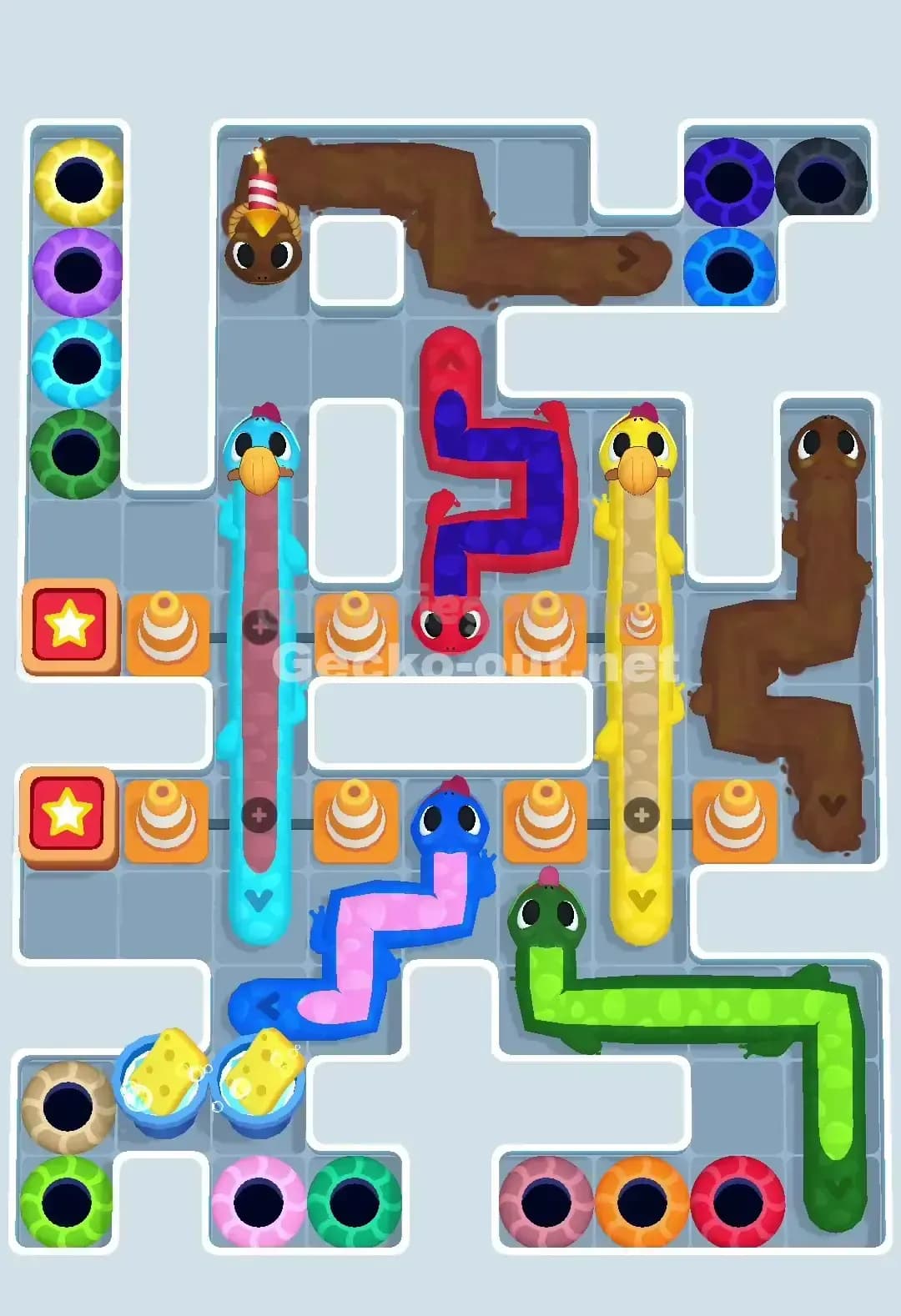
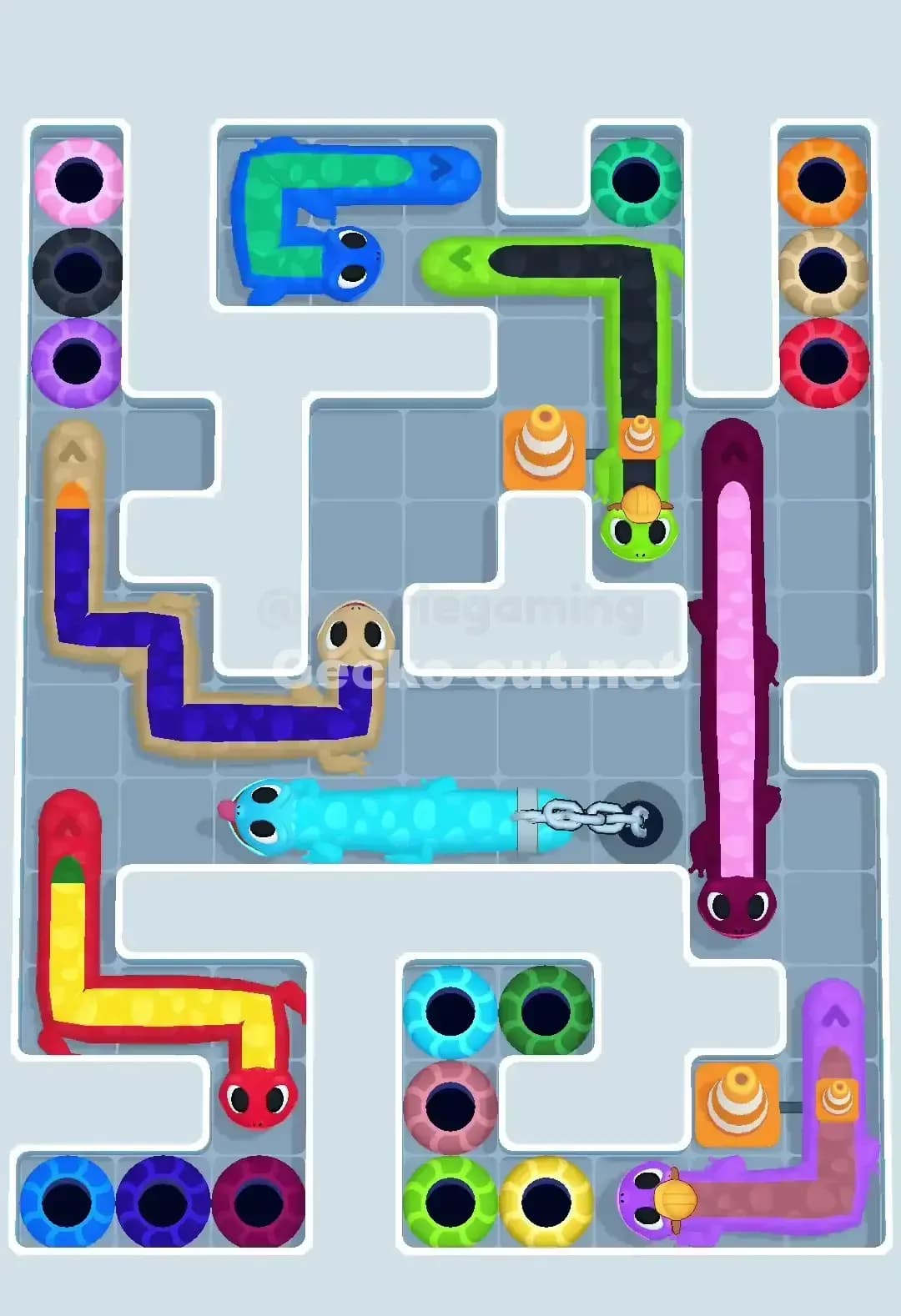
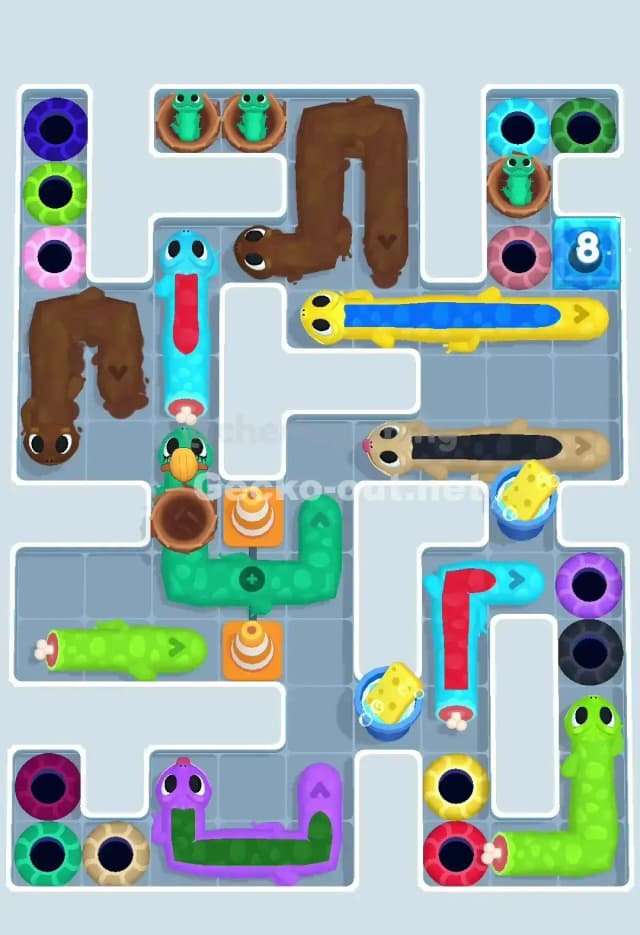
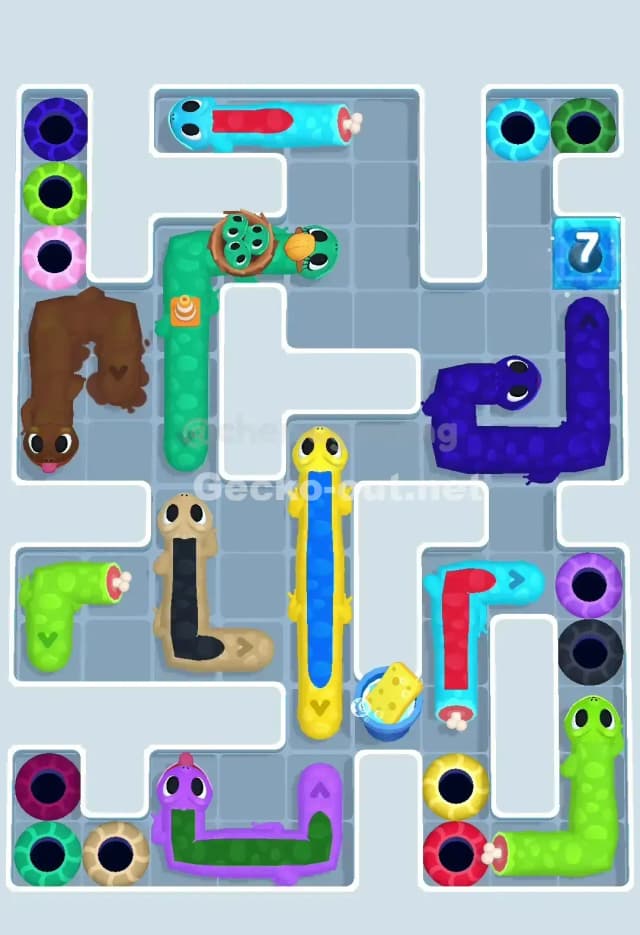
Gecko Out Level 669 is a densely packed puzzle with eight geckos of different colors scattered across an intricate maze of brown walls, white corridors, and colored exit holes. You've got purple, green, pink, cyan, yellow, brown, and red geckos all competing for space on a board that feels more like a traffic jam than a puzzle. The brown walls form a complex knot in the center of the board, creating multiple isolated chambers and chokepoints that'll test your spatial reasoning hard. What makes this level particularly brutal is that several geckos are long—especially the cyan gecko stretching horizontally near the center and the bright green gecko coiling through the lower portion of the board. These long bodies take up serious real estate and can easily block critical pathways if you're not strategic about where you drag them.
Win Condition and How the Timer Creates Pressure
To beat Gecko Out Level 669, every single gecko must reach a hole that matches its color before the timer runs out. The timer is your constant enemy here; you'll feel genuine pressure as you watch those seconds tick down, especially when you're stuck untangling two geckos that are practically locked together. The drag-path mechanic means that once you commit to a route for a gecko's head, its body follows that exact trajectory, so if you miscalculate, you might trap yourself into a dead-end situation where the body blocks its own exit. This isn't a level where you can afford to be sloppy or hesitant—you need a clear plan before you start dragging, or you'll waste precious seconds undoing failed attempts.
Pathing Bottlenecks and Logical Traps in Gecko Out Level 669
The Cyan Gecko Horizontal Corridor: Your Main Bottleneck
The cyan gecko lying horizontally across the middle of the board is unquestionably the biggest bottleneck in Gecko Out Level 669. This long body stretches across multiple cells, and its exit is tucked in the upper right corner of the board. Here's the problem: its current position cuts directly through the central corridor that multiple other geckos need to traverse to reach their exits. If you don't move it first or route it very carefully, it'll create a wall that traps the brown gecko, blocks access to the yellow gecko's path, and generally clogs up the entire puzzle. Moving the cyan gecko early isn't just helpful—it's essential because it opens up the arteries of the board and gives you room to maneuver everyone else.
The Yellow Gecko's Confined Upper Passage
The yellow gecko in the center-right area of the level sits in a relatively confined space with limited routing options. Its exit is somewhere in the upper right sector, but the path to get there is narrow and requires precise pathing. If you drag other geckos through that corridor before the yellow gecko escapes, you've essentially locked it in place. This is a subtle trap because the yellow gecko doesn't look immediately problematic, but it's actually quite vulnerable to being accidentally blocked by careless head-dragging. You have to plan its exit route before you commit other geckos to overlapping corridors.
The Pink and Brown Gang: Two Geckos, One Puzzle
The pink gecko on the left side and the brown gecko in the upper-middle area create a secondary knot because their optimal paths share a critical corridor. The brown gecko's body is long and sits in the central brown-wall knot, making it hard to route without tangling it with the pink gecko. I'll admit that when I first tackled Gecko Out Level 669, this is where I got frustrated—I'd move the cyan gecko successfully, only to discover that pink and brown were now blocking each other. The moment the solution clicked was when I realized I needed to route the brown gecko out through a longer, less obvious path that curved around the pink gecko's eventual trajectory rather than trying to squeeze them both through the same corridor.
Turn-by-Turn Path Strategy to Beat Gecko Out Level 669
Opening: Prioritize the Cyan Gecko and Clear the Center
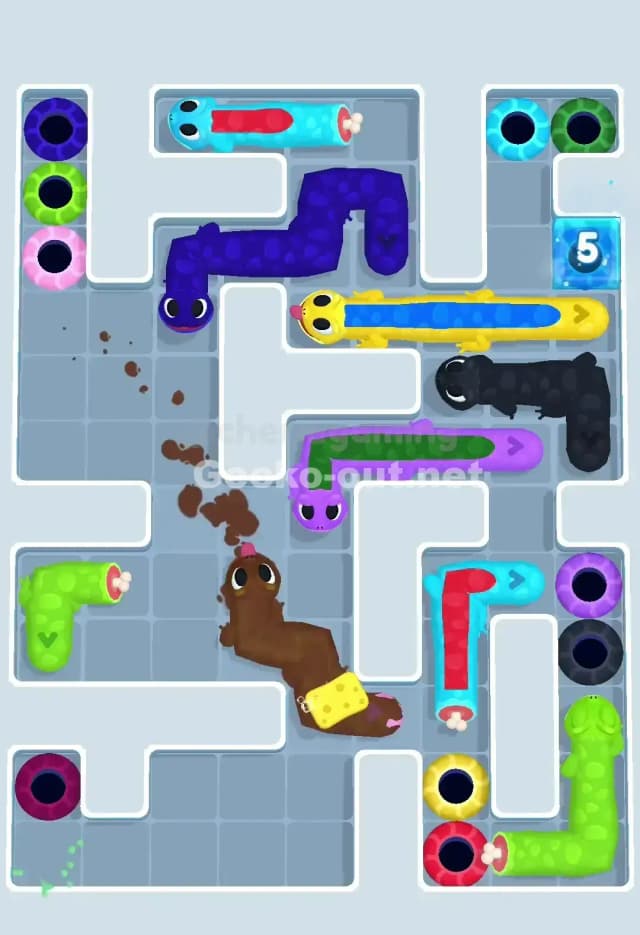
Start by moving the cyan gecko out of the central corridor—this is non-negotiable. Drag its head toward the upper right where its cyan exit hole awaits. The path will be curved and somewhat intricate because you need to navigate around the brown walls, but committing to this move first opens up the entire board for everyone else. While the cyan gecko is moving, you're essentially clearing the main artery, so every subsequent gecko has more room to breathe. Once cyan is out, immediately tackle the yellow gecko next because it's also a long gecko and also in a congested area. Route it upward and to the right, following the upper corridor toward its yellow exit. These two moves might take 15–20 seconds total, but they'll save you exponentially more time because the board suddenly becomes navigable.
Mid-Game: Reposition Long Geckos and Park Short Ones
After cyan and yellow are safely out of Gecko Out Level 669, focus on the long green gecko in the lower portion of the board. This gecko has a lot of body to manage, and its exit is somewhere in the lower right area. Drag it carefully along the lower corridors, being mindful not to push it through a path that'd block the purple gecko's eventual exit. While you're moving the green gecko, the brown gecko and pink gecko are still waiting. Here's the key: park the shorter geckos (like the purple, red, and the two small green geckos at the top) in staging areas where they won't interfere with your long-gecko maneuvers. Think of it like parking cars in a garage—you want the small ones in corners and dead-end alcoves so you can move the larger vehicles first.
End-Game: Orchestrate the Final Four in the Right Sequence
With the long geckos mostly out, you've got four or five short geckos left. Check the timer—you should have at least 30–40 seconds if you've moved efficiently. Now execute the final exits in this sequence: brown gecko first (it's still somewhat confined), then pink, then purple, then the remaining red and green geckos. Each of these should be a quick, straightforward drag toward their respective holes. If you're running low on time (fewer than 20 seconds), pause for two seconds to visually trace the shortest path for each remaining gecko before you drag. Committing mistakes now is catastrophic, so a two-second pause is actually a time-saver because you won't have to undo failed attempts.
Why This Path Order Works in Gecko Out Level 669
The Body-Follow Rule and Untangling the Knot
This strategy works because it respects the fundamental mechanic of Gecko Out Level 669: the body always follows the head's path exactly. By moving the longest, most spatially disruptive geckos first, you're essentially removing obstacles that would otherwise constrain every other gecko's possible routes. If you tried to move short geckos first, you'd get them out of the way, but you'd then have to route the long geckos around them, creating new tangles. It's like solving a mechanical puzzle where you have to remove certain pieces in a specific order—move the wrong one first, and you jam the whole mechanism. The cyan gecko isn't just long; it's blocking the primary transit corridor, so removing it first isn't optional—it's the difference between a solvable puzzle and an impossible one.
Managing the Timer: When to Pause Versus When to Rush
Gecko Out Level 669 gives you roughly 100–120 seconds depending on your game settings, which sounds like a lot until you realize how much time you lose to miscalculations and undos. Early in the level (first 30 seconds), pause after each major move to verify that you haven't accidentally trapped anyone. Once you've got the long geckos out and you're down to the final five or so, you can afford to move faster because the board is more open and the paths are simpler. Never pause in the last 10 seconds of the timer—at that point, you're just distracting yourself. If you're still holding geckos in the final seconds, move them quickly even if you're not 100% certain; an attempt beats a timeout.
Boosters: Optional But Helpful for Time Pressure
You don't strictly need boosters to beat Gecko Out Level 669 if you execute this plan perfectly, but the extra-time booster is genuinely useful if you mess up once and need a recovery window. If you're new to this level or you know you move slowly, grab the extra-time booster before you start—gaining 30 extra seconds removes a lot of the crushing pressure. The hint booster can also be valuable if you get stuck on the brown or pink gecko routing because it'll show you a valid path. Skip the hammer or other tool boosters; they're not necessary and they're not efficient uses of your resources on this puzzle.
Mistakes, Fixes, and Logic You Can Reuse in Other Gecko Out Levels
Five Critical Mistakes and How to Avoid Them
Mistake 1: Moving the pink gecko too early. If you drag pink out before brown is safely positioned, brown will have nowhere to go and will end up blocking pink's exit. Fix: always route the larger, more centrally-positioned gecko first, and only move secondary geckos once the big ones have created a clear lane.
Mistake 2: Dragging the cyan gecko upward instead of rightward. The temptation is to move it toward the nearest wall, but its exit is actually to the right, so you have to drag it across the board horizontally before angling upward. Fix: always identify your target exit hole first, then work backward to plan the path.
Mistake 3: Assuming the lower-left chamber is a separate puzzle. New players often focus on the isolated purple and cyan geckos in the lower-left corner before clearing the central corridor. This wastes time because you're solving two problems simultaneously instead of clearing the main obstacle first. Fix: map the entire board before you start dragging, and identify which geckos are blocking the critical transit routes.
Mistake 4: Routing the green gecko through the yellow corridor. The bright green gecko has multiple possible paths, but the one that goes through the yellow gecko's lane will trap yellow. Fix: trace two or three possible routes for each long gecko and pick the one that least conflicts with other geckos' likely paths.
Mistake 5: Over-committing to a path when the timer is low. When you've got 5 seconds left and one gecko remaining, the urge to just drag it toward the hole is overwhelming, but if you miscalculate, you'll timeout instead of finishing. Fix: in the final 15 seconds, move geckos only when you're absolutely certain of the path, or accept the booster cost and grab extra time.
Reusing This Logic on Similar Levels
Gecko Out Level 669 teaches you a critical principle: longest geckos first, then shortest. Whenever you encounter a level with mixed gecko lengths, especially ones in cramped central areas, use this order. Levels with gang-linked geckos (where two geckos move together) use the same principle—identify which gang member is blocking the most transit lanes and move that gang out first. Frozen-exit levels use a different constraint (you have to unfreeze the exit before you can use it), but the core logic is the same: identify the constraint that affects the most geckos, resolve it, then cascade your way outward. The "park short geckos in corners" strategy is also universally applicable and will reduce your timeout rate on every cluttered level you encounter.
Final Encouragement
Gecko Out Level 669 is legitimately tough—it's got spatial complexity, time pressure, and multiple long geckos competing for limited space. But it's absolutely beatable if you approach it systematically. You don't need perfect execution; you just need a clear plan that respects the game's pathing mechanics and prioritizes clearing the board's biggest obstacles first. Take a breath, map out your cyan-gecko-first strategy, and trust that once you've got those first three geckos out, the rest will fall into place. You've got this.