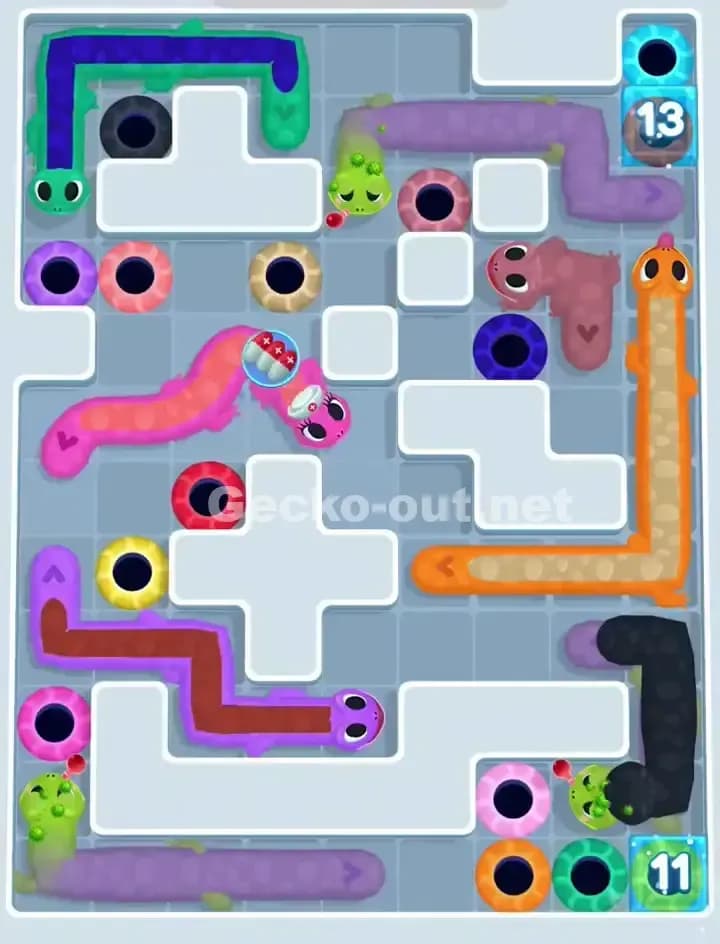
Gecko Out Level 1136 Solution Walkthrough | Gecko Out 1136 Answer
How to solve Gecko Out level 1136? Get step by step solution & cheat for Gecko Out level 1136. Solve Gecko Out 1136 easily with the answers & video walkthrough.



Gecko Out Level 1136: Board Layout, Rules, and Win Condition
Starting Board and Gecko Colors
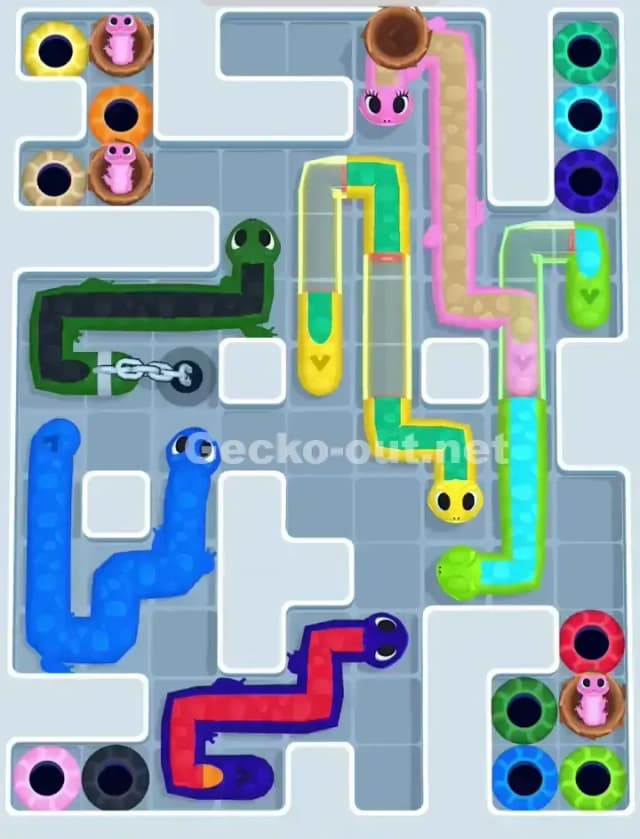
Gecko Out Level 1136 is a densely packed puzzle featuring eight individual geckos spread across a complex, winding board with multiple color-coded exit zones. You've got yellow, orange, pink (two of them), green, blue, red, and cyan geckos to evacuate, each one locked into its own colored hole somewhere on the perimeter. The board itself is dominated by a massive interlocking path system with purple, magenta, green, yellow, and cyan corridors that twist and loop throughout the playing space. The layout forces geckos to navigate through tight, overlapping channels—there's really nowhere to hide or bypass the main thoroughfares. Several geckos start near the top and side edges, while others are wedged into corners at the bottom and right side, which immediately signals that coordination will be tight.
Win Condition and Timer Pressure
Your goal in Gecko Out Level 1136 is to drag each gecko's head through the maze-like pathways until its body exits through the matching colored hole before time runs out. The timer in this level is genuinely punishing—you're working against the clock, and unlike easier stages, there's no room for leisurely experimentation. Every second counts because the board is so congested that one misplaced gecko body can lock three others into deadlock. You win the moment all eight geckos have successfully escaped their respective holes; if even one remains on the board when the clock hits zero, you fail and have to restart. This pressure transforms Gecko Out Level 1136 from a simple path-drawing puzzle into a sequencing and spatial-reasoning gauntlet.
Pathing Bottlenecks and Logical Traps in Gecko Out Level 1136
The Critical Central Chokepoint
The absolute biggest bottleneck in Gecko Out Level 1136 is the central corridor system where the purple, magenta, and yellow paths converge and overlap. This is where geckos from different starting zones must funnel through the same narrow space to reach their exits, and if you're not careful about the order in which you exit geckos here, you'll watch helplessly as a gecko body gets trapped perpendicular to a wall, blocking two other geckos' escape routes. The magenta path especially acts like a arterial highway—the pink geckos need to traverse it, but so does the tan/brown gecko coming from the top. If you don't plan this intersection perfectly, you'll find yourself stuck with a gecko body wedged sideways, taking up critical real estate.
Subtle Problem Spots Worth Noting
The right-side vertical column with the green and cyan geckos is deceptively tricky because those exit holes are stacked on top of each other with very little lateral wiggle room. If you drag the green gecko's head into its hole carelessly and the body curves awkwardly, you can accidentally create a barrier that prevents the cyan gecko from dropping straight down into its hole. Additionally, the bottom-left corner where multiple colored holes cluster (pink, gray, and salmon) looks spacious until you actually try threading three different gecko bodies through that zone simultaneously—the available open grid squares evaporate fast, and suddenly you're one move away from a pileup. Finally, the top-left section with yellow and orange geckos shares a close proximity that forces you to exit one before the other; if you get the sequence wrong, the second gecko has nowhere to go.
Personal Reaction and the "Aha!" Moment
I'll be honest—Gecko Out Level 1136 frustrated me the first two attempts because I kept assuming I could just draw paths willy-nilly and let physics sort it out. I'd drag the pink gecko, then the green gecko, then suddenly realize the purple path was now blocked and I'd wasted thirty precious seconds. The turning point came when I stopped treating this like a race and instead started asking myself: "If I pull this gecko now, what does that do to the three geckos still waiting?" Once I flipped that mental switch and started thinking backward from the exits instead of forward from the starts, the solution crystallized. It turns out Gecko Out Level 1136 has an elegant, almost inevitable order—you just have to spot it first.
Turn-by-Turn Path Strategy to Beat Gecko Out Level 1136
Opening: Clear the Top and Sides First
Start by dragging the yellow gecko (top-left area) into its yellow exit hole on the upper-left edge. This move is low-risk and immediately frees up critical space on the left side of the board. Next, tackle the orange gecko just below it—its path to the orange exit is relatively unobstructed at this stage, so execute it cleanly and park any overflow body segments away from the center. Don't even think about touching the central magenta and purple corridors yet; those are the highways you'll use later. Your job in the opening phase is to clear the perimeter geckos—yellow, orange, and the red gecko on the bottom-right—so that when you move into the mid-game, you've got breathing room and fewer bodies cluttering the lanes.
Mid-Game: Sequencing the Tangled Core
Once the perimeter is clear, bring your attention to the cyan gecko on the right edge (top-right area). Its path snakes down the cyan-colored corridor; dragging it now while the central zones are still relatively open is safer than waiting. Immediately follow up with the green gecko from the middle-left area—the green path is defined and can be drawn without interfering with the upcoming pink gecko movements. Now comes the critical juncture: the two pink geckos. The pink gecko starting from the middle-top area should exit first, as it has a straighter shot down the magenta corridor. The second pink gecko, positioned lower and nearer to the center, should go immediately after—this prevents either from having its body wrapped around the other. During the mid-game, keep an eye on the brown/tan gecko that's been patiently waiting near the top-middle; its path winds through the magenta area, so execute it after the first pink gecko but before you get too deep into repositioning lower geckos.
End-Game: Race to the Finish Without Collisions
As the timer creeps into its final seconds, you'll have the gray, blue, and possibly one remaining gecko left on the board. The gray gecko's exit is on the left side, and its path is now clear because you've already extracted everyone else from its lane. Pull it decisively and don't second-guess the head position—hesitation costs precious seconds in Gecko Out Level 1136. The blue gecko (bottom-left area) should follow next; its exit hole is nearby, making this a quick, high-confidence move. If time is running low and you're down to the final gecko, take a breath, verify the path one more time, and execute it without overthinking. The timer is your enemy in these final moments, and panic is your worst ally. If you're genuinely low on time (under five seconds) and unsure about a path, a quick time booster is justified here—it's far better to spend a virtual power-up than to fail after eight near-perfect geckos have already escaped.
Why This Path Order Works in Gecko Out Level 1136
Head-Drag Pathfinding and Body-Following Physics
This strategy works because it respects the fundamental rule of Gecko Out Level 1136: once you drag a gecko's head through a path, its body must follow that exact route. By extracting perimeter geckos first, you ensure their bodies don't occupy grid squares that central geckos will need to traverse. The body-follow rule becomes your ally rather than your enemy when you plan sequentially. The pink geckos, for example, both need access to the magenta corridor, so by exiting the first pink gecko completely (head and tail fully out), you reclaim that entire corridor for the second pink gecko. If you'd tried to exit them simultaneously or in the wrong order, their bodies would overlap, and the puzzle becomes unsolvable. The strategy also leverages the fact that exit holes are color-specific and immovable—you can't change where the yellow hole is, so planning around fixed endpoints is logical and efficient.
Balancing Speed with Precision
Gecko Out Level 1136's timer is generous enough that you don't need to rush blindly, but tight enough that you can't dilly-dally. The sweet spot is to spend the first fifteen to twenty seconds analyzing the board and confirming your sequence mentally, then execute the next sixty to eighty seconds with quiet confidence. Pause briefly between each gecko—just a two-second beat to verify the exit hole matches the gecko color and the path is clear—rather than yanking heads around frantically. This disciplined approach actually saves time because you avoid catastrophic mistakes that force a restart. Once you've done Gecko Out Level 1136 correctly once, you'll have memorized the sequence, and subsequent playthroughs will feel almost relaxing by comparison.
Booster Recommendations: When and Why
In my experience, Gecko Out Level 1136 does not require boosters on a clean, planned run. However, if you've already used two or three attempts and your mental clarity is fading, a time extension booster is a sensible safety net in the final thirty seconds. Similarly, if you make a mistake halfway through and trap a gecko body awkwardly, a hammer tool or reset booster might save you the frustration of starting over—weigh the cost of the booster against the time you've already invested. Hints are tempting but generally unnecessary if you follow the strategy outlined here. Save boosters for genuine emergencies, not for convenience.
Mistakes, Fixes, and Logic You Can Reuse in Other Gecko Out Levels
Five Common Mistakes and How to Avoid Them
Mistake #1: Dragging the central geckos first. Players often target the visually prominent magenta and purple paths immediately, creating a tangled mess before perimeter geckos are evacuated. Fix: Always ask yourself, "Is this gecko in the way of anyone else?" If yes, move someone else first. Mistake #2: Assuming overlapping paths mean simultaneous movement. New players sometimes try to drag two gecko heads at once, forgetting that Gecko Out Level 1136 processes one gecko at a time. Fix: Execute geckos sequentially, confirming each exit before moving to the next. Mistake #3: Curving gecko paths unnecessarily. Inexperienced players draw wavy, inefficient routes when a straight line exists, wasting grid space. Fix: Always use the most direct path available; curves should only occur when walls force them. Mistake #4: Panicking when the timer drops below ten seconds. Anxiety leads to sloppy head positioning, causing geckos to miss their holes or collide with walls. Fix: Pre-plan the final three geckos during the mid-game so you're not scrambling when pressure peaks. *Mistake #5: Forgetting to check gecko color matches. It's surprisingly easy to drag a yellow gecko's head toward the cyan hole, especially under time pressure. Fix: Call out the color aloud—"Green gecko to green hole"—to reinforce the match before dragging.
Reusable Logic for Similar Levels
Gecko Out Level 1136 teaches a master principle applicable to any congested, multi-gecko puzzle: prioritize clearing perimeter obstacles and geckos before tackling central knots. If a future level has overlapping paths and a central bottleneck, use the same analysis: which geckos must pass through the bottleneck, and in what sequence can you extract the others to create space? Additionally, the practice of pausing and pre-planning is invaluable for any puzzle with a timer shorter than two minutes—spend the first twenty percent of time analyzing, then execute during the remaining eighty percent. Finally, respect the body-follow rule as your core strategic tool; it's not a limitation but a feature that makes sequential extraction the dominant solution strategy.
Final Encouragement
Gecko Out Level 1136 is genuinely challenging—it's meant to humble you a little and make you think strategically—but it is absolutely, unquestionably beatable with a clear head and this plan in your back pocket. The first attempt might sting, but the second or third playthrough will feel like you've cracked a code. Once you've beaten Gecko Out Level 1136, you'll carry that confidence and analytical framework into harder levels, knowing that careful sequencing and spatial planning can solve even the most tangled boards. You've got this.