Gecko Out Level 101 Solution Walkthrough | Gecko Out 101 Answer
How to solve Gecko Out level 101? Get step by step solution & cheat for Gecko Out level 101. Solve Gecko Out 101 easily with the answers & video walkthrough.
Gecko Out Level 101: Board Layout, Rules, and Win Condition
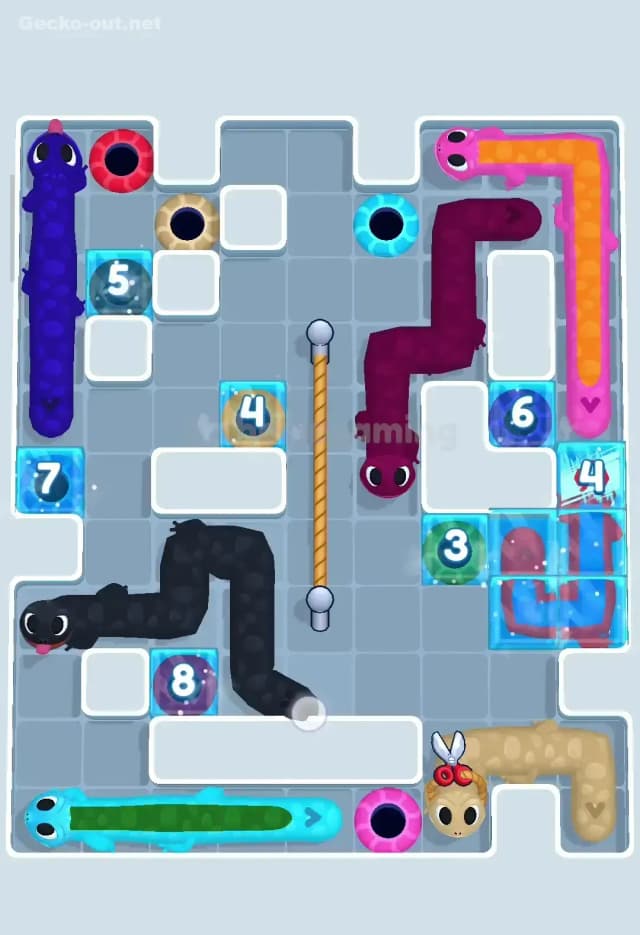
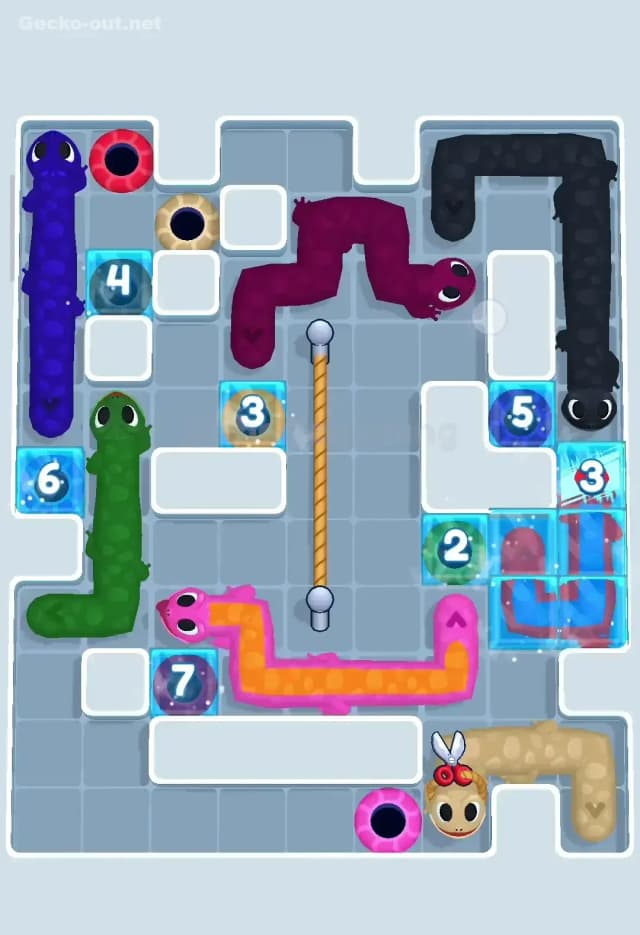
Starting Board: Who’s Where And What’s In The Way
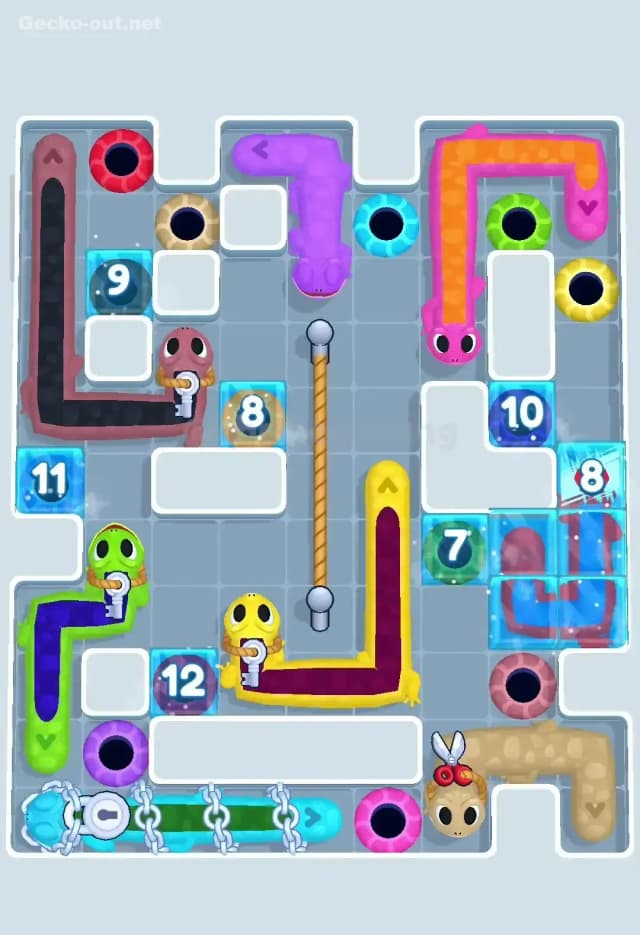
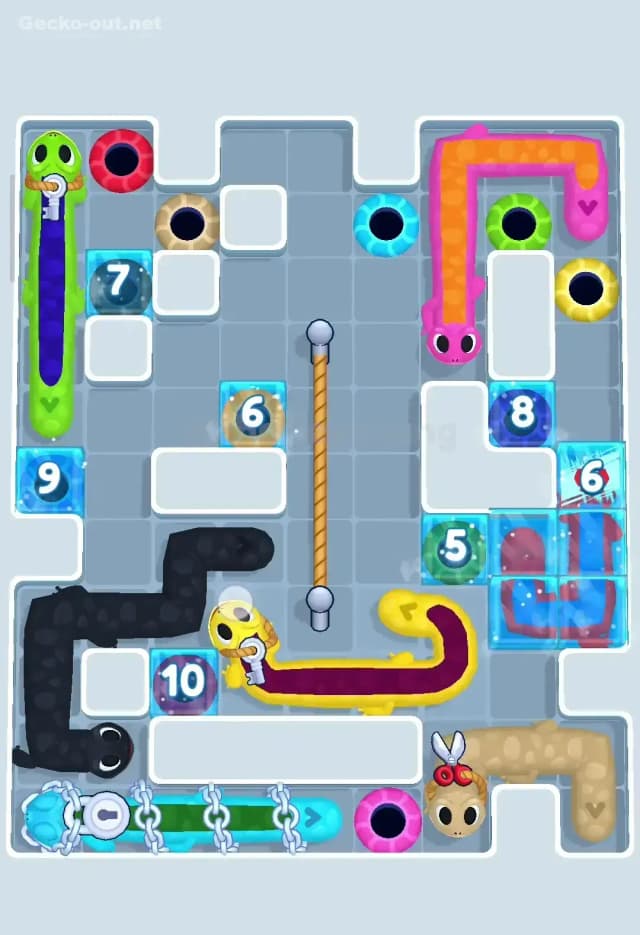
In Gecko Out Level 101 you start with a very crowded board. You’ve got several active geckos plus one chained gecko that can’t move yet:
- A short brown gecko on the left, sitting near a frozen exit.
- A medium purple gecko at the top‑middle, folded into a “7” shape.
- A long pink‑orange gecko along the top‑right edge, already bent around a corner.
- A green gecko at the lower‑left that’s already mixed into a purple tail (a “gang” gecko).
- A long yellow‑red gecko in the lower‑middle, pointing up toward the rope.
- A beige gecko at the bottom‑right next to a pair of scissors.
- A cyan gecko trapped behind chained tiles at the bottom‑left, completely blocked until keys unlock those chains.
On top of the crowding, Gecko Out 101 throws in:
- Frozen exits and frozen tiles with numbers on them (7–12). These thaw on the timer, so specific paths and exits become available only later.
- A chained lane in front of the cyan gecko that clearly needs multiple keys to unlock.
- Tight one‑tile corridors, especially around the center rope and along the bottom.
You can already see the “knot”: almost every gecko’s obvious path crosses another gecko’s body or an exit that isn’t open yet. If you just start dragging heads at random, you’ll lock yourself out in a few seconds.
Win Condition And Why The Timer Feels So Brutal
The win condition in Gecko Out Level 101 is simple: get every gecko into a matching‑colored hole before the main level timer hits zero. Because movement is path‑based, the route you drag the head is exactly what the body will trace.
That creates two big constraints:
- Every extra turn, loop, or wiggle wastes real time.
- A bad path replaces good open floor with a solid wall of gecko body, which can permanently block another gecko.
The numbered frozen tiles add a second timing layer. Some exits are unusable until their ice melts, and a few warning‑style tiles effectively say, “Either use this window now or be ready to route around it forever.” So the challenge in Gecko Out 101 isn’t just “where do I go?”—it’s “in what order do I free exits and keys so I don’t trap myself when the timer (and those numbers) tick down?”
Pathing Bottlenecks and Logical Traps in Gecko Out Level 101
The Main Bottleneck: Center Rope And Bottom Corridor
The single biggest bottleneck in Gecko Out 101 is the combination of:
- The vertical lane around the central rope, and
- The long bottom corridor that runs from the chained cyan gecko on the left to the beige/scissors on the right.
Almost every long gecko either needs to cross that rope lane or eventually pass through the bottom to reach its hole. If you let the yellow‑red or pink‑orange gecko sprawl horizontally too early, they’ll paint the bottom row with their bodies and nobody else will be able to cross.
That’s why your plan has to treat the rope lane and bottom row as “shared highways.” You want each gecko to use them once, in a clean direction, then disappear into its exit so those lanes are free for the next one.
Subtle Problem Spots You’ll Probably Ignore At First
There are a few easy‑to‑miss traps in Gecko Out Level 101:
- The brown key gecko on the left looks easy, but if you send it straight to its hole as soon as its exit thaws, its tail often wraps in a way that blocks the purple or yellow gecko from swinging up later.
- The frozen blue/red L‑shaped gecko on the right (behind the “7/8/10” ice) feels like a background object at first, but once those tiles thaw, its body occupies prime real estate near multiple exits. If you don’t clear a lane for it early, you’ll have to thread long geckos through a maze of fixed bodies.
- The scissors near the beige gecko are a trap if you’re impulsive. Cutting the beige gecko too short can make its own exit trivial but leave no way to snake the final cyan gecko out once the chains drop.
Each of these isn’t obviously deadly from move one, but together they’re why so many first attempts end with one gecko standing and no legal path left.
When The Level Finally “Clicks”
Personally, Gecko Out 101 felt unfair the first couple of runs. I’d clear three or four geckos and then realize my last one needed to pass through a lane I’d completely walled off 20 seconds earlier. The turning point was when I stopped trying to brute‑force exits and instead treated the board like a traffic puzzle:
- First, identify which gecko can safely exit without using shared highways.
- Second, decide who needs the rope lane and bottom row in what order.
- Third, only draw paths that either exit a gecko or clearly park it where no one will ever need to cross.
Once I saw the yellow‑red, pink‑orange, and chained cyan gecko as “bottom‑highway customers” to be served in a specific order, Gecko Out Level 101 went from chaotic to logical.
Turn-by-Turn Path Strategy to Beat Gecko Out Level 101
Opening: Clearing Space And Parking Safely
For the opening of Gecko Out Level 101, focus on two goals: free your key geckos and keep the highways clear.
-
Start with the medium geckos near the top (purple and brown).
As soon as their exits are available, drag them in short, direct paths that don’t sweep across the center or the bottom. Think “up and in” rather than “around and down.” Their job is to disappear early, before they can get in anyone’s way. -
Park the long pink‑orange gecko along the right wall.
Don’t rush for its hole yet. Instead, drag it in a tight path that hugs the right boundary and ends with its head near—but not inside—its exit. This keeps its body away from the rope lane and bottom while giving you a future quick exit. -
Nudge the beige gecko slightly away from the exact center of the bottom.
You don’t want to commit to its exit yet or cut it with the scissors. Just pull it so its tail no longer blocks the exact path the yellow‑red gecko will need later.
Throughout this opening, avoid drawing long swoops. Every gecko should either exit completely or end parked in a corner where no one else needs to travel.
Mid-game: Managing Lanes And Long Bodies
Once the upper section is less crowded, Gecko Out 101 becomes all about the long geckos:
-
Send the yellow‑red gecko up through the rope lane while it’s still mostly empty.
Draw a clean path: straight up, minimal turns, then into its matching exit once any ice in front of that hole has thawed. The tail will retrace that exact route, so don’t swing it sideways across the lower‑middle. -
Use the green/purple gang gecko to open one of the bottom‑left key locks.
The trick is to route it so its tail ends near the left wall, not stretching across to the center. That way, when it exits, it doesn’t re‑block the chained cyan gecko that you’re trying to free. -
Watch the numbered frozen tiles.
As soon as a key‑holding gecko’s exit is uncovered (usually around the 8–10 marks), send that gecko immediately. Don’t hesitate; the whole point of these runs is to strip chains from the cyan gecko as early as possible.
By the end of the mid‑game, you want: top cleared, key geckos exited, chains removed, and the bottom still mostly open.
End-game: Exit Order And Saving Runs When Time Is Low
End‑game in Gecko Out Level 101 is basically “cyan, beige, then whatever’s parked.”
-
Free and exit the cyan gecko as soon as all chains are gone.
Drag a short, direct path along the bottom row toward its nearby hole. Because everyone else is already out or parked on edges, this should be a clean slide. -
Decide whether to use the scissors on the beige gecko.
If the beige path to its exit crosses the exact route the cyan gecko just used, cut first: snip off the extra tail so it doesn’t clog the middle. If the lane is already clear, skip the scissors and just draw a minimal path. -
Finish with the parked pink‑orange gecko.
Its exit should now be wide open, and because you parked it near its hole earlier, this last draw is just a quick curve in. When you’re low on time, this “stored near exit” trick is what saves the run.
If you reach the final 5–6 seconds with two geckos left, prioritize whichever one has a clean, pre‑planned path. Don’t start improvising a long maze run when the timer’s red; that’s almost always a fail.
Why This Path Order Works in Gecko Out Level 101
Using Body-Follow Pathing To Untangle The Knot
The whole plan for Gecko Out Level 101 leans on the body‑follow rule. By choosing short, straight routes that run along the edges and shared highways, every exiting gecko is actually cleaning the board as it moves:
- Early short geckos vanish from crowded areas.
- Long geckos travel through the rope lane and bottom only once, then leave those spaces empty for the next gecko.
- The cyan gecko, which starts completely blocked, gets a perfectly clear corridor once the keys are used and the long bodies have already passed through and disappeared.
If you instead drag big spirals or snake bodies around corners “just to be safe,” their tails will trace the same ugly pattern and solidify the knot. The recommended order avoids that tightening effect.
Balancing Reading Time And Movement Time
Gecko Out 101’s timer is strict enough that you can’t pause before every single move, but you should pause twice:
- At the very start: 5–10 seconds just to spot which exits are frozen and where the key geckos are.
- Right after your first 2–3 exits: another brief scan to confirm that the rope lane and bottom are still open.
After that, you want to move decisively. Dragging confidently along a path you’ve already visualized is faster than constantly correcting mid‑drag. If you’re unsure, stop, lift your finger/mouse, and trace mentally rather than drawing messy “maybe here?” lines that you cancel.
Booster Use: Optional, But Here’s When They Help
Gecko Out Level 101 is beatable without boosters, but they can smooth out mistakes:
- Extra time: best used if you consistently get to the cyan gecko with one more gecko left and no timer. Pop it right after your second‑to‑last exit to give yourself breathing room for the final route.
- Scissors / cutter: on this board, cutting the beige gecko is situational. Use it only if your earlier routes accidentally filled the bottom with stray tail segments—snip to create a tiny, maneuverable beige that can squeeze through.
- Hints: they can show a valid order, but I’d treat them as confirmation. Try the plan above first; if you’re still stuck, a hint can reveal which specific gecko you’re mis‑ordering.
Mistakes, Fixes, and Logic You Can Reuse in Other Gecko Out Levels
Common Mistakes In Gecko Out Level 101 (And How To Fix Them)
-
Overdrawing long paths.
Fix: Commit to “shortest reasonable path.” If a gecko can exit in 5 segments, don’t let yourself draw 8. -
Filling the bottom too early.
Fix: Declare the bottom corridor off‑limits until your key geckos and the yellow‑red gecko are out. Park others on side walls instead. -
Ignoring frozen/numbered tiles.
Fix: Before moving anyone, identify which exits are currently unusable. Never drag a gecko toward an exit that’s still iced; you’ll just build a useless wall. -
Using the scissors immediately.
Fix: Wait until you know whether the beige gecko actually blocks anything. Many successful clears never tap the scissors at all. -
Forgetting the chained cyan gecko.
Fix: Treat “free the cyan” as the real objective. Every key gecko’s route should be judged by how much it helps or hurts that future path.
Reusing This Logic In Other Knot-Heavy Or Gang-Gecko Levels
The approach that cracks Gecko Out Level 101 works surprisingly well in later levels:
- Always identify shared highways (narrow corridors, rope lanes, central bridges) and plan a specific usage order.
- Exit small geckos early to reduce clutter; park long ones near their holes until their routes are truly clear.
- For gang geckos and key/lock interactions, route them with their secondary purpose in mind: not just reaching their hole, but clearing or unlocking space for someone else.
- In frozen‑exit levels, think of thaw times as phases. Plan Phase 1 moves for exits available now, Phase 2 for exits that come online mid‑timer.
Final Thoughts: Tough, But Totally Beatable
Gecko Out Level 101 looks overwhelming because everything’s tangled and half the exits are locked or frozen. Once you break it down into highways, keys, and phases, it becomes a clean logic puzzle: free the keys, respect the bottom and rope lanes, then escort the cyan and beige geckos out in the right order.
You don’t need perfect reflexes or heavy booster use—just a clear plan and a bit of discipline about path length. Stick to the strategy above, adjust your parking spots based on where you personally like to route, and Gecko Out 101 goes from “no way” to “oh, that actually makes sense.”