Gecko Out Level 1007 Solution Walkthrough | Gecko Out 1007 Answer
How to solve Gecko Out level 1007? Get step by step solution & cheat for Gecko Out level 1007. Solve Gecko Out 1007 easily with the answers & video walkthrough.

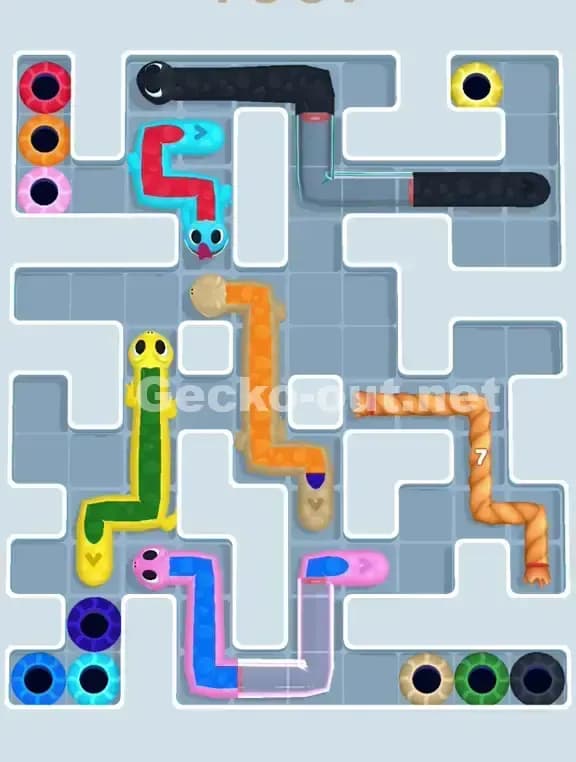
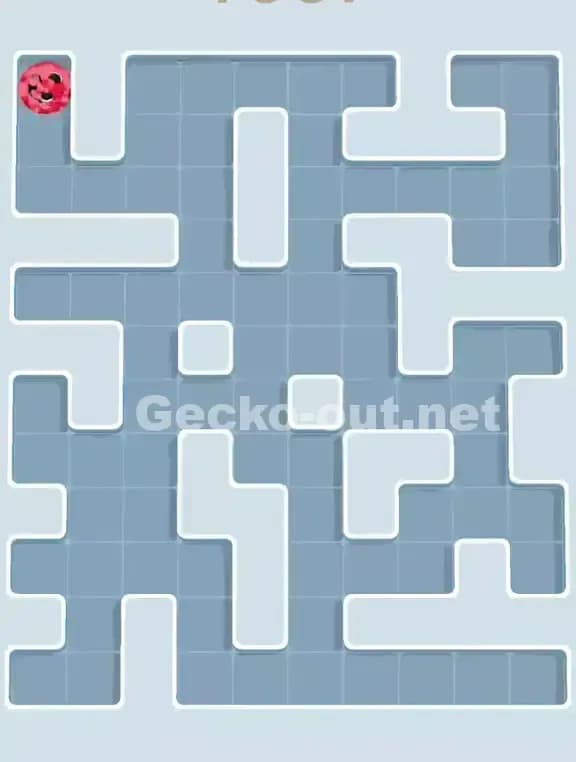
Gecko Out Level 1007: Board Layout, Rules, and Win Condition
Understanding the Starting Board
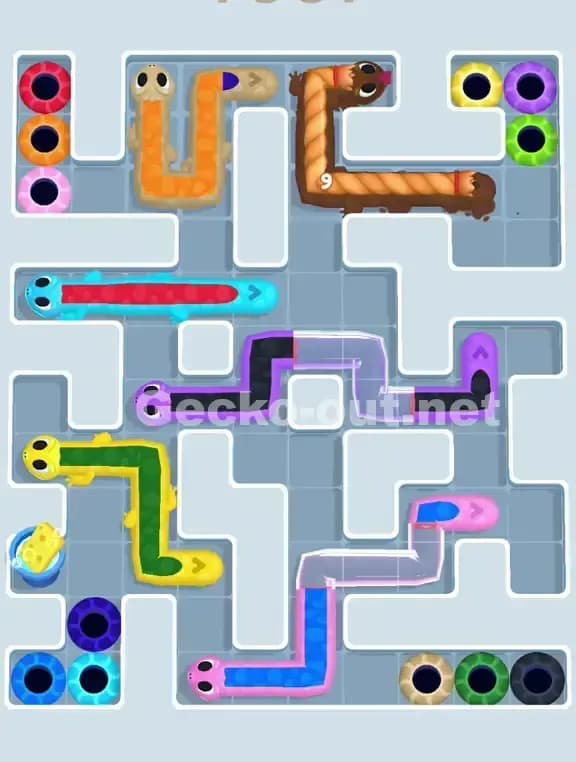
Gecko Out Level 1007 is a densely packed puzzle that tests your ability to route multiple geckos through a maze of tight corridors and overlapping bodies. You're managing six geckos in total: a red gecko (top left), an orange gecko (top center), a brown gecko (top right), a cyan gecko (middle left), a yellow gecko (bottom left), and a pink/magenta gecko (bottom center-right). Each gecko has a matching colored hole somewhere on the board, and you'll need to guide every single one safely to their exit before the timer runs out.
The board itself is a maze of white walls creating narrow passages and dead ends. What makes Gecko Out Level 1007 particularly tricky is that the corridors are barely wide enough for single geckos to pass through, and once you start moving one gecko, its body takes up valuable space that other geckos desperately need. The brown gecko at the top is especially long and serpentine—it's going to be a major obstacle if you don't plan its exit carefully. The cyan gecko in the middle is also quite lengthy and will dominate the horizontal space if you're not strategic about timing.
The Timer and Win Condition
You've got a limited amount of time to extract all six geckos. This isn't a leisurely puzzle—it's a race against the clock. You win only when every gecko has reached its matching colored hole and disappeared from the board. If even one gecko is still wandering around when the timer hits zero, you fail the entire level. This means you can't afford to be indecisive or to restart paths halfway through. Every drag matters, and every second counts in Gecko Out Level 1007.
Pathing Bottlenecks and Logical Traps in Gecko Out Level 1007
The Brown Gecko Bottleneck
The brown gecko at the top right is the single biggest obstacle in Gecko Out Level 1007. This gecko is long—really long—and it needs to snake its way through the upper portion of the board to find its hole. The problem is that once you drag its head down and around, the entire body occupies nearly every corridor in the upper-right quadrant. No other gecko can move freely while the brown gecko's body is coiling through those tight spaces. This means you absolutely must exit the brown gecko early, before you commit to moving any of the other upper-area geckos. If you try to route the orange or red geckos first, you'll paint yourself into a corner where the brown gecko can't fit anywhere.
The Cyan Gecko's Horizontal Sprawl
The cyan gecko in the middle left is nearly as problematic as the brown one. It's a horizontal spreader—when you drag its head to the right, the body stretches across multiple grid squares, blocking vertical movement everywhere it touches. I've watched so many players accidentally use the cyan gecko's body as a wall that traps the yellow gecko below it. The key insight here is that the cyan gecko needs to exit relatively early, but not so early that you haven't cleared a safe path for it. You'll need to ensure the middle corridor is mostly open before you commit to moving cyan.
The Yellow Gecko's Tight Lower-Left Corner
The yellow gecko is stuck in the bottom-left corner with what looks like a simple L-shaped path to freedom, but here's the trick: if the cyan gecko is still occupying the middle lane or if the pink gecko's body has snaked into the lower passages, the yellow gecko gets completely trapped. There's no alternate route, and the space is so tight that even a slight miscalculation in sequencing means you'll have to restart. This is a subtle trap that catches players who think they're doing great until suddenly they can't move the last two geckos with seconds on the clock.
My First Attempt and the "Aha" Moment
I'll be honest—my first time tackling Gecko Out Level 1007, I dragged the orange gecko first and it took up so much space that I had no idea how the brown gecko was supposed to exit. I panicked, watched the timer wind down, and failed with three geckos still on the board. The frustration was real. But then I stepped back, looked at the board coldly, and realized the solution wasn't about being fast—it was about sequence. Once I understood that the brown gecko had to leave before anything else could move smoothly, and that the cyan gecko needed to clear the middle before the yellow gecko could navigate the lower section, the whole puzzle clicked into place. Gecko Out Level 1007 went from impossible to manageable in one reset.
Turn-by-Turn Path Strategy to Beat Gecko Out Level 1007
Opening: Exit the Brown Gecko First
Start by dragging the brown gecko's head from its starting position at the top right. You want to guide it carefully down through the narrow corridor, then around the left side of the board to find its matching brown hole. The brown gecko is long, so this is a deliberate, careful drag—don't rush it, because if the head gets stuck in a wall, you're wasting precious seconds on corrections. Once the brown gecko is out of the picture, the entire upper portion of the board opens up. This is your first major relief in Gecko Out Level 1007. After the brown gecko exits, mentally note that you've freed up the top-right corridor and the central maze space where other geckos will now have room to maneuver.
Mid-Game: Sequence the Red and Orange Geckos Carefully
With the brown gecko gone, you now have room to move the red gecko (top left, the short red circle stack) and the orange gecko (top center, the taller orange snake). The red gecko is smaller and less disruptive, so move it next. Drag its head down and guide it around to find the red hole on the left side of the board. This shouldn't take long, and it further opens up the top-left area.
The orange gecko comes next. This is a medium-length gecko that needs to navigate from the top-center area around and down to find its hole. Be very deliberate with your path here—you're now committed to using the central and left corridors, so make sure you're not painting the cyan gecko into a corner with orange's body. A good strategy is to route orange downward and then around, being mindful that cyan is waiting to move in the middle-left area.
Mid-Game Continued: Clear the Cyan Gecko Before It Becomes a Prison
Once red and orange are out, it's time to tackle the cyan gecko. This is critical for Gecko Out Level 1007 because cyan's horizontal body is about to either unlock or lock everything else. Drag cyan's head from the middle-left, and guide it horizontally to the right and then down to find its cyan hole on the right side. Because you've already cleared the brown gecko and orange gecko, there should be a safe path for cyan to slide through. The key is to not let cyan's body coil back on itself or block the lower-middle corridor, where yellow will need to move soon.
End-Game: Release Yellow and Pink in the Home Stretch
With the big, space-hogging geckos gone, the yellow gecko (bottom-left) should now have a clear path downward and around to its yellow hole. Guide it carefully—it's still somewhat constrained by walls, but without cyan blocking the middle lane, it should have the room it needs. Yellow shouldn't take long once the way is clear.
Finally, the pink gecko (bottom center-right) gets its turn. By now, Gecko Out Level 1007's board should feel almost spacious compared to the opening. Guide pink's head from its starting position around to find the pink hole. This is usually one of the faster exits because you've already eliminated all the major traffic jams.
Panic-Mode Protocol: If You're Running Low on Time
If you're watching the timer and realize you've got fewer than 20 seconds left with one or two geckos still on the board, don't try to perfectly optimize the path. Instead, drag the remaining gecko's head directly toward its hole, even if the path isn't elegant. Sometimes a slightly longer route that you execute immediately is faster than waiting to find the "perfect" path. In Gecko Out Level 1007, a messy path that works beats a perfect path that you don't finish in time.
Why This Path Order Works in Gecko Out Level 1007
The Untangling Logic Behind the Sequence
The reason this turn-by-turn strategy works is rooted in how body-following pathing functions in Gecko Out. When you drag the brown gecko's head, its entire body traces behind, occupying every grid square you pass through. By removing the longest, most disruptive gecko first, you're not reducing the total number of geckos—you're reducing the total amount of occupied space on the board in a way that lets the next gecko move without conflict.
Think of it like this: imagine a parking lot where the biggest car is taking up space. If you move the big car first, all the smaller cars can now shuffle around more freely. In Gecko Out Level 1007, this principle is absolutely critical. The brown gecko isn't just long; it's positioned in a way that almost every other gecko's natural path passes through the space it would occupy if you didn't move it early.
The sequence of red → orange → cyan → yellow → pink works because each removal opens up a specific corridor that the next gecko needs. Red clears the top-left, orange clears the top-center, cyan clears the horizontal middle lane (which is essential for yellow), yellow clears the bottom-left, and pink has the most open space by the time it's its turn.
Timer Management: When to Pause and When to Commit
Gecko Out Level 1007 teaches a valuable lesson about pacing. At the start, spend 5–10 seconds reading the board and confirming that brown is your first target and that you understand roughly where its hole is. This isn't wasted time; it's prevention against false starts. Once you start dragging, commit to the move. Don't drag halfway and then second-guess yourself—that burns time and momentum.
In the mid-game, you can move a bit faster because the board is less constrained. You don't need to pause as much because the paths are clearer. In the end-game, when you've got only one or two geckos left and plenty of space, you can actually move quite quickly because there's no risk of collision.
The total time budget for Gecko Out Level 1007 is usually tight but not impossible. Most players can beat it in under 2 minutes if they follow the correct sequence, leaving maybe 30 seconds as a buffer.
Boosters: Optional but Situational
Extra time boosters are tempting on Gecko Out Level 1007, but they're not necessary if you nail the sequencing. I'd recommend treating extra time as a "plan B" option—if you get halfway through and realize you've made a sequencing mistake, an extra-time booster can save your run rather than forcing a restart. A hint booster might seem useful on your first attempt to identify gecko colors and exit locations, but honestly, the visual design of the game makes this pretty clear once you're looking for it.
The hammer-style tool (if available) to clear specific obstacles isn't really applicable here since the board is purely a pathing puzzle with no destructible walls. Skip that and save your resources.
Mistakes, Fixes, and Logic You Can Reuse in Other Gecko Out Levels
Mistake #1: Moving Orange or Red Before Brown
The classic rookie error on Gecko Out Level 1007 is thinking "I'll get the smaller geckos out of the way first." This is backwards. The brown gecko isn't small—it's long and disruptive. If you move orange first, you'll create a body that blocks brown's only viable exit path. Fix: Always identify the longest gecko and move it first, even if it seems like a complex drag.
Mistake #2: Letting Cyan's Body Coil Into the Lower Passages
Players often drag the cyan gecko around in a way that its body wraps into the space where yellow needs to move. They don't realize they've done it until it's too late. Fix: Plan cyan's path to go rightward and then downward, not in a way that coils back or creates a U-shape in the lower section. Trace the path mentally before dragging.
Mistake #3: Trying to Route Yellow Too Early
Yellow looks trapped in the corner, so some players think they should prioritize it. But yellow actually needs cyan and pink to be completely gone before it can move freely. Fix: Save yellow for near the end—it's easier than it looks once the mid-board is clear.
Mistake #4: Misjudging the Pink Gecko's Starting Position
The pink gecko's head is partially obscured or blends into the colorful board at first glance. Players sometimes drag the wrong gecko or drag pink too early, thinking it's already out. Fix: Carefully identify each gecko by its circle head. Pink is distinct once you look for it, and it should always be last or second-to-last.
Mistake #5: Panicking and Restarting When You're Actually on Track
I've seen players restart with 40 seconds left and two geckos to go, when they could have actually made it. Fix: Trust your plan. If you've followed the sequence, you likely have enough time. Only restart if you've genuinely painted yourself into an unsolvable corner (e.g., cyan's body has blocked yellow's only path).
Reusable Logic for Similar Levels
This strategy applies to any Gecko Out level with a long gecko, tight corridors, and multiple colors. The principle is simple: identify the longest or most disruptive gecko, move it first, and let the removals cascade to open up space for the others. Many gang-gecko levels (where geckos are linked and move together) benefit from this logic too—you want to break apart the most constraining links first.
Frozen-exit or gang-linked puzzles also reward this sequencing mindset. Instead of trying to find a path that gets everyone out simultaneously, you're strategically removing the blockers so that the rest of the puzzle becomes a simple, straight-forward routing exercise.
Conclusion: You've Got This
Gecko Out Level 1007 is tough—there's no sugar-coating it. But it's absolutely beatable once you stop trying to optimize every gecko's individual path and start thinking about the board as a whole, with big geckos being the keys to unlocking space for smaller ones. You've got the sequence down now: brown, red, orange, cyan, yellow, pink. Trust that order, and you'll watch each gecko slide into its hole with time to spare. The satisfaction of clearing this puzzle after a few attempts is totally worth it.