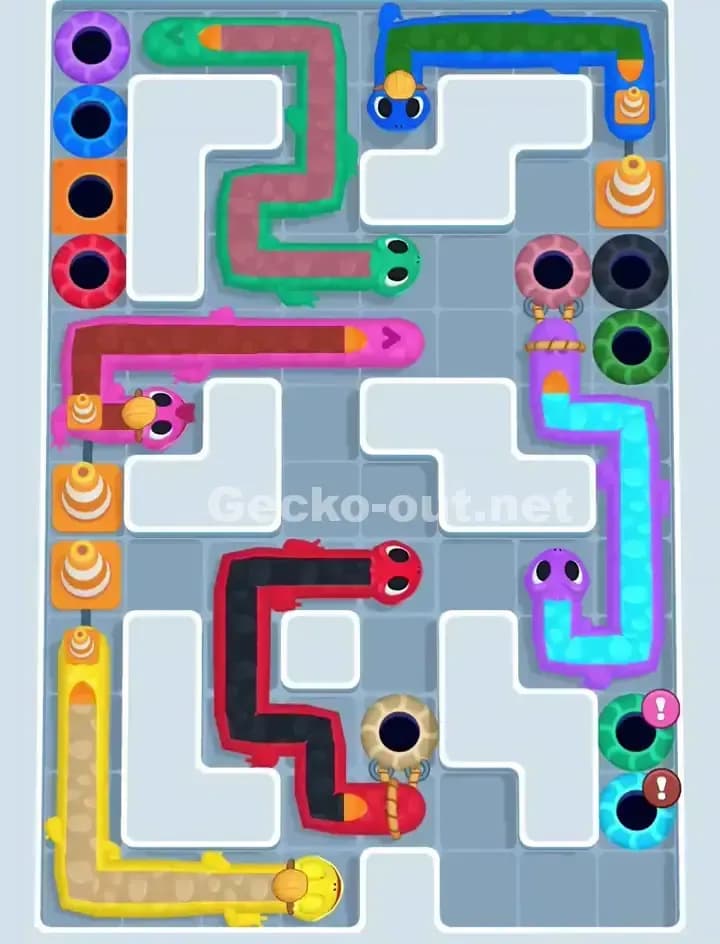
Gecko Out Level 1142 Solution Walkthrough | Gecko Out 1142 Answer
How to solve Gecko Out level 1142? Get step by step solution & cheat for Gecko Out level 1142. Solve Gecko Out 1142 easily with the answers & video walkthrough.
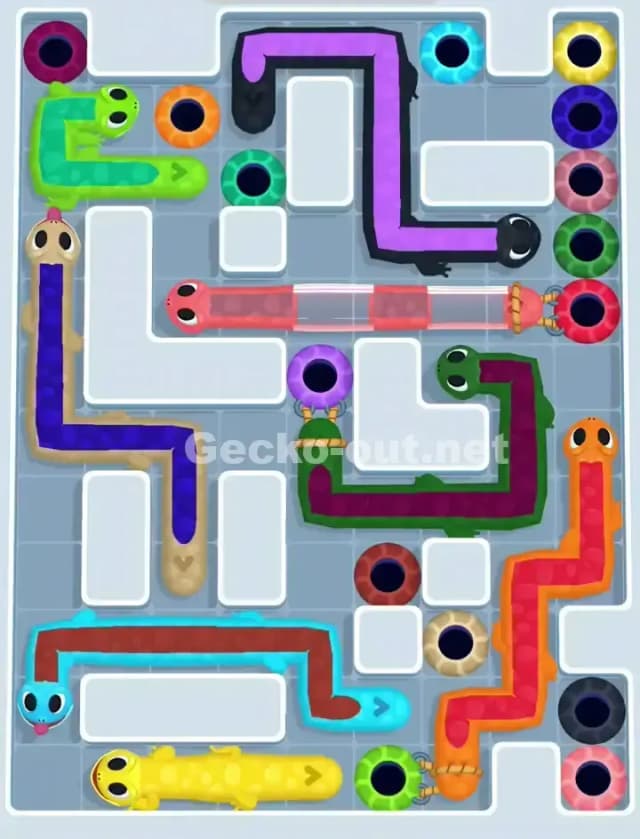


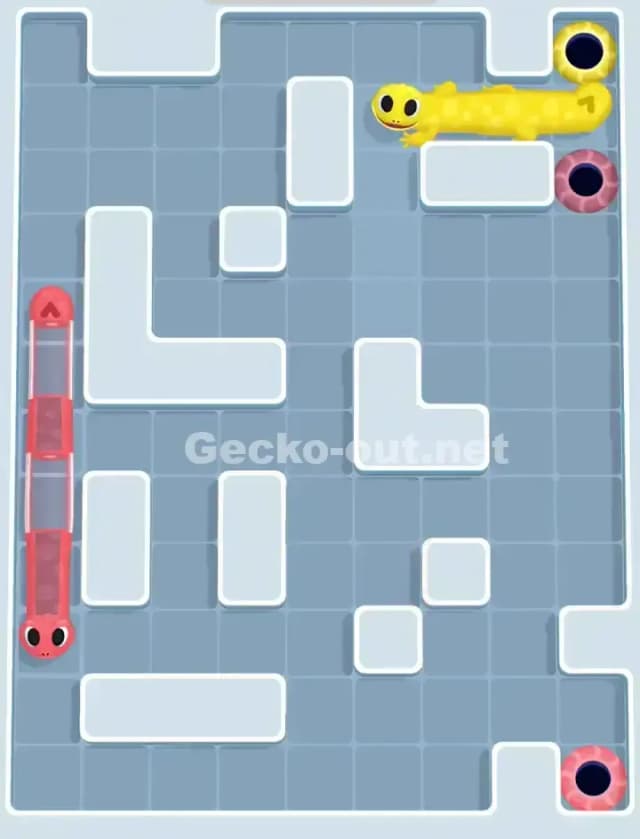
Gecko Out Level 1142: Board Layout, Rules, and Win Condition
Starting Board: Geckos, Colors, and Critical Layout
Gecko Out Level 1142 is a dense, multi-gecko puzzle that'll test your spatial reasoning hard. You're looking at six geckos spread across the board: a long lime-green gecko on the upper left, a red gang gecko stretching horizontally across the middle, a tan-and-purple gecko on the lower left, a dark green gecko anchored in the center-right area, a bright yellow gecko at the bottom, and a cyan gecko in the lower-left corner. Each one has a matching colored hole somewhere on the board's perimeter or within accessible corridors. The walls form an intricate maze of white barriers, and there's a purple "L"-shaped solid structure dominating the upper-center area that acts as both a landmark and a major physical obstacle. You'll also notice a cyan exit portal and a tan exit portal, plus several colored holes anchored to the grid edges. The layout is deliberately cramped—this isn't a level where you can just drag geckos straight to their holes. Instead, you're going to be choreographing a complex dance where every move either opens a new path or locks down future options.
Win Condition and Timer Pressure
Your goal is to get all six geckos to their matching-colored exit holes before the timer runs out. Unlike easier Gecko Out levels, Level 1142 doesn't give you much breathing room. Each gecko's body follows the exact path you drag its head along, and if any part of that body overlaps a wall, another gecko, or a blocked exit, the move fails. The timer is genuinely tight here—you've got maybe 60–90 seconds depending on your playstyle—so hesitation costs you dearly. This is why planning before you move is non-negotiable. Every drag-and-drop sequence should be thought through at least one step ahead. You're not just solving a spatial puzzle; you're solving it against the clock while managing the ripple effects of each gecko's movement on the available space for everyone else.
Pathing Bottlenecks and Logical Traps in Gecko Out Level 1142
The Red Gang Gecko Chokepoint
The biggest bottleneck in Gecko Out Level 1142 is undoubtedly the red gang gecko stretching horizontally across the middle of the board. This gecko is long—it takes up a significant horizontal corridor—and its exit hole is on the right side. Because of its length, it acts as a physical barrier that separates the upper and lower halves of the board once it's placed. If you're not careful with your move order, you'll trap yourself in a situation where other geckos can't reach their exits because this red behemoth is blocking the critical middle lane. What makes it especially tricky is that you need to exit it before you can comfortably move several other geckos out of the way. This means your early moves must position every other gecko so the red one has a clear, unobstructed path to slide toward its exit without triggering a collision.
Subtle Trap: The Purple L-Structure and Tight Corners
That purple L-shaped wall formation in the upper-center area creates a subtle but lethal trap. The corners are tight, and if you're dragging the lime-green gecko (which is also quite long) around that structure, one miscalculation sends its body slamming into the wall and forces a restart. The geometry here is unforgiving—you need to route the green gecko's head in a very specific arc to avoid clipping the wall while still leaving space for the red gang gecko and the dark green gecko to maneuver. I found myself restarting three times before I realized I was trying to be too aggressive with the green gecko's path. Once I accepted that it needed to take a longer, safer route around the obstacle instead of trying to thread the needle, the puzzle started opening up.
The Yellow Gecko's Isolation Problem
The bright yellow gecko at the bottom is almost isolated by its own position. It's tucked into a corner with limited direct access to its exit. The cyan gecko nearby can actually block yellow's only viable escape route if you're not careful about the order. Additionally, the lime-green gecko's long body, if positioned incorrectly, can wrap around and trap the yellow gecko against the wall. This teaches you an important lesson about Gecko Out Level 1142: sometimes the gecko that looks easiest to solve is actually the one that will punish you most if you move it at the wrong time.
Turn-by-Turn Path Strategy to Beat Gecko Out Level 1142
Opening: Freeing the Corners First
Start with the cyan gecko in the lower-left corner. This one has a relatively short body and a clear exit path toward the cyan portal. By moving it first, you're eliminating a potential traffic jam and freeing up lateral space on the lower half of the board. Next, tackle the tan-and-purple gecko on the lower left—it's tall but stationary, and its exit is accessible if you drag it straight down and then toward its tan-colored hole. Once these two are out of the way, you've got breathing room to handle the longer geckos without constant collision fear. I like to think of this phase as "clearing the edges so the center can breathe." You're not solving the whole puzzle yet; you're removing the obstacles that would constrain your moves later.
Mid-Game: Untangling the Red and Green Giants
Now comes the critical moment. The lime-green gecko on the upper left needs to move, but it's long and it's positioned in a way that could easily tangle with the purple wall structure or the red gang gecko if you rush. Drag its head carefully down and to the right, following a path that curves around the purple obstacle and then toward its green-colored exit on the upper right. Make sure its body doesn't collide with the red gang gecko's current position—you might need to swing wide. Once the green gecko is in motion, you'll have a clearer board. Then move the dark green gecko (center-right). This one doesn't have far to go, but timing is everything: move it only after the red gang gecko's lane is truly clear, otherwise you'll have them jammed against each other. The red gang gecko comes next—it's the most space-consuming piece, so you want maximum freedom. Drag its head toward the right side of the board in a smooth, deliberate arc, hugging the path around all other geckos' previous positions.
End-Game: Yellow Last, Eyes on the Timer
By the time you reach the final moves, you should have the cyan, tan, lime-green, dark green, and red geckos already exited. That leaves the yellow gecko—and honestly, it's easy to forget about until you're down to the final seconds. Don't fall into that trap. The yellow gecko's exit is on the right side of the board. Drag its head carefully upward and then to the right, keeping it away from any remaining walls. If you're running low on time (say, under 15 seconds), don't panic—just commit to a simple, direct path rather than trying to optimize. A slightly inefficient path that works beats a perfect path that times out.
Why This Path Order Works in Gecko Out Level 1142
Head-Drag Physics and Body-Follow Logic
The reason this strategy works comes down to understanding how the game engine resolves movement. When you drag a gecko's head, its body is constrained to follow that exact path, one grid square at a time, like a snake. This means if you leave obstacles in place, the body might coil back on itself or collide mid-route. By clearing the perimeter geckos first (cyan and tan), you reduce the number of "obstacles" the system has to navigate around. The longer geckos (green, red, dark green) then have more runway to move without triggering collision detection. Gecko Out Level 1142 rewards you for thinking about the board state holistically, not just one gecko at a time. Each exit removes a permanent physical barrier, which makes the next move geometrically simpler.
Pacing the Timer: Think vs. Move
Here's the honest truth about the timer in Gecko Out Level 1142: you have enough time if you're decisive. Spend your first 10–15 seconds studying the board, identifying the red gecko's exit path, tracing the lime-green gecko's route around the purple wall, and confirming yellow's endpoint. Then execute moves quickly and confidently. Don't overthink individual drags; trust your planning. The players who fail usually aren't slow—they're indecisive. They move a gecko halfway, realize it might not work, and restart. On Gecko Out Level 1142, once you drag the head, commit to seeing the route through. If you've planned correctly, it will work.
Boosters: Optional, Not Required
You can absolutely beat Gecko Out Level 1142 without boosters if you nail the path order. However, if you're stuck and frustrated after a few attempts, a time-extension booster is a legitimate "I'm learning the layout" tool—it gives you an extra 30 seconds to work with, which is genuinely helpful when you're still discovering where walls are hiding. A hint booster is less useful here because the puzzle isn't about finding a path; it's about finding the optimal sequence of paths, and that's something you need to figure out yourself. Skip the hammer-style tools unless you get genuinely jammed and run out of undo moves.
Mistakes, Fixes, and Logic You Can Reuse in Other Gecko Out Levels
Common Mistake #1: Moving the Red Gecko Too Early
Players often try to exit the red gang gecko before the board is truly clear. This results in its long body colliding with another gecko that hasn't moved yet. Fix: Always clear at least the two corner geckos (cyan and tan) before touching the red gecko. The red gecko is the spaceship engine of this level—don't fire it until the launch pad is ready.
Common Mistake #2: Assuming Yellow is Easy
Yellow's isolation makes players underestimate it. They move it too early or choose a path that doesn't account for other geckos still on the board. Fix: Move yellow last, always. It's small enough to slip through gaps, so save it as your cleanup move.
Common Mistake #3: Trying to Thread the Purple Wall Too Tightly
The lime-green gecko's path around the purple L-structure is not a tight squeeze—it's a gentle loop. Players who try to shave seconds by cutting the corner short end up bouncing off the wall and restarting. Fix: Drag the green gecko's head in a wide, generous arc around the purple obstacle. Longer paths are sometimes faster because they don't trigger failed collisions.
Common Mistake #4: Forgetting the Dark Green Gecko Exists
Because the dark green gecko is already fairly central and doesn't move much, players sometimes forget about it until they're down to two geckos left and one of them is blocked. Fix: After the green gecko is out, immediately move the dark green gecko before it becomes a traffic jam for red.
Common Mistake #5: Panicking When the Timer Gets Low
Gecko Out Level 1142 looks chaotic when you're down to 20 seconds and still have two geckos left. But panic leads to rushed drags and failed collisions, which cost more time than a calm, deliberate final move. Fix: Take a breath. Identify each gecko's exit, then move them in the order you planned. Even if time's tight, a clean execution beats a frantic one.
Reusing This Logic on Similar Levels
This puzzle showcases a pattern you'll see on many Gecko Out levels: the long-gecko bottleneck in a maze-like board. Whenever you see a gang gecko or an unusually long gecko blocking a middle corridor, default to this strategy: clear the edges first, plan the long gecko's exit route in detail, then move everything else. Also, if a level has a complex wall structure (like the purple L in Level 1142), always trace your path around it with your eyes before dragging. Finally, always identify which gecko is "safest" to move last—usually it's the smallest or most isolated—and save it as your final move. This takes pressure off the endgame because you know one gecko will slip through easily no matter how cluttered the board is.
Gecko Out Level 1142 is genuinely tough, but it's absolutely beatable once you commit to a clear plan and trust your spatial reasoning. The key is recognizing that this level isn't about finding one perfect path—it's about orchestrating the right sequence of moves so that each gecko's exit is accessible when its turn comes. You've got this. Plan methodically, move decisively, and before you know it, all six geckos will be home safe.