Gecko Out Level 776 Solution Walkthrough | Gecko Out 776 Answer
How to solve Gecko Out level 776? Get step by step solution & cheat for Gecko Out level 776. Solve Gecko Out 776 easily with the answers & video walkthrough.
Gecko Out Level 776: Board Layout, Rules, and Win Condition
Understanding the Starting Board
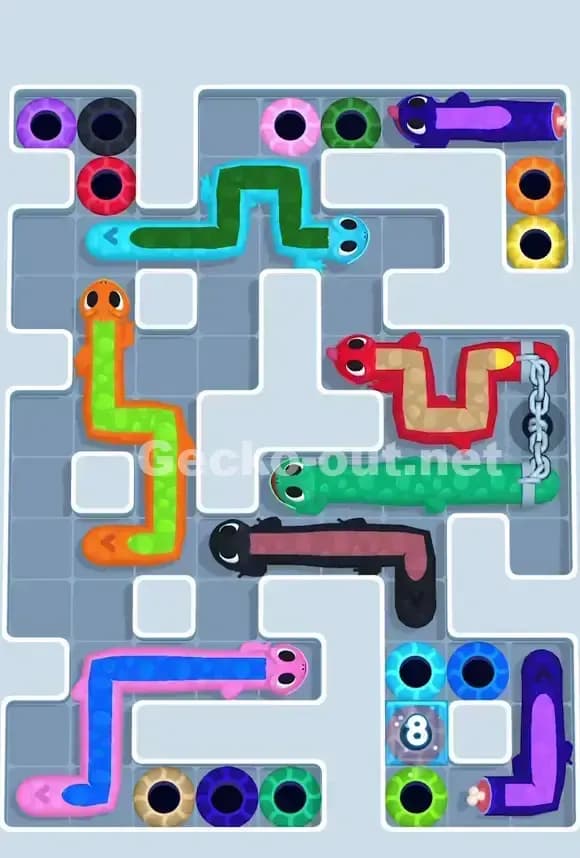
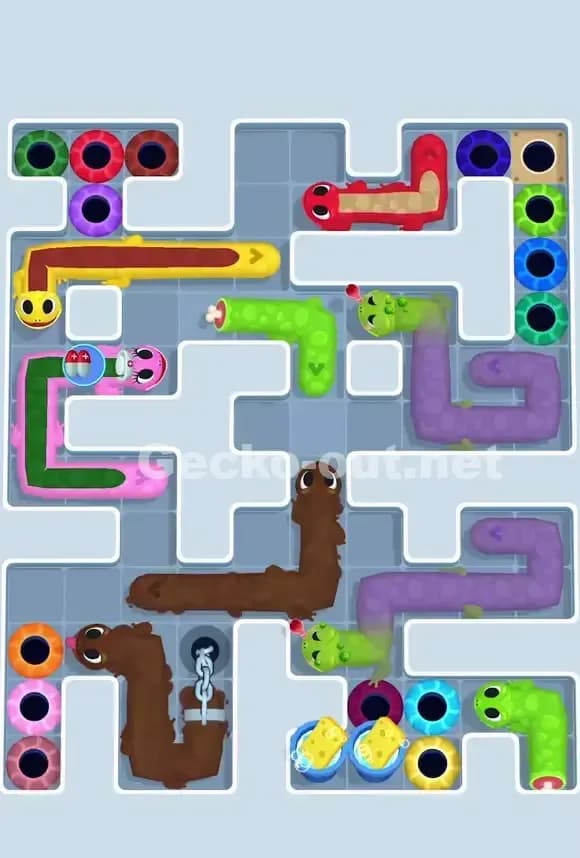
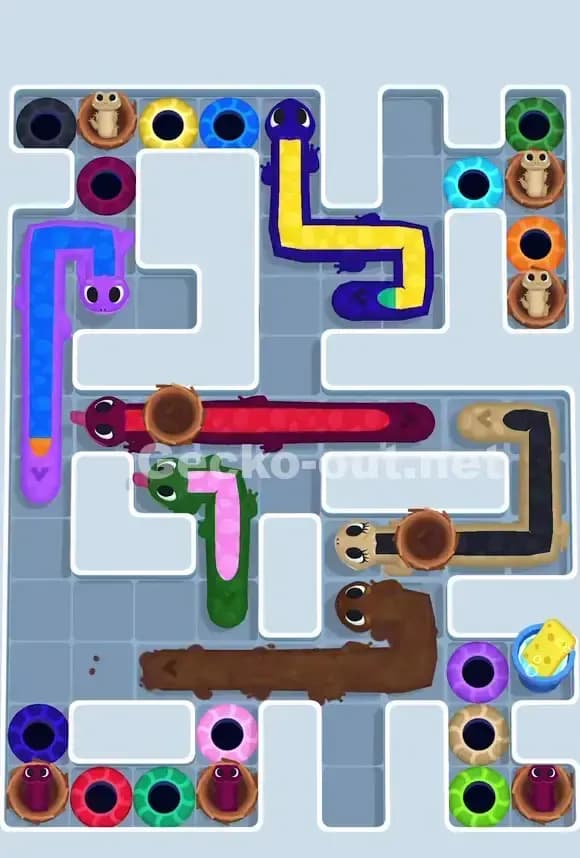
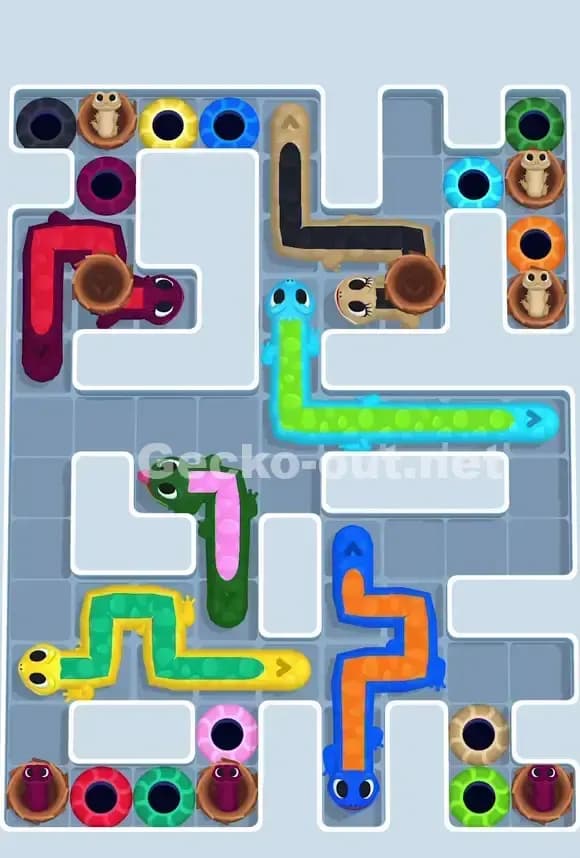
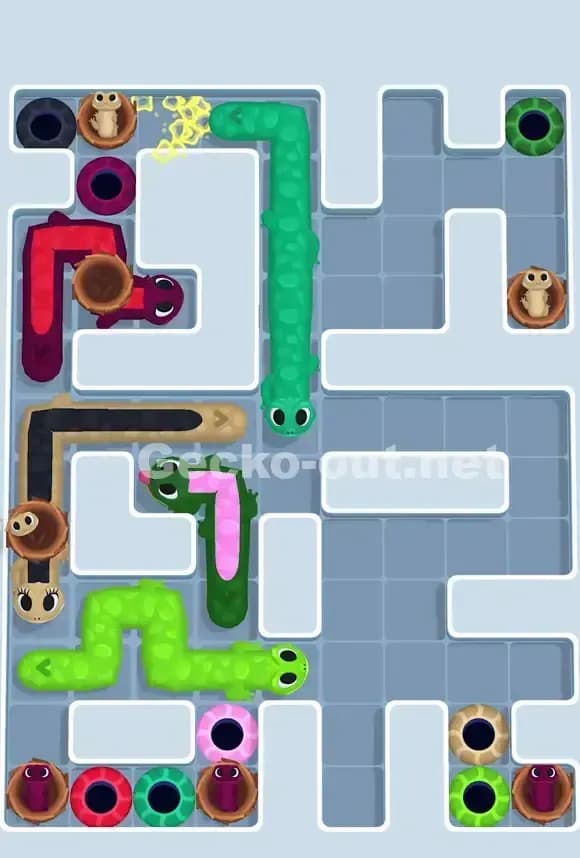
Gecko Out Level 776 is a seriously tangled puzzle with nine geckos scattered across a dense, maze-like grid. You've got a mix of colors: blues, greens, reds, purples, oranges, and browns, each one needing to find its matching hole to escape. What makes this level particularly nasty is the sheer number of long-bodied geckos—some of them stretch across multiple tiles—and they're positioned in a way that creates immediate spatial conflict. The board is split into distinct zones: an upper-left cluster with several stacked geckos, a central pathway with one brutally long red gecko that acts like a living barrier, and a lower section with tight corridors that will test your patience. Walls form irregular channels everywhere, and there's precious little open space to maneuver. The timer is your silent pressure: you'll need to execute this cleanly, or you'll run out of moves before everyone escapes.
The Win Condition and the Timer's Role
To beat Gecko Out Level 776, every single gecko must reach a hole of its matching color before the timer hits zero. That sounds straightforward until you realize that dragging one gecko's head traces a path for its entire body to follow—and if you're not careful, that body becomes a roadblock for everyone else. The timer doesn't give you much breathing room here; you can't afford lengthy trial-and-error sessions. This means your first attempt should be your best attempt, built on reading the board carefully and understanding which gecko must move first so the others can flow out safely.
Pathing Bottlenecks and Logical Traps in Gecko Out Level 776
The Critical Bottleneck: The Red Gecko as a Living Wall
The red gecko sprawling horizontally across the middle of the board is the single biggest chokepoint in Gecko Out Level 776. This long-bodied creature is positioned like a cork in a bottle—it blocks vertical and diagonal movement for at least three other geckos trying to reach the lower half of the board. If you don't address it early and route it correctly, you'll create a traffic jam that makes the puzzle unsolvable within the time limit. The trick is that you must move it in a way that clears the vertical corridor it's currently occupying, but you can't just shove it anywhere; its exit hole is in the upper-right region, which means dragging its head up and right requires careful choreography.
Subtle Trap #1: The Purple Gecko Pair and Overlapping Paths
Two purple geckos sit in the upper-left corner, and they're dangerously close to each other. If you drag one's head without planning where the other one goes, their bodies will overlap mid-path, and that's an instant failure. This is a classic Gecko Out Level 776 gotcha because the overlap happens during the drag, not when you place them. You'll need to move one completely out of the board before committing the other to its path—which eats up execution time but is absolutely necessary.
Subtle Trap #2: The Frozen Exit and the Yellow Booster Corridor
There's a frozen (icy) exit in the upper-center region, and it blocks access to the yellow booster sitting nearby. If you forget that frozen exits can't be used until they're thawed (usually by a hammer or a specific puzzle mechanic), you might waste precious seconds trying to drag a gecko head toward an unreachable hole. On Gecko Out Level 776, this means you either need to identify an alternate route for the yellow gecko or plan to grab the hammer booster early to unfreeze that exit.
Subtle Trap #3: The Lower-Right Choke Point and the Tight Corridor
The bottom-right area of Gecko Out Level 776 has a narrow passage where three geckos need to exit. It's physically tight, and if you send them in the wrong order, the first one to enter might block the other two. This is where exit order becomes critical—and it's easy to overlook when you're focused on the upper chaos.
A Moment of Clarity
I'll be honest: the first time I looked at Gecko Out Level 776, I felt overwhelmed. There are so many geckos, so many walls, and the timer ticking down made me want to just start dragging randomly. But then I realized something clicked—if I could identify which gecko had to move first (the red one blocking everything), and which gecko could sit safely in a corner while I worked on others (the brown one in the middle-right), the puzzle started to feel less like a knot and more like a sequence. That shift from panic to "Okay, I see the order" is what makes Gecko Out Level 776 solvable.
Turn-by-Turn Path Strategy to Beat Gecko Out Level 776
Opening: Remove the Red Gecko and Park the Purples
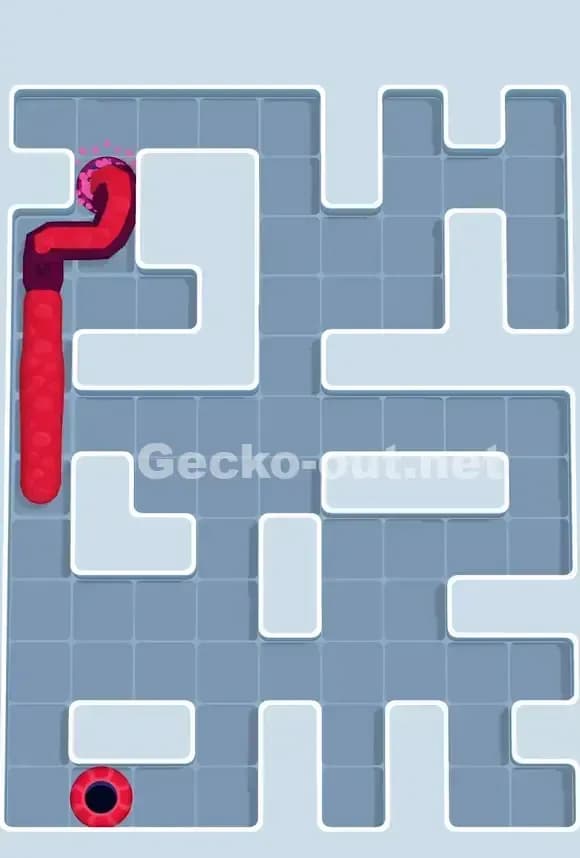
Your first move should be to drag the red gecko's head upward and then to the right, routing it toward the red hole in the upper-right zone. This long creature is your priority because moving it opens a critical vertical corridor for everyone else. Don't try to optimize the path on your first move—just get it moving and out of the way. While the red gecko is sliding along its path, you've created mental space to handle the purple pair. Move the darker purple gecko (the one on the far left) down and around the lower-left corridor toward its hole at the bottom-left. This clears the upper-left cluster immediately. Park the lighter purple gecko in a safe corner—don't drag it to its exit yet; just get it out of the way so it's not an obstacle. This opening sequence should take you about 30–40 seconds if you're decisive.
Mid-Game: Untangle the Upper-Left, Manage the Center Flow
Once the red and purple geckos are moving, tackle the yellow and blue geckos in the upper-center area. The yellow gecko should head toward the yellow booster (assuming the frozen exit is no longer a problem). The blue gecko goes to its hole in the upper-right. What you're doing here is systematically clearing the "top shelf" of the board so that the remaining geckos—the brown and green ones currently clustered in the middle and lower regions—have clear pathways. Keep an eye on the green gecko in the middle-left; it's a long one and needs a careful, winding route downward toward the lower-left exit. Don't rush this section; take a breath between moves and confirm each head-to-hole pairing before you drag. This is where most players lose time by making hasty mistakes and having to restart.
End-Game: Exit Order Matters, Watch the Timer
In the final phase of Gecko Out Level 776, you're left with the brown geckos and any remaining secondary colors. The key is to move them in an order that prevents overlap in the lower-right choke point. Start with the brown gecko closest to its hole, then move the others outward. If you're running low on time (say, under 30 seconds remaining), commit to dragging even if you're not 100% certain—hesitation will cost you more than a slightly imperfect path. The last two or three geckos should exit almost in sequence; don't leave gaps where they can interfere with each other.
Why This Path Order Works in Gecko Out Level 776
How Head-Drag Pathing Prevents Tangling
The genius of following the red-gecko-first strategy in Gecko Out Level 776 is that you're using the body-follows-head rule to your advantage instead of fighting it. By moving the longest obstacle first, you reduce the number of other bodies that could potentially overlap with it. Each subsequent gecko has fewer "active" bodies on the board to avoid, making their paths simpler. This is the opposite of the intuitive mistake—moving small geckos first—which leaves big ones scrambling through an increasingly crowded board.
Timer Management: Pause vs. Commit
Here's the truth about Gecko Out Level 776: the timer is generous enough to let you think between moves, but not so generous that you can afford extensive deliberation. After the first two geckos, commit to a rhythm. Spend 5–10 seconds reading each gecko's target hole and the most direct path, then drag confidently. Pausing mid-drag wastes time, so once you start a move, finish it. The only exception is if you realize mid-drag that you're about to create an overlap—in that case, abort, reset, and try again. A quick reset is faster than a failed full attempt.
Booster Strategy: Optional but Smart
On Gecko Out Level 776, the hammer booster (used to unfreeze exits) is genuinely useful if you're stuck on the frozen exit in the upper-center. However, it's not mandatory if you can route the yellow gecko around it via an alternate path. The extra time booster? Only grab it if you're running behind schedule after the first five geckos; don't plan on needing it, but use it if panic sets in.
Mistakes, Fixes, and Logic You Can Reuse in Other Gecko Out Levels
Mistake #1: Moving Short Geckos First
The Problem: It feels logical to clear the "easy" geckos first, but in Gecko Out Level 776, the short ones are actually more mobile and can be moved later. Moving them early wastes their flexibility.
The Fix: Identify the longest gecko (usually the bottleneck) and move it first, regardless of size. This opens space for everything else.
Mistake #2: Forgetting About Frozen Exits
The Problem: You drag a gecko toward a hole, only to realize the hole is frozen and unusable. You waste time and must reset.
The Fix: Before dragging, scan the board for any icy or locked exits. If they block a gecko's natural path, either grab the hammer booster early or find an alternate route.
Mistake #3: Overlapping Bodies During Mid-Path
The Problem: Two geckos' bodies cross each other as they're being dragged simultaneously, causing an instant fail.
The Fix: Never drag two geckos at the same time on Gecko Out Level 776. Always complete one full path before starting another. This also prevents accidental overlaps from bodies crossing mid-transit.
Mistake #4: Losing Track of Exit Order in Choke Points
The Problem: The lower-right corridor is tight, and sending geckos through it in the wrong sequence causes gridlock.
The Fix: Before the end-game, mentally rank the remaining geckos by proximity to their holes. Move the closest one first, then the next closest. This prevents backups.
Mistake #5: Panicking and Rushing the Final Moves
The Problem: With 20 seconds left, you start dragging frantically, making careless errors.
The Fix: Stay calm. Gecko Out Level 776 is solvable within the time limit if you follow the plan. Rushing introduces mistakes that cost more time than a composed, methodical approach.
Reusing This Logic on Similar Levels
This strategy—**identify the biggest bottleneck, move it first, then work outward—applies to any Gecko Out level with long geckos and tight spaces. The same principle holds if you encounter gang geckos (linked pairs), frozen exits, or multiple choke points. Always ask yourself: "Which gecko, if moved, opens the most space for others?" That's your starting move every time.
Final Encouragement
Gecko Out Level 776 is genuinely tough, but it's absolutely beatable. The maze is intimidating, the timer creates pressure, and the long geckos create real spatial constraints—but none of that means it's unsolvable. You've got the tools: a clear bottleneck-first strategy, a logical exit order, and an understanding of how body-following physics work in your favor. Take a deep breath, commit to the plan, and trust the process. The moment you see that last gecko slide into its hole with seconds to spare, you'll realize Gecko Out Level 776 was a puzzle of order, not chaos.