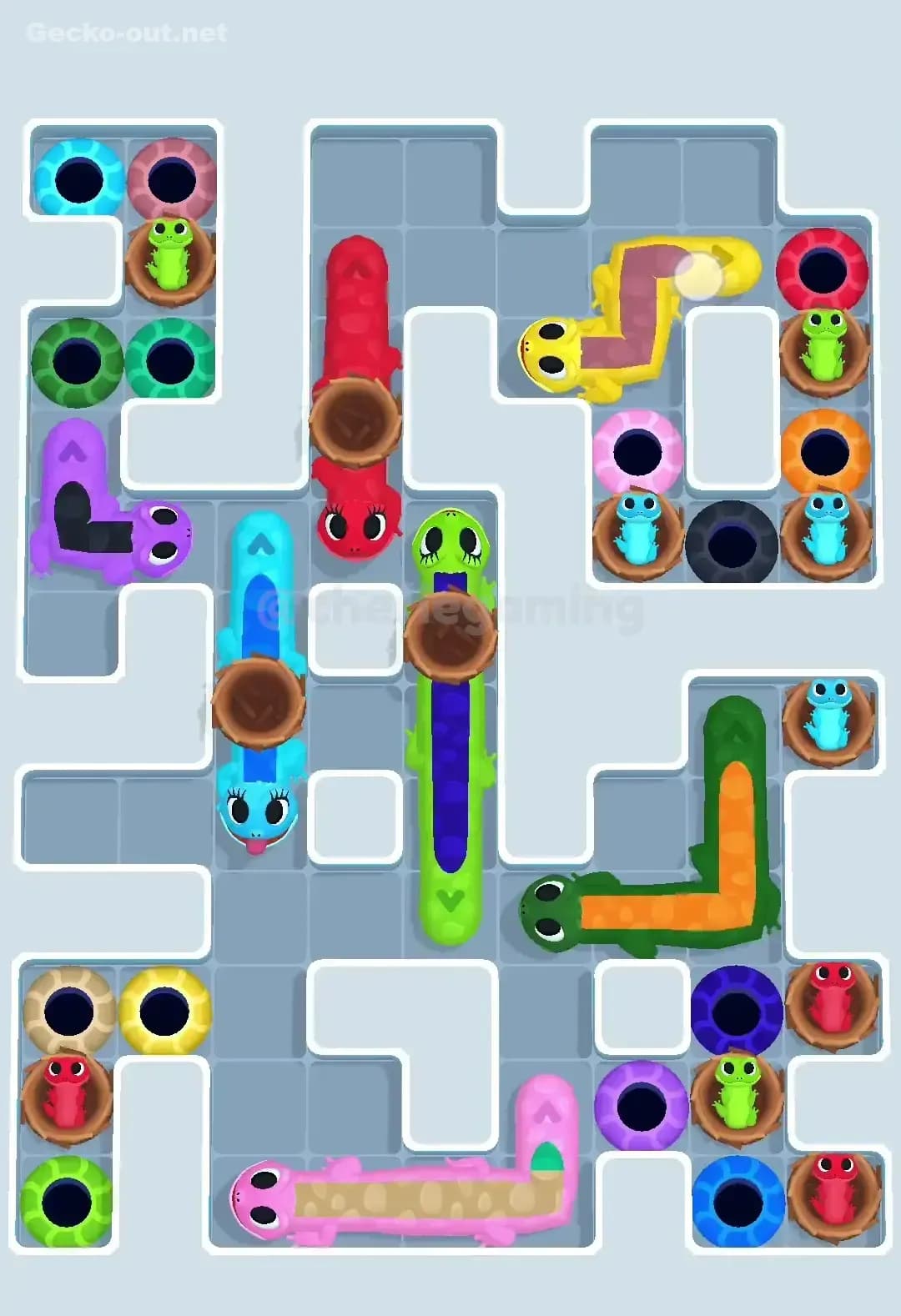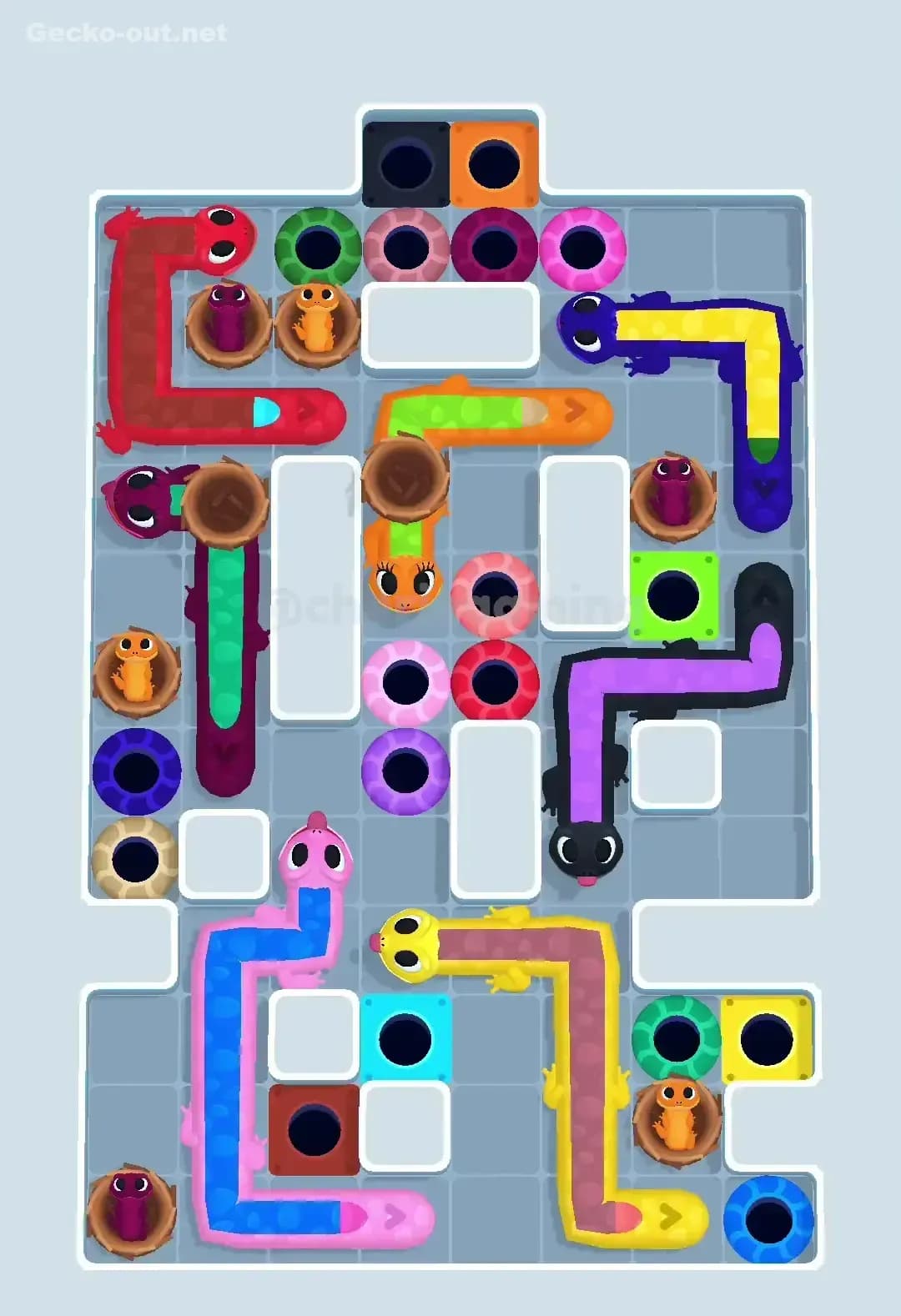
Gecko Out Level 633 Solution Walkthrough | Gecko Out 633 Answer
How to solve Gecko Out level 633? Get step by step solution & cheat for Gecko Out level 633. Solve Gecko Out 633 easily with the answers & video walkthrough.
Gecko Out Level 633: Board Layout, Rules, and Win Condition
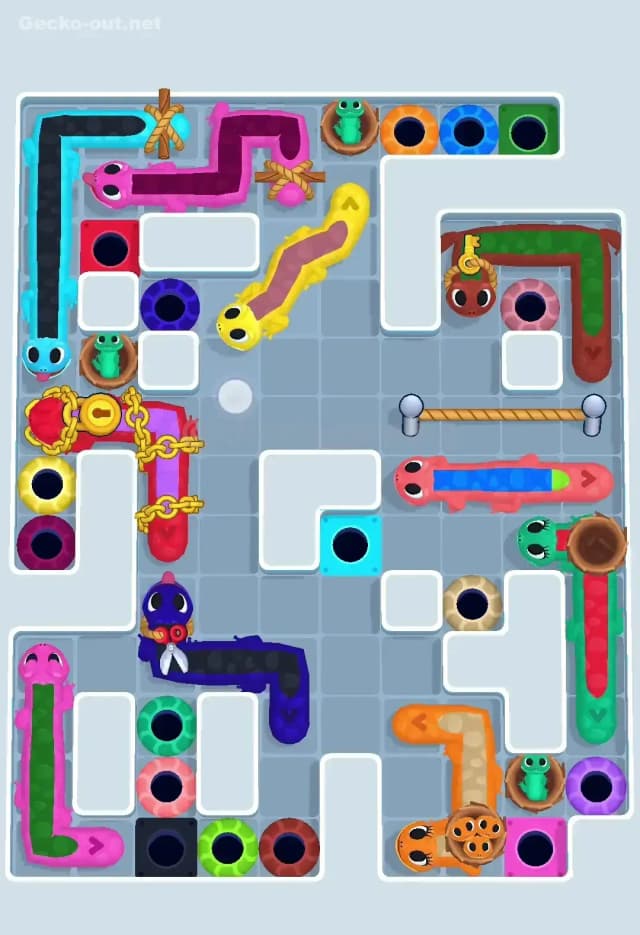
Understanding the Starting Position
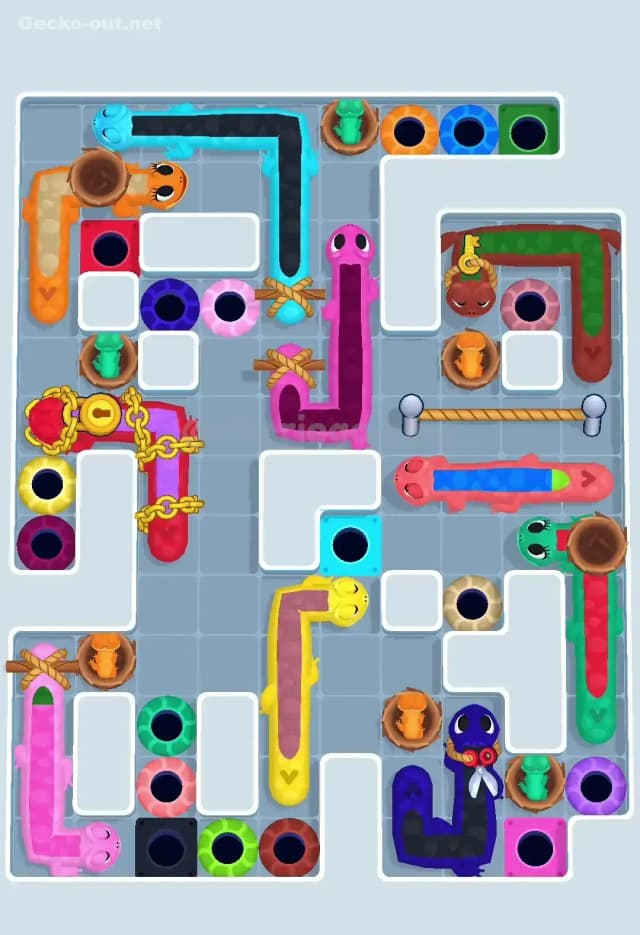
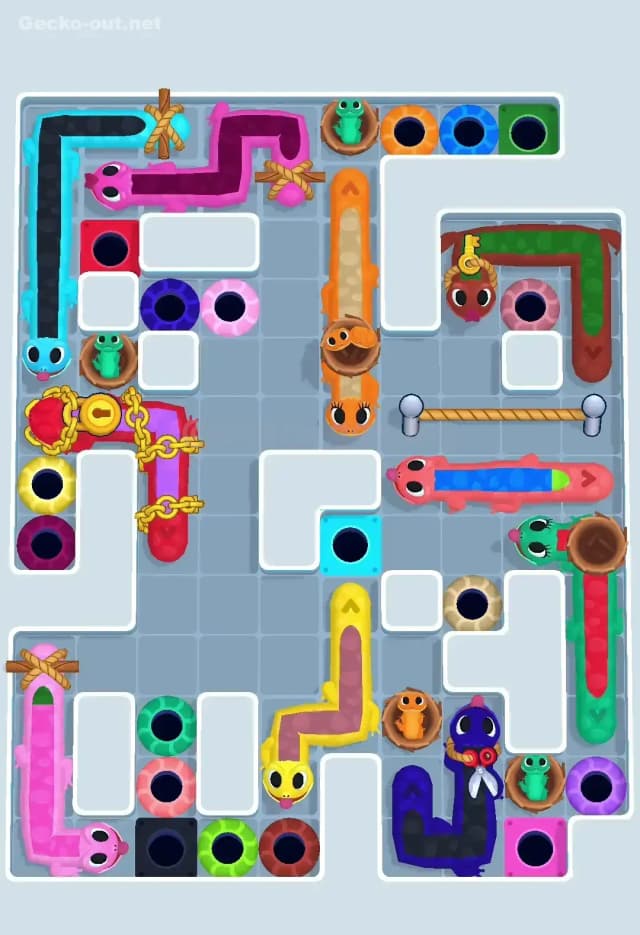
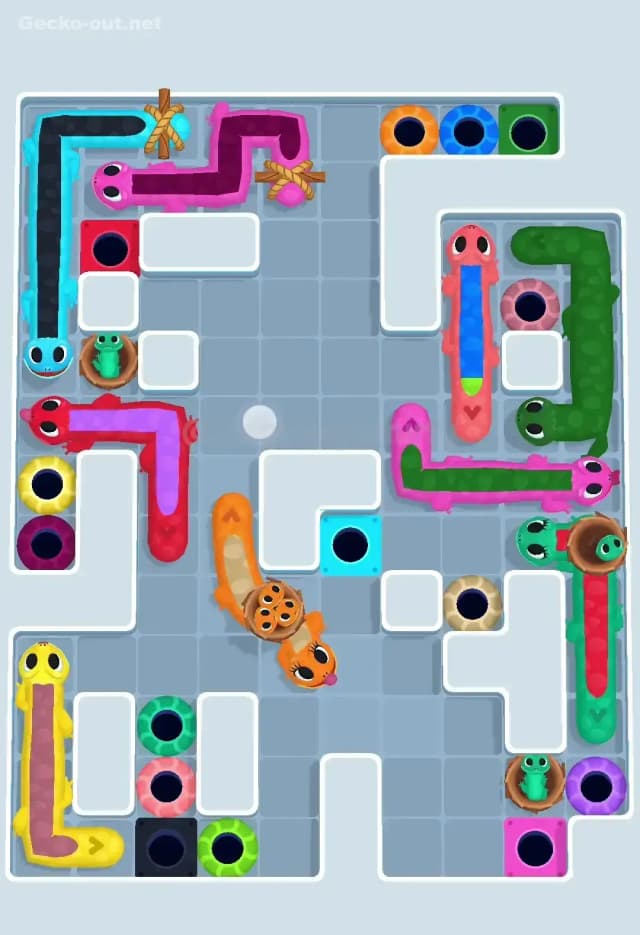
Gecko Out Level 633 throws you into one of the densest grids you've seen in a while. The board is packed with at least eight geckos of various colors—cyan, orange, pink, yellow, green, blue, and purple—all twisted into overlapping paths that fill nearly every available square. You'll spot several geckos already stretched across multiple tiles, with their heads and tails positioned in ways that immediately suggest they're blocking each other. The white rectangular obstacles scatter across the grid, creating narrow corridors and forcing you to think carefully about every single drag path you commit to.
What makes Gecko Out Level 633 particularly challenging is the sheer number of "gang" geckos—pairs or groups linked together that must move as one unit. You'll see brown circular holders containing gecko segments, indicating that certain geckos are frozen or anchored until you address them in the correct sequence. The colored holes (your exit points) are distributed around the perimeter and interior of the board, but reaching them requires threading geckos through impossibly tight spaces without crossing paths or bodies.
The Win Condition and How Time Pressure Changes Everything
Your goal in Gecko Out Level 633 is straightforward: drag each gecko's head to its matching colored hole before the timer runs out. The body follows the exact path you drag, so every turn, corner, and detour you make with the head determines where the body segments will lie on the grid. This path-based movement is what transforms Gecko Out Level 633 from a simple matching puzzle into a spatial logic nightmare.
The timer is aggressive here. You don't have the luxury of trial and error unless you're willing to restart multiple times. Every second counts, which means you need to visualize the entire sequence of moves before you start dragging. One gecko stuck in the wrong position can jam three others, and if you realize your mistake too late, you won't have time to undo the damage and still clear the board. Gecko Out Level 633 demands that you think in layers: which gecko unlocks which corridor, which body positions will leave room for the next gecko to pass, and which exits need to stay accessible until the very end.
Pathing Bottlenecks and Logical Traps in Gecko Out Level 633
The Central Corridor Chokepoint
The biggest bottleneck in Gecko Out Level 633 is the central vertical corridor that runs through the middle of the board. Multiple geckos need to either pass through this space or position their bodies along its edges, and if you fill it with the wrong gecko too early, you'll trap at least three others with no way out. I'm talking specifically about the long pink gecko that snakes through the left-center area and the magenta/purple gecko that occupies a massive L-shaped path down the middle-right.
If you move the pink gecko toward its exit without first clearing space for the cyan and orange geckos to escape, you'll create a wall of gecko body that blocks the central passage completely. The cyan gecko in particular needs that corridor to reach its hole in the upper-right area, and the orange gecko has a similar dependency. This is the single most important concept to internalize for Gecko Out Level 633: the central corridor must remain open or become open at the right moment, and that means you have to move geckos in a specific sequence that keeps clearing that space rather than filling it.
Subtle Problem Spots That Quietly Wreck Your Run
Beyond the central corridor, Gecko Out Level 633 has a few sneaky traps. The first is the lower-left corner, where a pink gecko and a green gecko are positioned near each other with very limited maneuvering room. If you try to move the pink gecko out too early, its body will block the green gecko's path to its exit. You need to "park" one gecko in a safe holding pattern while you clear the other, and the timing matters because the clock is ticking.
The second trap is in the upper-right area, where several colored holes are clustered together. It's tempting to rush geckos toward those exits because they look accessible, but the approach paths are narrow and easily blocked by gecko bodies from other areas. If you move the blue or purple gecko too soon, their bodies can accidentally seal off the cyan gecko's route, forcing you to waste precious seconds repositioning.
When the Solution Finally Clicked
I'll be honest: Gecko Out Level 633 frustrated me for a solid fifteen minutes. I kept jamming the board by moving the long magenta gecko first, thinking I could just "deal with" the consequences later. The moment the strategy clicked was when I stopped focusing on individual geckos and started asking, "Which gecko, if I move it last, will have the cleanest path?" That flipped my entire approach. Suddenly Gecko Out Level 633 became about working backward from the final state, identifying which geckos needed to exit first to create space for the ones that would otherwise be impossible to route.
Turn-by-Turn Path Strategy to Beat Gecko Out Level 633
Opening Moves: Establishing Safe Zones
Start Gecko Out Level 633 by identifying the geckos that are easiest to move and whose exits are located in positions that won't interfere with later moves. I recommend beginning with the small orange gecko in the upper-left area. This gecko has a relatively short body and can reach its orange hole without crossing through the central corridor. Drag its head directly to the exit, keeping the path as compact as possible so the body doesn't sprawl across critical tiles.
Next, handle the green gecko in the top-right corner. This gecko also has a short path to its green hole, and moving it early clears space near the upper-right cluster of exits. The key here is to drag the head in a way that keeps the body hugging the outer edge of the board, not snaking inward where it would block the cyan gecko's future path.
"Parking" is essential in Gecko Out Level 633. If a gecko doesn't have a clear shot to its exit yet, position its head in a corner or edge tile where its body will occupy dead space rather than active corridors. The yellow gecko in the lower-middle area is a perfect candidate for parking. You can't move it to its exit yet because the central corridor is still congested, so tuck it into a safe spot and leave it there while you address the bigger problems.
Mid-Game: Threading the Needle Through the Central Corridor
Once you've cleared the easy perimeter geckos, Gecko Out Level 633 shifts into its hardest phase. The cyan gecko needs to move from the left side toward its hole in the upper-right, and this requires threading its head through the central corridor while avoiding every other gecko's body. The trick is to move the cyan gecko before you commit the magenta gecko to its final path, because the magenta gecko's body is so long that once it's extended, it blocks almost everything.
Drag the cyan gecko's head carefully through the central corridor, making tight turns to minimize how much space the body occupies. You want the body to form a compact zigzag pattern rather than a sprawling curve. Once the cyan gecko is safely in its hole, you've opened up a ton of breathing room for the remaining geckos.
Now tackle the magenta gecko. This is the longest gecko on the board in Gecko Out Level 633, and its path needs to be deliberate. Start by dragging its head toward the lower-right area, keeping the body as straight as possible. Every unnecessary turn you make with this gecko wastes tiles and creates new blockages. If you've parked other geckos correctly, the magenta gecko should have just enough space to reach its exit without colliding with anyone.
End-Game: Racing the Clock with the Final Geckos
By the time you're down to the last two or three geckos in Gecko Out Level 633, the timer is probably getting uncomfortable. The good news is that if you've followed the sequence above, the board should be relatively clear. The yellow gecko you parked earlier can now move through the central corridor to its exit in the lower-right area. Drag its head quickly—there's no need for perfection at this point, just speed.
The final gecko is usually the blue or purple one in the lower-right cluster. These geckos have short paths to their holes, but you need to make sure no stray body segments from earlier moves are blocking the way. If you're cutting it close on time, don't hesitate to use the extra-time booster here. Gecko Out Level 633 is beatable without boosters, but if you're on your last few seconds and one gecko away from victory, that time extension is absolutely worth it.
Why This Path Order Works in Gecko Out Level 633
Leveraging the Body-Follow Rule to Untangle the Knot
The reason this sequence succeeds in Gecko Out Level 633 is that it respects the fundamental rule of the game: the body follows the head's exact path. Every gecko you move early is chosen specifically because its body, in its final position, will not block the paths of the geckos you move later. This is the opposite of what most players do instinctively. The instinct is to move the geckos that look "ready" or closest to their exits, but in Gecko Out Level 633, those geckos are often the ones whose bodies will create the worst jams.
By moving perimeter geckos first and keeping the central corridor clear until the mid-game, you're essentially peeling away layers of the knot rather than tightening it. The cyan gecko is the linchpin—once it's out, the magenta gecko can stretch across the board without consequence, and the remaining geckos have free rein to exit in almost any order.
Managing the Timer: When to Pause and When to Commit
Gecko Out Level 633 punishes hesitation, but it also punishes reckless speed. The optimal approach is to spend the first 10–15 seconds of the timer studying the board and visualizing the full sequence. Identify which geckos are gang-linked, which exits are hardest to reach, and which gecko bodies are most likely to cause blockages. Once you've committed that plan to memory, execute it quickly and confidently.
If you make a mistake mid-run, resist the urge to restart immediately. Sometimes a "mistake" is actually just a less efficient path, and you can still recover by adjusting the order of the remaining geckos. I've beaten Gecko Out Level 633 with five seconds left on the clock after what I thought was a fatal error, simply because I kept moving and adapted on the fly.
Are Boosters Necessary for Gecko Out Level 633?
Boosters are optional but helpful. The extra-time booster is the most valuable here, and I'd recommend using it if you're consistently running out of time in the final 10 seconds. The hammer-style tool (which removes a single obstacle or breaks a frozen gecko free) is less useful in Gecko Out Level 633 because the primary challenge isn't obstacles—it's spatial logic and pathing. If you're stuck because a frozen gecko is blocking a critical exit, the hammer can save you, but most runs fail due to poor sequencing rather than hard blockages.
The hint booster can be useful if you're completely stumped, but honestly, by the time you've read this far, you already understand the core strategy for Gecko Out Level 633. Save your boosters for levels where the obstacles are more random or unpredictable.
Mistakes, Fixes, and Logic You Can Reuse in Other Gecko Out Levels
Common Mistakes and How to Fix Them
The number one mistake in Gecko Out Level 633 is moving the magenta gecko too early. This gecko's body is so long that it dominates the board, and if you move it before clearing the cyan and orange geckos, you'll block multiple exits and corridors. The fix is simple: treat the magenta gecko as one of the last geckos you move, not one of the first.
The second mistake is failing to park geckos in safe zones. Players often try to move every gecko toward its exit immediately, which creates a chaotic tangle of bodies. In Gecko Out Level 633, parking is a core mechanic. If a gecko doesn't have a clear path yet, tuck it into a corner and forget about it until the board opens up.
The third mistake is dragging heads in inefficient paths. Every turn and detour you make with a gecko's head adds body segments to the grid, and those segments occupy space. Keep your drag paths as direct as possible, especially for long geckos. A straight line is always better than a curve when space is tight.
The fourth mistake is ignoring the timer until it's too late. Gecko Out Level 633 requires you to internalize the rhythm of the clock. You should be glancing at the timer every few moves, not just at the end. If you're past the halfway point and you've only cleared two geckos, you're behind schedule and need to speed up.
The fifth mistake is giving up too early. Gecko Out Level 633 feels impossible on your first few attempts, but it's absolutely beatable once you understand the sequencing. Don't restart after one failed move—play it out, observe where the jam happens, and adjust your strategy for the next run.
Reusing This Approach on Similar Levels
The logic you've learned from Gecko Out Level 633 applies directly to any level with dense grids, long geckos, and tight corridors. The core principle—move perimeter geckos first, keep central corridors clear, and park geckos in safe zones—works on dozens of later levels. Gang geckos and frozen exits add complexity, but the fundamental sequencing strategy remains the same.
If you encounter a level where one gecko is obviously blocking everyone else, that gecko is almost always the last one you should move, not the first. Gecko Out Level 633 teaches you to work backward from the final state, and that mindset is invaluable for the hardest puzzles in the game.
Final Encouragement
Gecko Out Level 633 is tough, no question. It's one of those levels where the solution feels elegant and obvious in hindsight, but getting there requires patience and a willingness to fail a few times. The good news is that once you crack it, you'll have a much sharper understanding of how gecko bodies interact with space, and you'll be better prepared for the even harder levels ahead. Take your time, visualize the full sequence, and trust that the path order outlined here will get you through. You've got this!