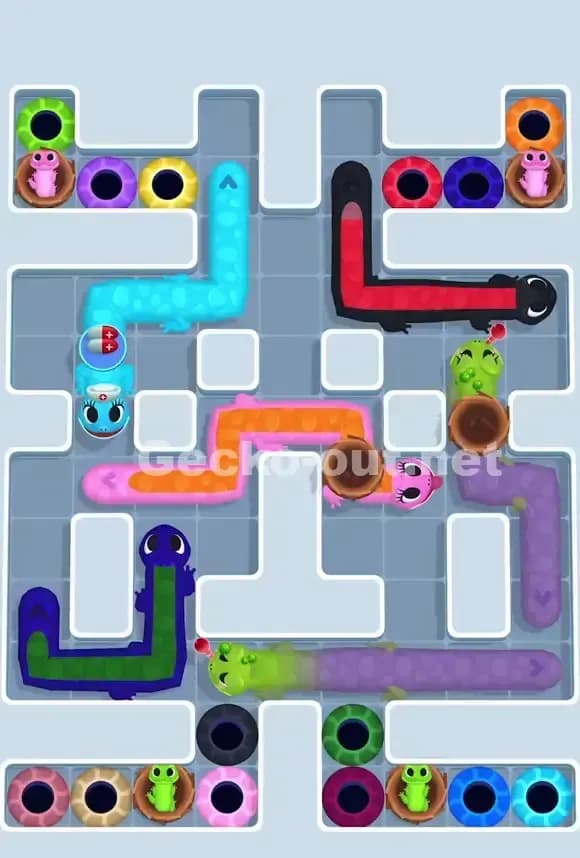
Gecko Out Level 763 Solution Walkthrough | Gecko Out 763 Answer
How to solve Gecko Out level 763? Get step by step solution & cheat for Gecko Out level 763. Solve Gecko Out 763 easily with the answers & video walkthrough.
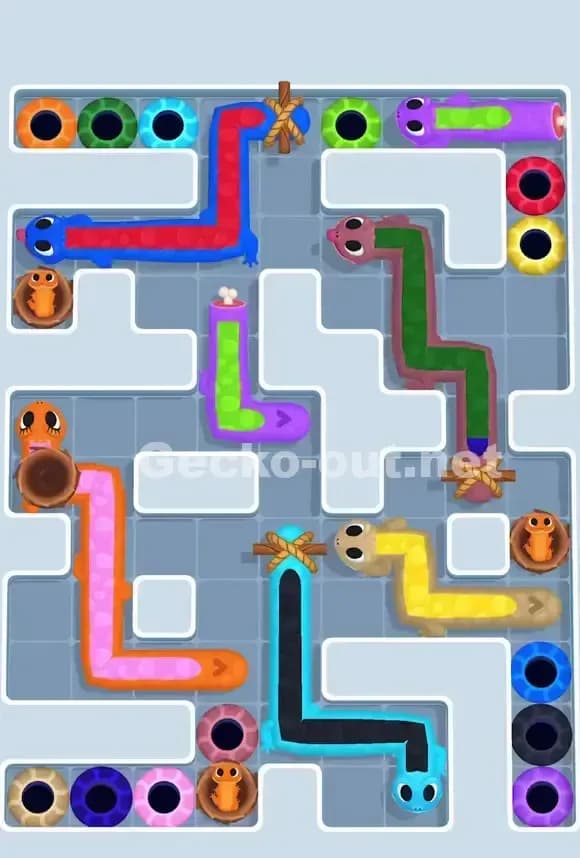
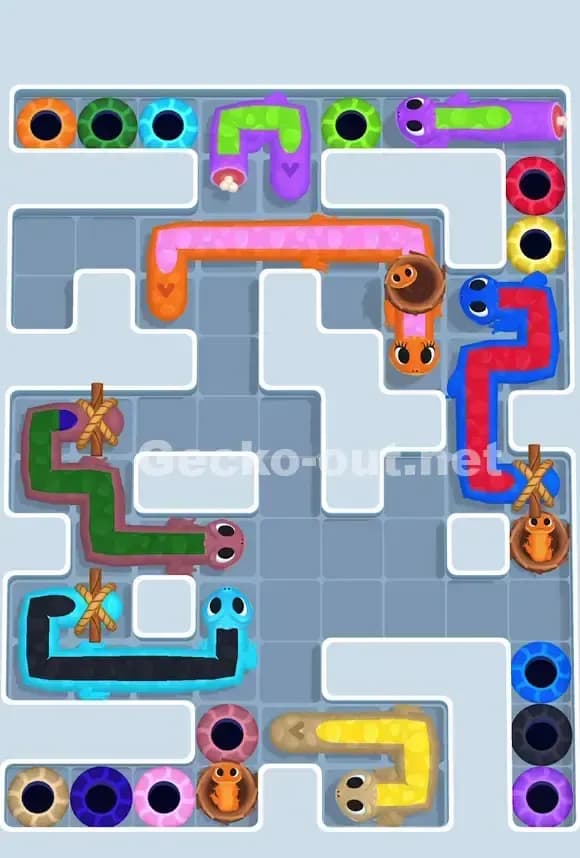
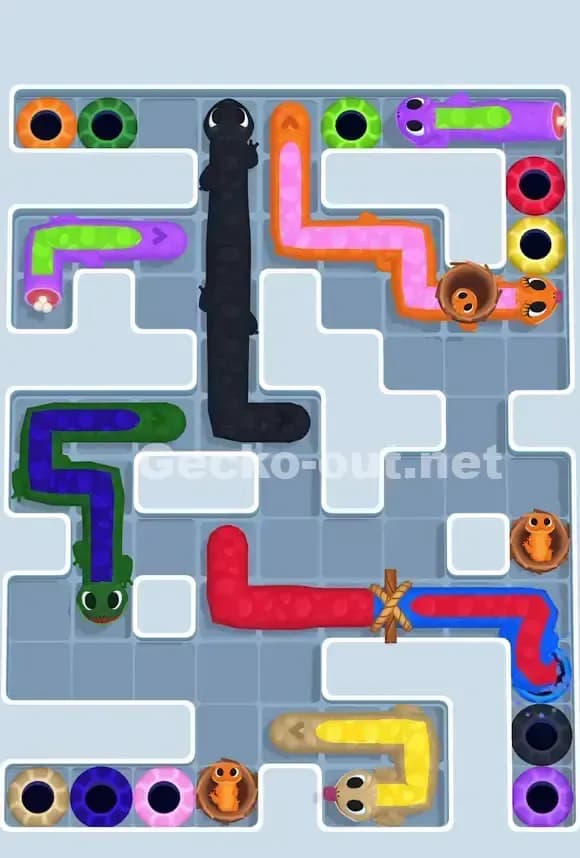
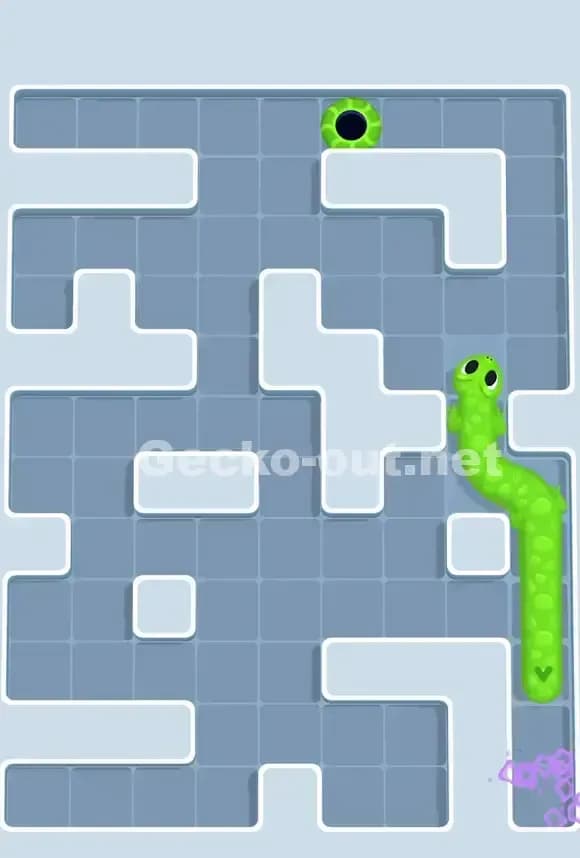
Gecko Out Level 763: Board Layout, Rules, and Win Condition
The Starting Board: Geckos, Colors, and Layout
Gecko Out Level 763 is a crowded, multi-color puzzle that'll test your spatial reasoning and patience. You're working with seven geckos spread across the board—orange, blue, red, pink, green, yellow, and cyan—each one waiting to be dragged to its matching-colored exit hole. The board itself is a maze of white walls creating narrow corridors and dead-end chambers, with exit holes positioned strategically around the perimeter and interior. What makes this level particularly brutal is that several geckos are positioned deep inside chambers, far from their exits, which means their bodies will snake through tight spaces and potentially block other geckos' paths if you're not careful about sequencing. The timer gives you a reasonable but not generous window—you need to think fast and commit to your moves without second-guessing every drag.
The Win Condition and Timer Pressure
To beat Gecko Out Level 763, all seven geckos must reach their color-matched exit holes before the timer hits zero. The twist? Every gecko's body follows the exact path you drag its head, so if you pull a long gecko through a narrow corridor in a careless way, you've just created a wall that blocks everyone else. The timer isn't brutal enough to force panic, but it's tight enough that you can't afford to undo mistakes repeatedly or experiment randomly. You need a plan, and you need to execute it with confidence. This is where Gecko Out Level 763 separates casual players from those who understand the head-drag-path mechanic deeply.
Pathing Bottlenecks and Logical Traps in Gecko Out Level 763
The Central Choke Point: Why the Red Gecko Is Your Keystone
The red gecko is your main bottleneck in Gecko Out Level 763. It's positioned in the upper-left chamber with a long body that extends horizontally, and its exit is on the upper-right side of the board. The problem? This gecko's body will occupy a critical horizontal lane that multiple other geckos need to use to reach their exits. If you drag the red gecko out early and leave its body coiled in the wrong place, you've essentially locked down the top portion of the board. Conversely, if you wait too long to move it, you'll run out of time shuffling other geckos around it. The key insight is that the red gecko must be exited along a very specific path—up and around the outer edge—so that its body doesn't linger in the central corridors where orange, blue, and pink geckos need to travel.
Subtle Trap One: The Orange Gecko's Starting Position
The orange gecko sits in the lower-left corner, almost a full gecko-length away from any useful corridor. Its exit is orange, positioned on the left side. Sounds straightforward, right? Wrong. The path from the orange gecko's starting position to its exit requires navigating around the pink gecko's body and squeezing through a narrow vertical slot. If you move the orange gecko first without thinking ahead, you risk tangling it with the pink gecko, which then can't exit easily. This is why you can't just grab geckos in color order—you have to think about their physical entanglement.
Subtle Trap Two: The Green Gecko's Long Body
The green gecko is one of the longest on the board, and it's coiled in the right-center area. Its exit is green, also on the right side, but getting there means threading through multiple white-wall corridors. If you drag the green gecko's head before clearing a safe path through those corridors—or before moving other geckos out of the way—its body will wrap around them like a boa constrictor. I spent my first two attempts fighting the green gecko because I didn't realize how many geckos it could accidentally pin. The moment I moved the cyan and yellow geckos out of the right-side corridors first, the green gecko's exit became trivial.
Subtle Trap Three: The Time Crunch on the Final Gecko
Players often leave one gecko for last and then panic when the timer is running low. On Gecko Out Level 763, that final gecko is usually the blue one, and by that point, if you haven't been methodical about parking finished geckos in safe zones, the board becomes a maze of frozen bodies. You'll be dragging frantically, watching the timer, and making sloppy decisions. The frustration is real, but it's entirely preventable with the right sequence.
My Aha Moment
I'll be honest—my first three attempts on Gecko Out Level 763 felt chaotic. I was dragging geckos and watching them collide, then undoing moves, then restarting. The breakthrough came when I realized that I wasn't actually solving a color-matching puzzle; I was solving a spatial choreography puzzle. Each gecko had to exit in a specific order so that their bodies could clear the board without jamming anyone else. Once I mapped that order and committed to it, Gecko Out Level 763 went from infuriating to manageable. Now it feels almost elegant.
Turn-by-Turn Path Strategy to Beat Gecko Out Level 763
Opening: Clear the Outer Lanes First
Start by exiting the yellow gecko from the right-center area. It's one of the shorter geckos, its exit is relatively accessible, and moving it first clears valuable space in the right-side corridors. Drag its head down and around to the yellow exit hole on the right edge. Next, exit the cyan gecko from the bottom-center area. It also has a fairly direct route to the cyan exit hole at the bottom. These two moves clear the middle and bottom portions of the board without creating any tangled pathways. Park your mental image here—you've just removed two geckos, and now the corridors are less crowded. Your board now has more breathing room, and you haven't blocked anyone yet.
Mid-Game: Untangle the Left and Center Zones
Now tackle the orange gecko, but be deliberate. Drag its head up and around the pink gecko's area, steering clear of the pink gecko's body entirely. Once the orange gecko is out through its exit on the left, you've cleared the lower-left corner. Next, move the pink gecko straight up through its designated path to the pink exit hole. The pink gecko's body is medium-length, so it won't sprawl across the board—just make sure its path is clear and doesn't zigzag unnecessarily. With orange and pink out, the left side is now clear. Turn your attention to the blue gecko. Its body is long, so plan carefully. Drag its head up from the left-center chamber, around the red gecko's area, and guide it toward the blue exit on the right side. This move is critical because the blue gecko's body will occupy significant real estate. Make sure you're dragging it along a path that doesn't re-block the corridors you've already cleared.
Mid-Game Continued: Handle the Green Gecko's Length
The green gecko is still on the board, and it's long. At this point, the red gecko is also still there, and they're in close proximity. Before you move the green gecko, reposition the red gecko first. Drag the red gecko's head up and out along the top edge of the board to its red exit. The red gecko's body will follow that path and will end up exiting upward, clearing the horizontal lane at the top. Now you have room to move the green gecko. Drag its head carefully through the cleared right-side corridors to the green exit. Because you've already exited yellow, cyan, orange, pink, blue, and red, the right-side corridors are mostly clear, and the green gecko's long body has room to extend without hitting anyone.
End-Game: The Final Push
You're left with one gecko—let's say it's a color you deliberately saved because its path is the most straightforward. Drag its head to its exit hole, and you're done. At this point, if you've followed the sequence, you should have time to spare. The board is otherwise empty, so there's no risk of collision. The timer is in your favor, and Gecko Out Level 763 is yours.
Why This Path Order Works in Gecko Out Level 763
The Head-Drag Principle and Body-Following Mechanics
The genius of this sequence is that it respects the fundamental rule of Gecko Out Level 763: the body follows the head's path exactly. By exiting shorter geckos first (yellow, cyan), you're reducing the number of "body obstacles" on the board. Then, by moving the geckos in the left and center zones (orange, pink, blue) before tackling the long geckos on the right (green), you're systematically clearing corridors so that when the longest geckos move, they have open lanes. You're not fighting the game's mechanics; you're working with them. Each gecko you exit removes a physical barrier, making subsequent moves faster and safer. This is the opposite of the chaotic approach where you drag geckos randomly and hope they don't collide.
Timer Management: When to Pause and When to Commit
You don't need to pause and over-analyze every single move. The timer on Gecko Out Level 763 is generous enough to allow for one or two moments of reflection. Use your pause time when you're about to move a long gecko (like the green one) to double-check that its destination corridor is actually clear. For short geckos, move with confidence—you've already planned the sequence, so trust it. The biggest time-waster is second-guessing yourself mid-move or restarting because you're nervous about a collision. Commit to the plan, and you'll finish Gecko Out Level 763 with seconds to spare.
Booster Strategy: Do You Actually Need Help?
Gecko Out Level 763 doesn't require boosters if you follow this guide. However, if you're genuinely stuck after multiple attempts, the extra time booster is your safety net—it gives you a 30-second buffer, which is enough to recover from one sequencing mistake. The hint booster can also be useful if you're unsure about which gecko to move first; it'll highlight the optimal starting move. I'd recommend trying this level 2–3 times with the strategy before purchasing boosters. You'll likely beat it without them, and that victory feels so much better.
Mistakes, Fixes, and Logic You Can Reuse in Other Gecko Out Levels
Common Mistake One: Exiting Long Geckos First
Players often assume they should move the longest geckos first to "get them out of the way." This backfires spectacularly on Gecko Out Level 763 because a long gecko's body occupies corridors for a long time, blocking everyone else. Fix: Always exit shorter geckos first, especially if they're in the central or outer lanes. Reserve long geckos for when the board is nearly empty.
Common Mistake Two: Ignoring Gecko Position Relative to Exits
A gecko's starting position and exit location define whether its path will block others. On Gecko Out Level 763, some geckos are positioned such that their exit paths naturally clear the board (like yellow exiting right). Others require careful navigation to avoid tangling (like orange near pink). Fix: Before you start, trace each gecko's shortest path to its exit with your finger. If that path crosses another gecko's body, make a mental note to move that other gecko first.
Common Mistake Three: Dragging in Straight Lines Instead of Smart Curves
Geckos don't have to move in L-shapes or straight lines—their bodies follow whatever path you drag their heads along. Many players create inefficient paths that take up more space than necessary. On Gecko Out Level 763, especially in the tight corridors, a slightly curved path can be shorter than a zig-zag. Fix: Practice dragging smoothly, even if it means taking a slightly longer route that avoids other geckos. Smooth paths are often shorter in terms of corridor occupation.
Common Mistake Four: Panicking When the Timer Drops Below 30 Seconds
If you follow the sequence from this guide, you won't panic. But if you do end up with one gecko left and 25 seconds on the clock, don't rush and make a collision error. Instead, take one deep breath, verify the path is clear, and make a single confident drag. Panic leads to sloppy moves, which lead to collisions, which lead to restarting. Calm execution beats frantic speed.
Common Mistake Five: Not "Parking" Geckos in Safe Zones
Once a gecko exits, its body is gone from the board—but only if you've successfully guided it all the way out. Make sure your exit paths don't loop back or leave the gecko hanging halfway out. Always drag the gecko's head fully into the exit hole. Fix: Watch the gecko disappear completely before moving on to the next one.
Reusable Logic for Similar Levels
This strategy applies to any Gecko Out level with multiple geckos, tight corridors, and a timer. The core principle is: map the board, identify bottlenecks, exit geckos in an order that clears pathways progressively, and commit to your sequence without second-guessing. Whether it's a gang-gecko level (where geckos are linked and move together) or a frozen-exit level (where some exits are temporarily blocked), the spatial choreography principle holds. Shorter, less-blocking geckos should exit before long ones. Geckos whose exits are on the board's perimeter should often exit before those whose exits are interior or require threading through other corridors.
The Final Word on Gecko Out Level 763
Gecko Out Level 763 is tough, no question. The combination of seven geckos, a complex wall maze, and a strict timer can feel overwhelming on your first attempt. But it's absolutely beatable with a clear plan. You now have a sequence, a rationale, and a set of principles you can apply to similar puzzles. The key is understanding that Gecko Out Level 763 isn't about speed—it's about order. Execute the right moves in the right sequence, and the level solves itself. You've got this.