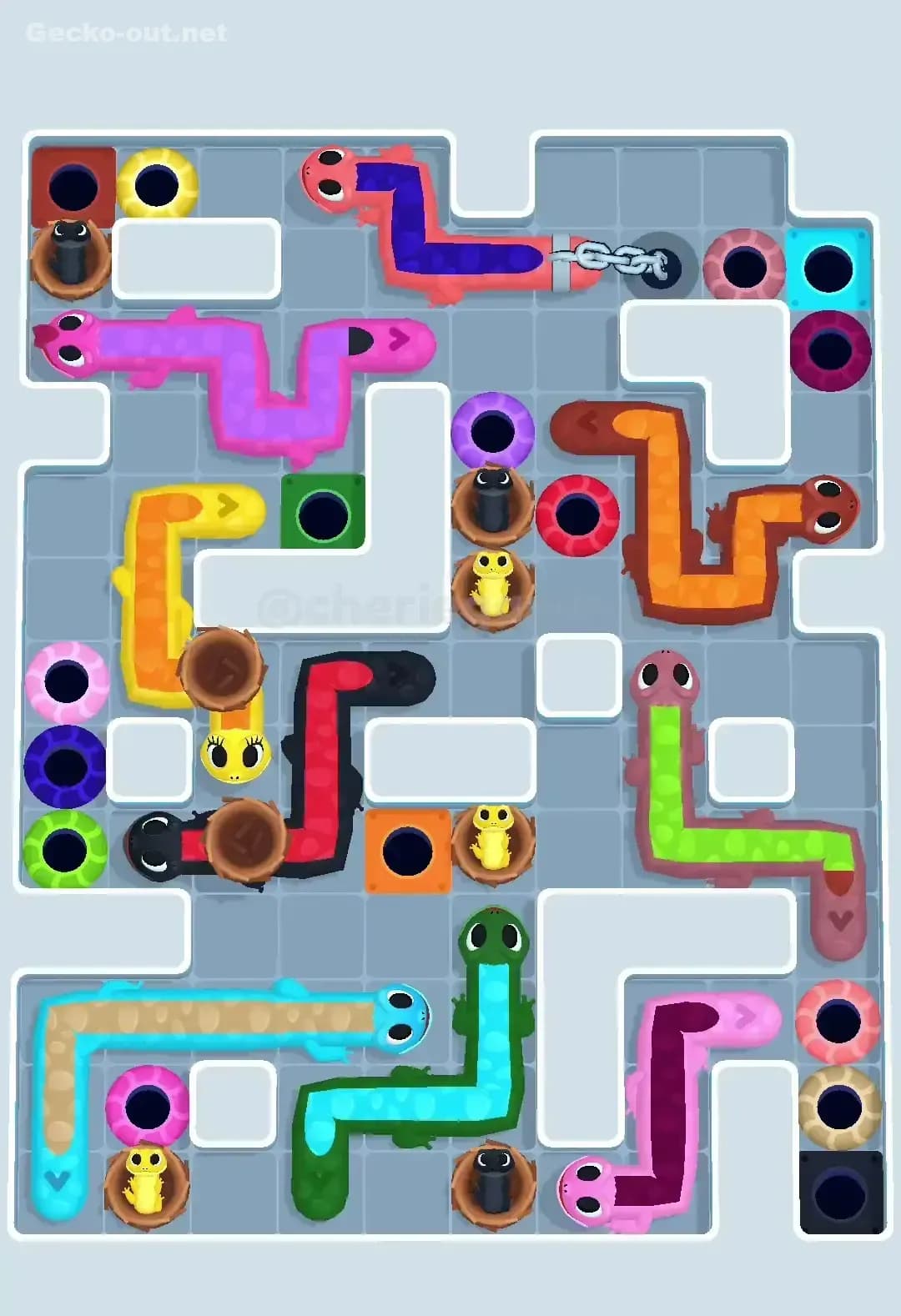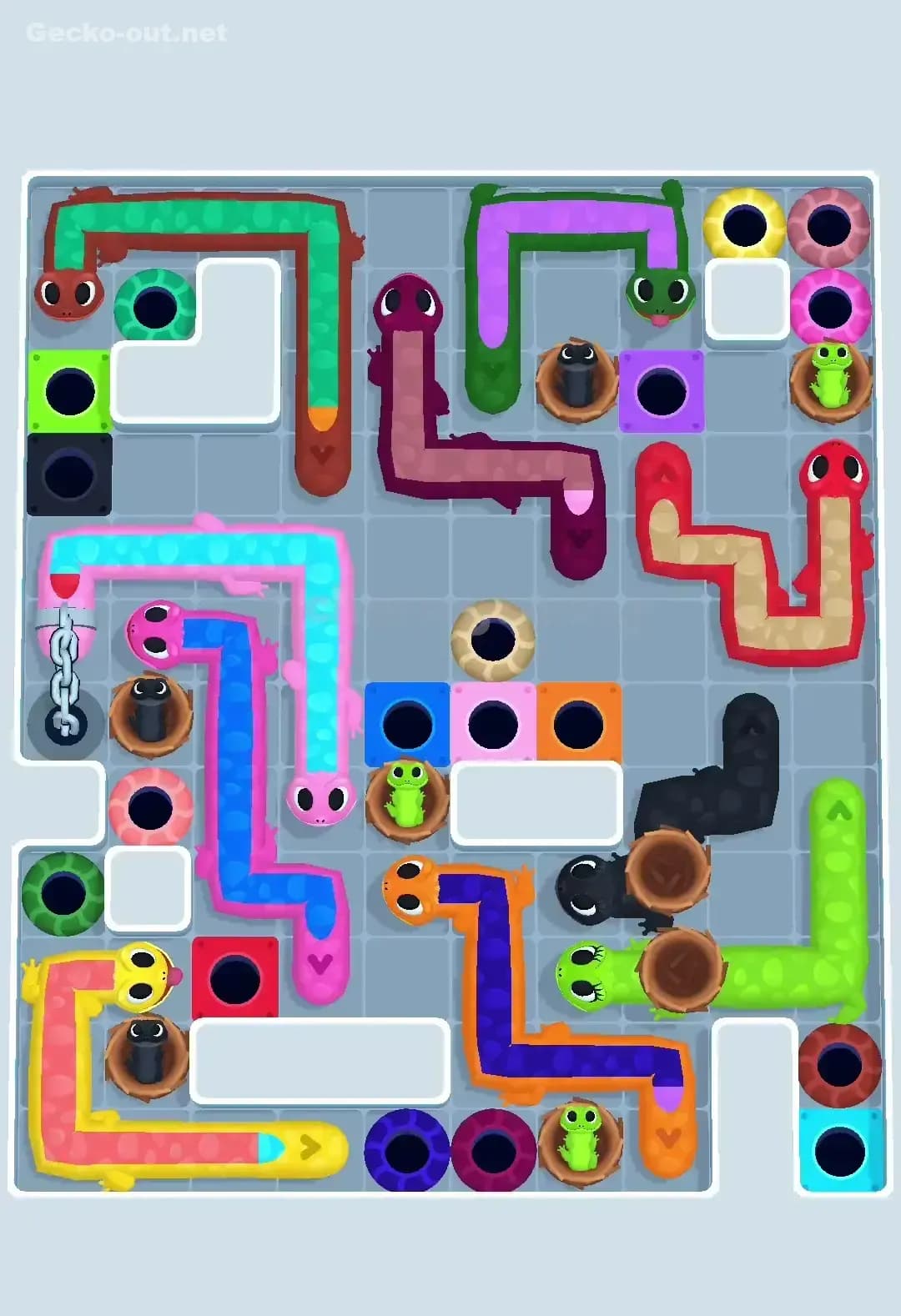
Gecko Out Level 636 Solution Walkthrough | Gecko Out 636 Answer
How to solve Gecko Out level 636? Get step by step solution & cheat for Gecko Out level 636. Solve Gecko Out 636 easily with the answers & video walkthrough.
Gecko Out Level 636: Board Layout, Rules, and Win Condition
Understanding the Starting Board Configuration
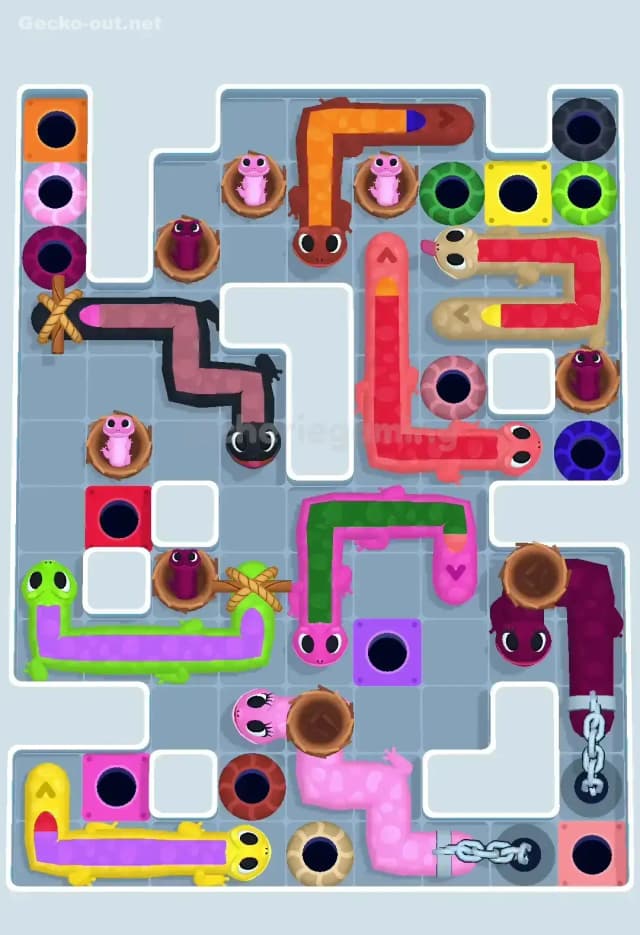
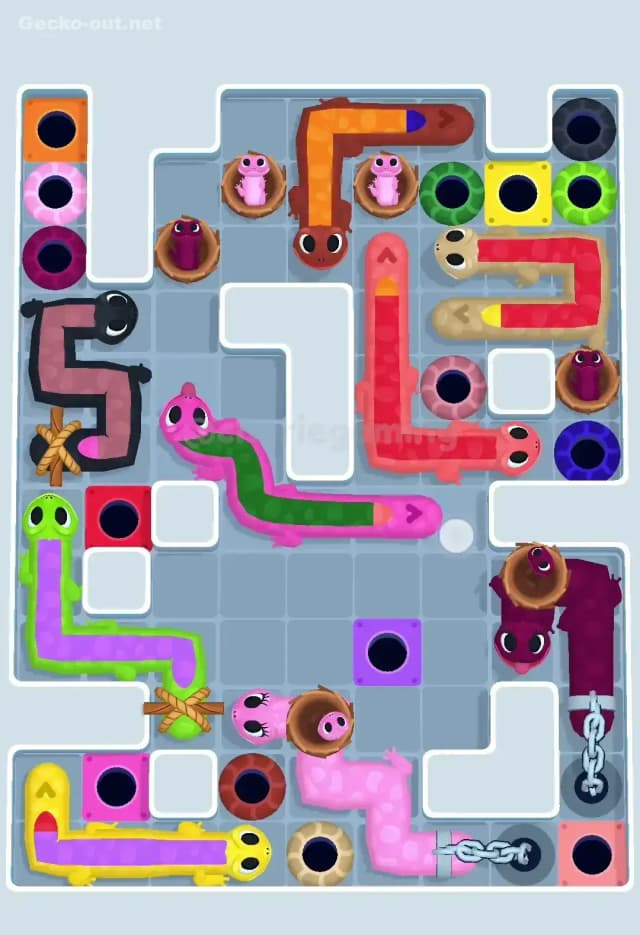
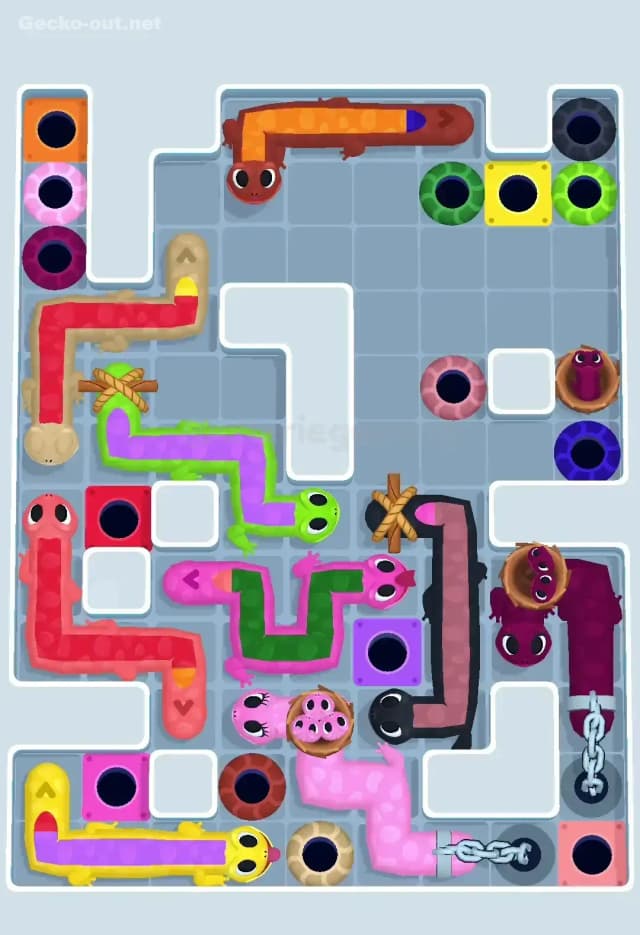
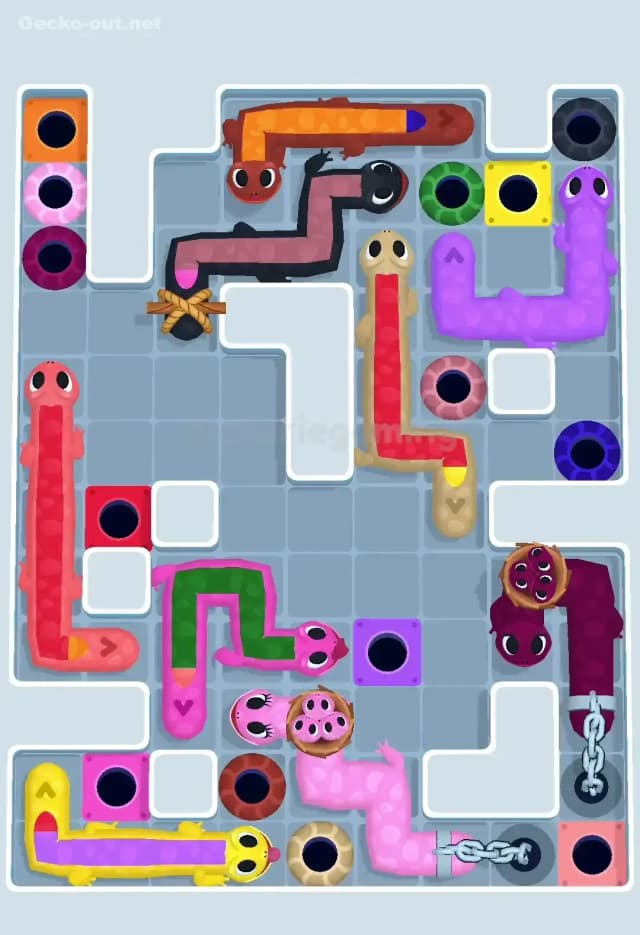
Gecko Out Level 636 throws you into a densely packed grid where every square inch matters. You're managing multiple geckos of different colors—orange, pink, purple, green, yellow, and red—each needing to reach their matching exit hole. The board features several brown nest obstacles that restrict movement paths, creating natural choke points throughout the puzzle. What makes Gecko Out Level 636 particularly challenging is the sheer number of geckos crammed into overlapping zones, forcing you to think several moves ahead before dragging any single head.
The visual chaos can be overwhelming at first glance. Long gecko bodies snake through the middle sections, while shorter geckos huddle near the edges. Some geckos are positioned in what I call "nested" configurations—where one gecko's body literally boxes in another gecko's head. You'll also notice several chain-linked obstacles that prevent certain paths from being viable until you've cleared adjacent geckos first.
The Win Condition and Movement Mechanics
To beat Gecko Out Level 636, you need to evacuate every gecko to its color-matched exit before the timer expires. The drag-path mechanic is crucial here: when you pull a gecko's head toward its exit, the entire body follows that exact route. This means you can't just think about endpoints—you must visualize the full path trajectory, accounting for every turn and twist. One careless diagonal drag can cause a gecko's body to clip through occupied spaces, blocking critical corridors for the remaining geckos.
The timer adds relentless pressure to Gecko Out Level 636. Unlike easier levels where you can experiment freely, here you need a coherent strategy from move one. Random dragging will tangle the board into an unsolvable state within seconds. The challenge isn't just solving the spatial puzzle—it's executing the solution fast enough that you don't run out of time halfway through.
Pathing Bottlenecks and Logical Traps in Gecko Out Level 636
The Central Corridor Bottleneck
The biggest chokepoint in Gecko Out Level 636 sits right in the center of the board, where multiple gecko paths must cross through a narrow L-shaped corridor. This zone acts as a highway intersection—if you send geckos through in the wrong order, their bodies will crisscross and lock the entire board. I've seen players lose here repeatedly because they evacuate perimeter geckos first, which sends long bodies snaking through the center at angles that permanently block the remaining exits.
The purple gecko positioned near the top-right quadrant is particularly problematic. Its exit hole is accessible, but the natural path cuts directly across two other geckos' escape routes. If you move purple too early, you'll create a body barrier that makes the red and orange geckos nearly impossible to extract later.
Subtle Problem Zones That Ruin Runs
Beyond the central bottleneck, Gecko Out Level 636 has three sneaky traps. First, the lower-left corner features a cluster of short geckos near white obstacle blocks. It's tempting to clear this area first since the paths look simple, but doing so often positions gecko bodies in ways that block the long green gecko's path later. Second, the pink geckos scattered around the board create a false sense of easy targets—they're short and numerous, but evacuating them randomly leaves their body segments littering the board like landmines.
Third, there's a deceptive gap near the right edge where it looks like you have room to maneuver geckos temporarily. In reality, that space becomes a dead-end parking lot. If you move geckos there "just to get them out of the way," you'll spend precious seconds reversing those moves when you realize they're now stuck behind newly positioned gecko bodies.
The Moment It Finally Clicked
Honestly, Gecko Out Level 636 frustrated me for a solid fifteen attempts. I kept running into situations where I'd successfully evacuate eight geckos, only to discover the last two were physically impossible to reach because of how earlier body paths had settled. The breakthrough came when I stopped thinking about "which gecko is easiest to move first" and started asking "which gecko's body will cause the least interference if I move it now?" That shift from opportunistic thinking to consequence-based planning transformed Gecko Out Level 636 from impossible to manageable.
Turn-by-Turn Path Strategy to Beat Gecko Out Level 636
Opening Moves and Parking Strategy
Start Gecko Out Level 636 by identifying geckos whose exits are on the outer perimeter with clear, non-intersecting paths. Your first move should target one of the green geckos positioned near the top-right—specifically, the one whose exit is in the upper-right corner cluster. Drag its head straight to the exit using the shortest possible path that hugs the right edge. This clears a crucial lane without sending the body through contested territory.
Next, focus on the yellow gecko in the bottom-left area. Its exit is nearby, and evacuating it early removes a body that would otherwise complicate later moves. The key is dragging it along the left wall, not through the center. When you're "parking" geckos temporarily (positioning them to create space without exiting yet), use the corner zones—but only if those corners are near that gecko's eventual exit. Never park geckos in the center; that's prime real estate you'll need for crossing paths.
Mid-Game Path Management
Once you've cleared two or three perimeter geckos, Gecko Out Level 636 opens up slightly. Now tackle the pink geckos, but in a specific order: shortest bodies first, prioritizing those whose exits are already accessible without crossing the center. As you move each pink gecko, watch where its body settles. If a body segment lands in a crossing lane, immediately evaluate whether you need to adjust your planned order for the remaining geckos.
The orange gecko near the top becomes critical mid-game. Its path to the exit requires threading through the central corridor, so you need to clear that corridor first. Before moving orange, ensure at least one of the long-bodied geckos (like the extended green or purple ones) has been evacuated or repositioned. If you try to move orange while those long bodies are still coiled in the center, you'll create an impossible knot.
This is also when the timer starts biting. You should be roughly halfway through the gecko count with about 40-50% of your time remaining. If you're significantly behind that pace, you may need to take a calculated risk—evacuate a gecko using a slightly suboptimal path just to maintain momentum.
End-Game Exit Sequencing
The final four or five geckos in Gecko Out Level 636 require surgical precision. By this point, the board should be relatively clear, but the remaining paths will intersect at critical junctions. I recommend saving one of the purple geckos for near-last because its exit is centrally located and its body is short—giving you maximum flexibility if you need to make last-second adjustments.
The very last gecko should be one positioned near its exit with a straight, unobstructed final path. This is your safety valve. If you're down to five seconds, you need that gecko to be a one-motion drag with zero chance of pathing errors. Often, this will be a small pink or a favorably positioned yellow gecko.
If you're low on time with two geckos remaining, resist the urge to rush. A failed attempt from careless dragging wastes more time than pausing for two seconds to visualize the path. Drag deliberately, confirm the path preview is clear, then commit.
Why This Path Order Works in Gecko Out Level 636
Exploiting Body-Follow Mechanics
The strategy above succeeds because it respects how Gecko Out Level 636's drag-path system actually functions. When you move a gecko, its body doesn't teleport—it unspools along your drag trajectory. By clearing perimeter geckos first, you're essentially "deflating" the board from the outside in, reducing body density in contested zones before you attempt complex central maneuvers.
This approach also minimizes path intersections. Every time two gecko bodies cross, you create a potential deadlock point. The turn order I've outlined sequences moves so that when paths must cross, they do so with bodies already evacuated (and thus no longer occupying space). You're using the body-follow rule as a clearance mechanism rather than fighting against it.
Timer Management Philosophy
Gecko Out Level 636 gives you enough time to succeed, but not enough to experiment. The strategy balances speed with precision by front-loading simpler moves. Those first few perimeter evacuations are fast and low-risk, building momentum and confidence. You're essentially banking time during the easy phase to spend it carefully during the complex mid-game knot.
Pausing to read the board is legitimate strategy, not hesitation. I take micro-pauses before each of the middle five or six moves—just one or two seconds to trace the drag path mentally and confirm no collisions. These pauses cost maybe ten seconds total but prevent thirty-second backtracking disasters.
Booster Recommendations
For Gecko Out Level 636, boosters are optional if you execute the strategy correctly, but they're excellent insurance. The extra time booster is most valuable—activate it around the mid-game point (when you've cleared about half the geckos) to relieve timer pressure during the complex central evacuations. The hammer tool can remove a brown nest obstacle if you find yourself with an impossible path, though the level is solvable without destroying any obstacles.
I don't recommend using the hint booster here. Gecko Out Level 636's solution requires understanding the full sequence, not just the next single move. Hints show you one gecko's path but don't explain why that move must happen now versus later. If you're stuck, it's better to reset and try a different opening sequence than to spend hints on moves that might not fit your overall strategy.
Mistakes, Fixes, and Logic You Can Reuse in Other Gecko Out Levels
Common Errors and How to Fix Them
First mistake: evacuating the longest gecko first because "it'll be hardest to move later." In Gecko Out Level 636, long geckos are actually easier to manage mid-game when the board is partially cleared. Moving them first drapes their bodies across the entire board, blocking everything. Fix this by targeting short perimeter geckos in your opening moves.
Second mistake: using the center of the board as temporary storage. Players see empty squares in the middle and think "I'll just move this gecko here to get it out of the corner." Then that gecko's body creates a wall through the center. The fix: only reposition geckos toward their exits, never perpendicular to them.
Third mistake: panic-dragging when the timer is low. I've lost Gecko Out Level 636 more times to misclicks under pressure than to actual strategy failures. The fix is counterintuitive—when you're down to fifteen seconds, slow down slightly. One accurate drag beats three frantic attempts.
Fourth mistake: ignoring body segment positions after each move. After evacuating a gecko, immediately look at where its path cut through the board. If it blocked something critical, undo it (if time permits) or adjust your next two moves to work around that new obstacle. The fix is treating each move as setting up the next move, not as an isolated action.
Fifth mistake: assuming all geckos of the same color have equal priority. In Gecko Out Level 636, some pink geckos are positioned perfectly for early evacuation, while others should wait. The fix: prioritize by path simplicity and body length, not by color matching.
Applying This Logic to Similar Levels
The strategic principles from Gecko Out Level 636 transfer beautifully to other high-difficulty stages. Any level with dense gecko populations benefits from the "deflate from outside-in" approach. When you encounter levels with gang-linked geckos (where two geckos move together), apply the same sequencing logic but treat the linked pair as a single long-bodied unit.
For levels with frozen exits, adapt the strategy by mentally removing those exits from your first-pass planning—evacuate other geckos first, then address the frozen ones only after using a booster or waiting for the ice to clear. The core logic of "which move creates the least interference" still applies universally.
Final Encouragement
Gecko Out Level 636 absolutely deserves its reputation as a tough puzzle, but it's not luck-based. Every failed attempt teaches you something about path interference patterns. Most players beat it within ten to fifteen attempts once they grasp the sequencing principles. The level rewards patience and visualization over raw speed. You've got this—just remember that every gecko you evacuate makes the next one easier, and the strategy above gives you a proven roadmap from chaos to that satisfying final exit.