Gecko Out Level 150 Solution Walkthrough | Gecko Out 150 Answer
How to solve Gecko Out level 150? Get step by step solution & cheat for Gecko Out level 150. Solve Gecko Out 150 easily with the answers & video walkthrough.
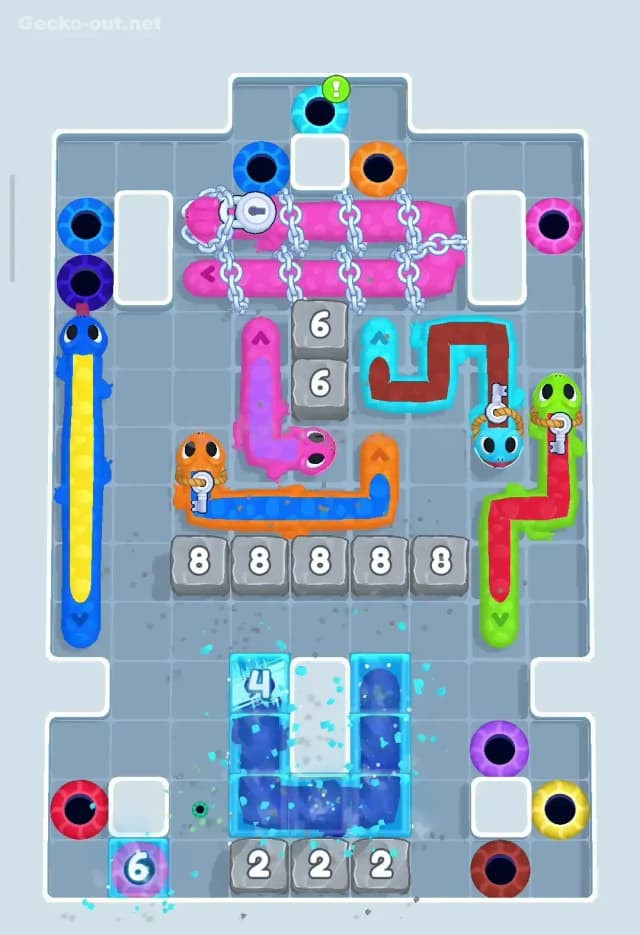
Gecko Out Level 150: Board Layout, Rules, and Win Condition
Starting board: chained lanes and a frozen U
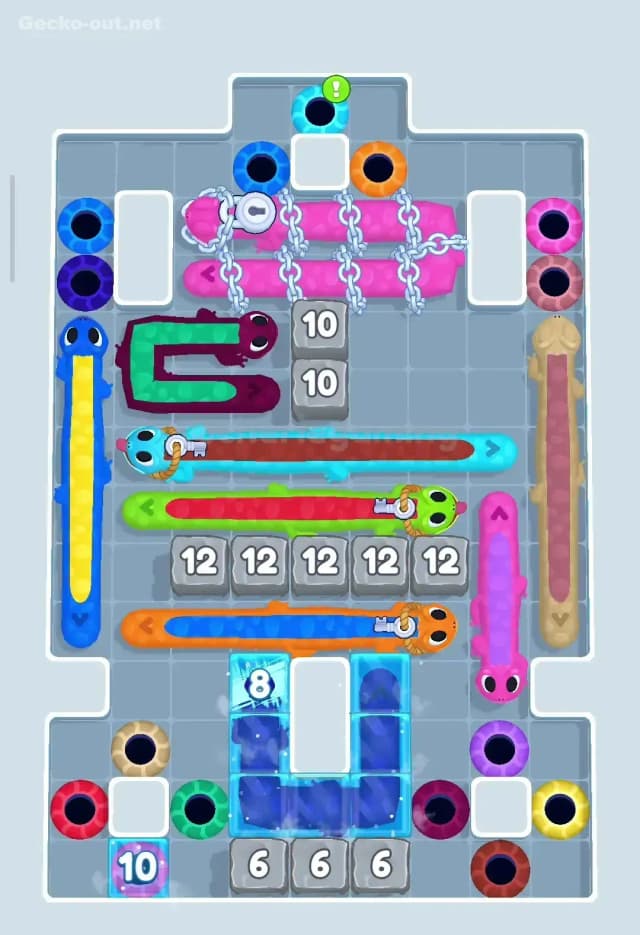
When Gecko Out Level 150 loads, you’re dropped into a very cramped board. Most of the tiles are already filled with long bodies, countdown blocks, or frozen sections, so it looks “solved but wrong” from the start.
Here’s what you’re dealing with:
- A tall blue gecko runs straight up the left side.
- In the upper‑middle you’ve got a short maroon/green “gang” gecko pair wrapped into a C‑shape in front of a pair of
10blocks. - Across the central lanes sit three long horizontal geckos with ropes on their heads. Their bodies sit just above or on top of
12countdown blocks. - On the right, a long vertical pink gecko and a long tan gecko share a tight side corridor with exits stacked around them.
- At the very bottom there’s a blue gecko frozen into a U‑shaped ice channel with an
8counter on it, plus a line of6blocks in front. - The top row has several exits blocked by a set of chained pink “gang” segments; these don’t move until you unlock them.
So Gecko Out 150 isn’t about finding space; it’s about reusing the same two or three lanes in a better order without letting the countdown tiles or chains ruin your plan.
Win condition, timer, and drag-path movement
As always, the win condition in Gecko Out Level 150 is simple: every gecko must slither into a hole of the same color before the level timer hits zero. The execution, of course, is the painful part.
Two things make this level feel harsher than usual:
- Strict timer plus long bodies. Every gecko is huge. If you draw slow, windy paths, you chew through the global timer and the local countdown numbers (
6,8,10,12) at the same time. - Body-follow pathing. Whatever route you drag the head, the body traces exactly. If you lazily snake a gecko around a corner “just for now,” you’re very likely building a knot that blocks exits later.
Gecko Out 150 is all about efficient, straight paths and planning where bodies will lie before you touch a head.
Pathing Bottlenecks and Logical Traps in Gecko Out Level 150
The main bottleneck corridor
The single biggest bottleneck is the central horizontal lane with the 12‑countdown blocks. The red‑topped geckos that start here are effectively sitting in the only real freeway of the board.
If you drag those middle geckos out in the wrong direction, their bodies sprawl over the 12 tiles and the approach to multiple exits, blocking:
- The vertical pink gecko’s way out.
- Access around the right‑side tan gecko.
- Room for the frozen bottom gecko once the
8melts.
The trick is to treat that center like a shared hallway: each gecko uses it once, in a controlled, mostly straight line, then leaves it empty for the next one.
Subtle traps most people miss
A few smaller problem spots consistently punish rushed play in Gecko Out Level 150:
- The maroon/green gang pair over the 10‑blocks. If you slide this gang gecko too early, you may lock their bodies over the
10tiles. When those change state, the pair can’t return to a clean parking spot and you lose the flexibility you need for the end‑game exits. - The left vertical blue gecko. It looks “free,” so it’s tempting to send it straight to its hole. But its long body can either:
- Block the bottom ice section from ever joining the main lanes, or
- Cover a key approach lane you’ll need for the roped middle geckos.
- The frozen U at the bottom. Because it’s frozen, a lot of players ignore it until the very end. By then, the
6countdown tiles in front have changed, and the only safe paths force you to rethread half the board under heavy time pressure.
Each of these is fixable if you mentally reserve lanes before you move anything.
When Gecko Out 150 “clicks”
I’ll be honest: the first few runs feel awful. It’s that classic “I got 80% of them out and now everything’s jammed” vibe.
The moment Gecko Out Level 150 started to make sense for me was when I stopped treating each gecko as an isolated problem and instead decided:
- Which two lanes I’d keep clear at all times, and
- Which three geckos would leave first, specifically to unlock chains and frozen exits for the others.
Once you think of it as orchestrating traffic rather than solving little snake puzzles, the level drops from “impossible” to “tight but manageable.”
Turn-by-Turn Path Strategy to Beat Gecko Out Level 150
Opening: create space and prep the timers
In the opening of Gecko Out 150, you’re not trying to exit anyone yet; you’re just carving safe parking spots.
- Nudge the left vertical blue gecko just enough to free a tile or two near its head, then park it along the outer wall so its body is straight and not blocking the bottom.
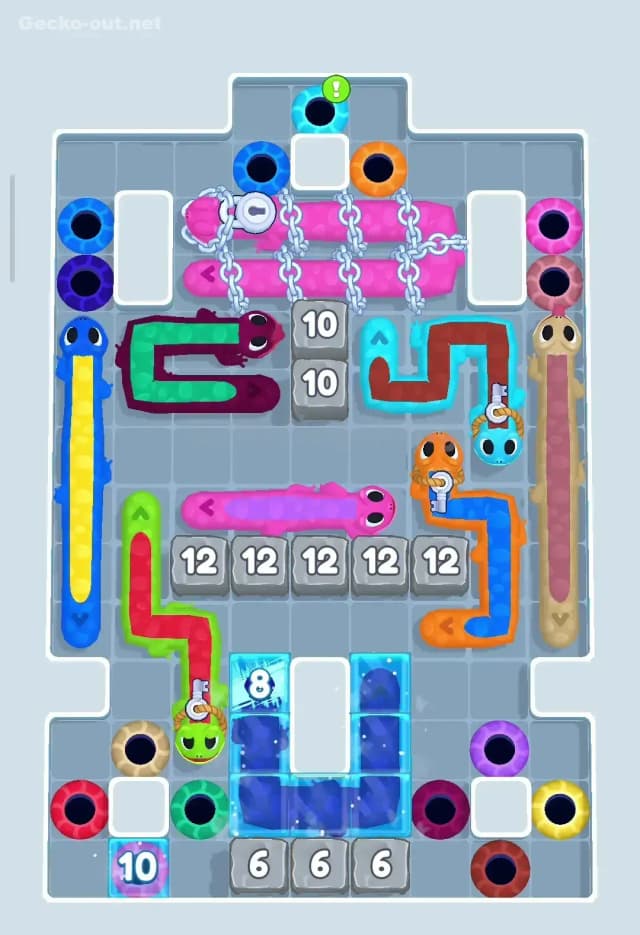
- Shift the central horizontal red/blue gecko (the one closest to the middle) in a short, clean path so its body ends up hugging the bottom edge of its row, leaving the
12blocks mostly visible. Don’t cross multiple countdown tiles if you don’t have to. - Do the same with the green‑headed horizontal gecko just below: slide it slightly, then park its body tight against the opposite side of the row. Your goal is to create a central “lane” that other heads can later traverse.
- While those moves tick, keep an eye on the
8-frozen U at the bottom. You want its thaw to sync with the moment the6blocks are still usable but not about to flip.
If you do this right, you end the opening with:
- Central lanes mostly clear.
- No body lying permanently across the numbered tiles.
- Enough turns burned that the frozen gecko is nearly ready to move.
Mid-game: unlock chains and rotate the long bodies
Now Gecko Out Level 150 opens up.
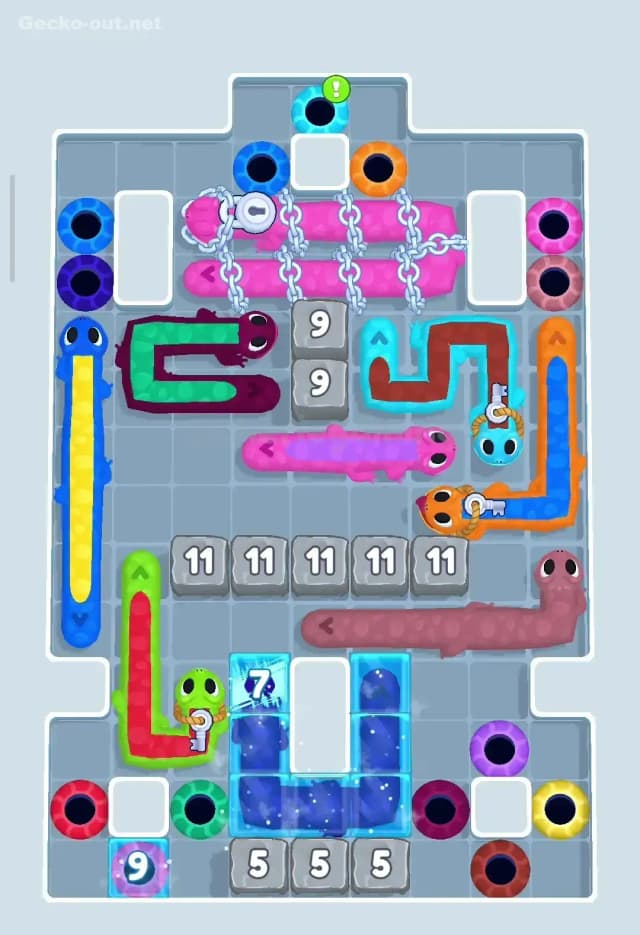
- Unfreeze and route the bottom U gecko as soon as the
8hits a safe value. Pull it out of the U in a tight loop, send it over the6tiles in one clean pass, and either:- Exit it immediately if its hole is nearby, or
- Park its body in an unused side pocket, out of the central lane.
- Use your roped middle geckos to grab keys/unlocks. Typically, one or two of them need to pass specific tiles to:
- Release the chained pink gang line at the top, and/or
- Unlock a frozen or locked exit on the right. Take them one at a time through the middle lane so their bodies don’t cross each other. Straight lines, minimal zigzags.
- Rotate the right‑side verticals. Once you’ve got some chain or exit unlocked:
- Slide the tan vertical gecko first, getting it to its exit while the path is less cluttered.
- Then reposition the long pink vertical gecko so it can later reach its matching top‑right exit once the pink gang barrier is out of the way.
During this phase, think of the center as a conveyor belt: each gecko takes a single ride, then leaves the area forever.
End-game: exit order and avoiding last-second jams
End‑game in Gecko Out 150 is where good runs die, so stick to a clean exit order.
- Clear the central horizontals first. Once they’ve grabbed any necessary keys/unlocks, send the remaining red/blue and red/green geckos out. Make sure their bodies don’t sweep across exits reserved for others.
- Resolve the maroon/green gang pair over the 10s. With the middle clear, unwrap this pair carefully so their bodies travel through the freed lanes and then straight into their holes. Avoid leaving them coiled around the
10tiles. - Finish with the tall verticals and top exits.
- Exit the left blue gecko once its path no longer interferes with the bottom.
- Then take the long pink vertical to its now‑unblocked pink hole.
- Use any remaining free tiles to route the final stragglers to their color‑matched exits.
Low on time? Prioritize the longest remaining bodies first; short ones can be snapped to their exits with small, direct paths in the final seconds.
Why This Path Order Works in Gecko Out Level 150
Using body-follow pathing to loosen the knot
The recommended path order in Gecko Out Level 150 works because every early move creates long, straight bodies that line the walls instead of crisscrossing the board.
- By parking early geckos along edges, you free the middle for high‑traffic routes.
- You only send a gecko through the central lane once, in a deliberate direction, so you never have to “weave back” through your own tangle.
- Unlocks and chains are triggered by geckos that were already blocking key areas, so solving one problem naturally solves the next.
Instead of tightening the knot with spirals, you’re systematically pulling threads out to the edges.
Managing the level timer
For Gecko Out 150, think of time management in two phases:
- Planning phase (first few seconds): Pause, trace with your finger or eyes how each long gecko could exit if the lane in front of it were clear. Decide where you’ll park 2–3 of them. This mental step saves more time than it costs.
- Execution phase: Once you start dragging, commit. No decorative loops, no “just for now” detours. If a path doesn’t progress toward an exit or a key, don’t draw it.
Most failures come from redrawing paths three or four times. One clean route per gecko is enough to beat the timer on Gecko Out Level 150.
Boosters: optional, but here’s where they help
You can absolutely beat Gecko Out Level 150 without boosters, but they’re nice safety nets:
- Extra time: Best saved for the end‑game if you see you’ve got 2 long geckos left and a nearly solved board.
- Hammer / remove‑tile tool: If available, using it on a particularly nasty countdown tile in the middle can simplify the routing, but it’s overkill if you follow the lane plan.
- Hint: If you’re stuck on which gecko to move first, one hint early on can show you the intended opener without spoiling the whole solution.
I’d treat boosters as backup, not plan A. If you rely on them, the same logic problems will hit you in later levels.
Mistakes, Fixes, and Logic You Can Reuse in Other Gecko Out Levels
Common mistakes in Gecko Out 150 and how to fix them
-
Exiting the left blue gecko immediately.
Fix: Nudge it into a wall‑hugging park first so its body doesn’t block the bottom and center lanes. -
Dragging middle geckos in big curves.
Fix: Force yourself to draw mostly straight, 90‑degree turns only when absolutely needed. Treat countdown rows as one‑time highways. -
Ignoring the frozen U until the end.
Fix: Time your early moves so you free the frozen gecko as soon as it’s legal and send it over the6tiles before they become awkward or unsafe. -
Unwrapping the maroon/green gang pair too early.
Fix: Leave that pair until the central lanes are empty. They’re easier to untangle when nothing else is in their way. -
Panicking when the timer turns red.
Fix: In Gecko Out Level 150, a red timer doesn’t mean “spam moves.” Stick with straight, pre‑planned paths; wild dragging usually creates jams you can’t undo in time.
Reusing this logic in other knot-heavy levels
The habits you build on Gecko Out 150 apply everywhere:
- Always identify the one or two critical lanes and protect them.
- Park early geckos along outer walls in straight lines.
- Handle frozen or chained pieces at moments when the board around them is as empty as possible.
- Treat countdown tiles as bridges: cross them once with purpose, don’t camp on them.
On future gang‑gecko or frozen‑exit stages, the same “lane ownership” approach makes huge, messy boards feel much more controlled.
Final encouragement
Gecko Out Level 150 looks brutal, and it’s meant to; the whole board starts in a knot. But once you decide which lanes belong to which geckos and stick to a simple path order, the chaos turns into a clear sequence of moves.
Take a moment to plan, keep your lines straight, and don’t be afraid to restart a couple of times while you internalize the lane pattern. With that mindset, Gecko Out 150 is tough, but absolutely beatable.