Gecko Out Level 721 Solution Walkthrough | Gecko Out 721 Answer
How to solve Gecko Out level 721? Get step by step solution & cheat for Gecko Out level 721. Solve Gecko Out 721 easily with the answers & video walkthrough.
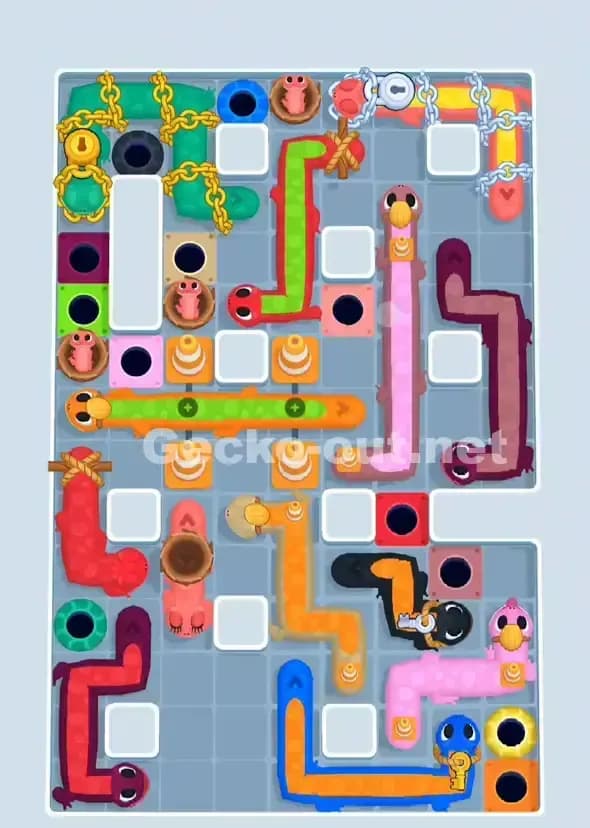
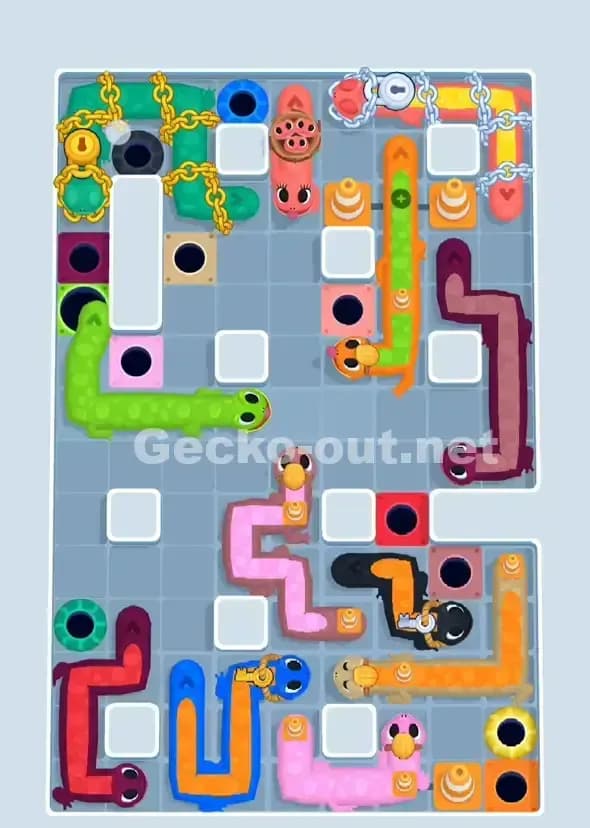
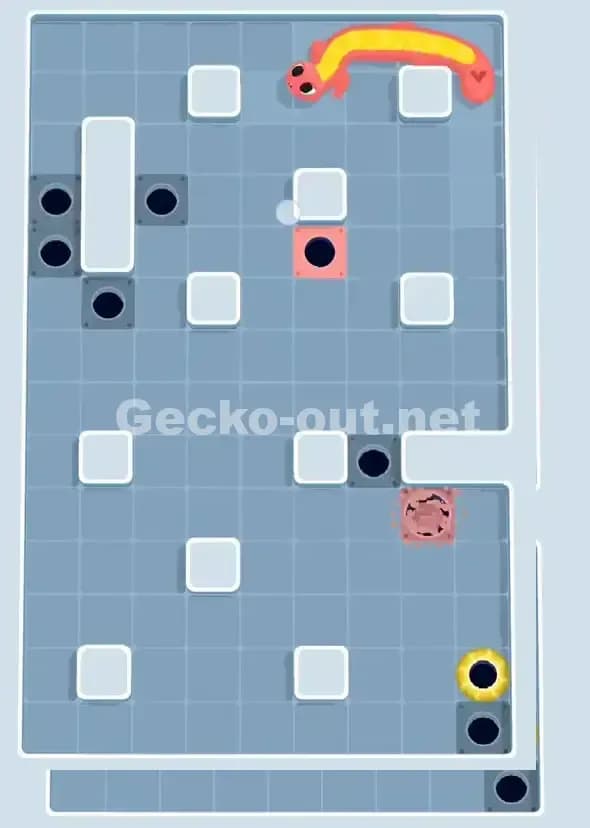
Gecko Out Level 721: Board Layout, Rules, and Win Condition
The Starting Board and Gecko Setup
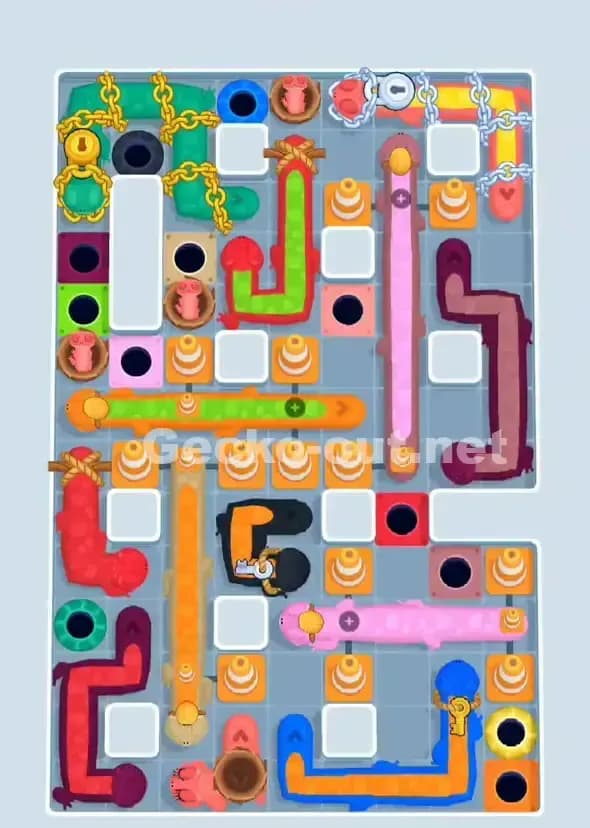
Gecko Out Level 721 is a complex, multi-colored puzzle that demands precision and careful planning. You'll encounter six geckos spread across the board in various colors—reds, blues, greens, pinks, and oranges—each needing to reach their matching colored exit hole. The board itself is packed with obstacles: multiple white "wall" squares that form tight corridors, chain-link barriers in the upper left that create a locked zone, and numerous toll gates (those distinctive orange rings) scattered throughout the middle and lower sections. There's also a substantial frozen pink path on the right side and several red gang-gecko formations that are physically linked together, meaning they move as a unit and can't be separated. The layout feels almost like a metal puzzle game compressed into a grid—every millimeter counts.
The Win Condition and Time Pressure
Your mission is straightforward: drag each gecko's head along a safe path to guide its body into the matching exit hole before the timer runs out. All six geckos must be safely out, or you fail the entire level. The timer in Gecko Out Level 721 is generous enough to allow for careful planning, but it's tight enough that you can't afford long pauses or path-drawing mistakes. Every incorrect drag costs you time to undo and restart, and the narrow corridors mean that if one gecko blocks a critical route, the others get trapped waiting for you to backtrack and reposition. This is where the true challenge lies: not just solving the puzzle, but solving it in the right sequence so nobody becomes an accidental roadblock.
Pathing Bottlenecks and Logical Traps in Gecko Out Level 721
The Central Corridor Choke Point
The biggest bottleneck in Gecko Out Level 721 is undoubtedly the narrow vertical corridor that runs through the center-left of the board. Multiple geckos need to pass through or around this passage, but its width is barely two squares in places, and it's bordered by walls and locked zones on both sides. If you send a long gecko through first without thinking, you'll trap shorter geckos behind it, and backtracking becomes a nightmare. The red gang-gecko formation is a particular culprit here because it's physically long and rigid—it must be routed carefully or it will jam the entire puzzle. I'd recommend identifying an alternative route for at least one gecko before you commit to moving the gang unit through the center, otherwise you'll find yourself redrawing paths frantically as the clock ticks down.
Hidden Problem Spots That Catch New Players
The frozen pink path on the right side of Gecko Out Level 721 looks inviting as a shortcut, but don't be fooled: it's locked, which means certain colored geckos can't use it as an exit route and can't even traverse it safely if their color doesn't match. Many players try to drag a gecko through that frozen section only to hit an invisible wall and waste precious seconds. Additionally, the chain-linked area in the upper left creates a perception problem—it looks like a maze when it's actually a dead zone that only specific geckos can exit from, and only if you route them through the correct unlocking sequence. Finally, the toll gates aren't just decorative: each one consumes movement time and requires a gecko to pass through rather than around it, so plotting a path that avoids unnecessary tolls is essential. I'd say the first time I tackled Gecko Out Level 721, I got hung up on these three spots for a solid three minutes before I realized the solution wasn't "find the fastest route"—it was "find the sequence that keeps everyone from getting stuck."
The Frustration-to-Solution Moment
Honestly, Gecko Out Level 721 feels overwhelming at first glance. There are so many geckos, so many obstacles, and the timer creates this background anxiety that makes you want to rush. But then it clicks: you realize that the "locked" areas and frozen paths aren't tricks meant to block you—they're actually instructions telling you which gecko to move first and which to save for last. Once I accepted that the level itself was teaching me the right order, everything fell into place, and I went from frustrated to confident in about two attempts.
Turn-by-Turn Path Strategy to Beat Gecko Out Level 721
Opening: Secure the Red Gang-Gecko First
Start by routing the red gang-gecko unit. Don't overthink this—the red exit is in the lower-left corner, and despite the gang's length and rigidity, there's a clear L-shaped path that gets it there without blocking anyone else. Drag the head from its starting position downward along the left edge, then curve it around toward the exit hole. This accomplishes two things: it removes the longest, most restrictive gecko from the board and clears the center corridor for smaller, more maneuverable geckos. Park the red gang so its body doesn't extend into high-traffic zones.
Next, tackle the blue gecko. It's relatively isolated in the lower-middle area, and its exit is nearby. Route it quickly and without fanfare—this is your "warm-up" gecko that builds confidence and opens up space on the board. By the time you've moved red and blue, you've freed up approximately a third of the board's walking space, and the remaining four geckos suddenly feel less claustrophobic.
Mid-Game: Manage the Frozen Pink Path and Use Toll Gates Strategically
Now comes the delicate part. The pink gecko needs to navigate that frozen pink path on the right side, but only if your color alignment is correct—and it is. Drag the pink gecko's head rightward, but don't rush it through the frozen zone. Instead, move it in small increments to ensure its body doesn't accidentally overlap with walls or other geckos that might still be in mid-transit. The toll gates in this section aren't optional, so factor in their animation time.
For the orange geckos, identify which one is closest to its exit and route it next. In Gecko Out Level 721, there are multiple orange exits, so you have flexibility in which gecko uses which hole. Use this to your advantage: if one orange gecko has a cleaner path than another, send that one first and leave the longer route for when the board has more open space. The green gecko should come fourth, using the lower-left after the red gang has vacated that area completely.
End-Game: The Final Two Geckos Without Last-Second Collisions
You're down to the last two—likely a combination of remaining orange, green, or any gecko you've held back. At this point, the board is mostly clear, but don't let that fool you into thinking it's easy. The remaining corridors are now highway routes, and if both geckos are moving simultaneously (which they aren't—you can only drag one at a time), their paths might intersect. Plan the second-to-last gecko's route to snake around the final gecko's position, avoiding any crossing. If time is low—say, 10 seconds or fewer remain—commit to dragging in smooth, confident motions rather than hesitating. Hesitation costs more time than a slightly suboptimal path.
Why This Path Order Works in Gecko Out Level 721
Head-Drag Pathing and the Body-Follow Mechanism
The genius of Gecko Out Level 721 is that it respects the body-follow rule: once you drag a gecko's head, its body is locked into that exact path, unable to deviate. This means you can "plan ahead" by visualizing where each body segment will occupy space even after the head reaches the exit. By moving the longest, most spatially demanding gecko first (the red gang), you eliminate the entity most likely to become an accidental trap. Subsequent geckos can navigate around the "dead" body segments of already-exited geckos without worry, since those spaces are now just static terrain. This order—longest to shortest, or most constrained to least constrained—is a universal principle that works on similar levels across the game.
Timing: Pause for Strategy, Then Execute with Speed
Gecko Out Level 721 gives you about 90–120 seconds (the exact timer depends on your game version), which is plenty of time if you spend the first 20 seconds planning your four main routes and the final two geckos' paths as backup. Use the pause feature to draw imaginary lines on the board: one for red, one for blue, one for pink, one for orange. Once you've committed that plan to memory, stop pausing and execute. Dragging geckos in the intended sequence takes about 60–70 seconds, leaving a comfortable 20–30 second buffer for corrections or a failed drag that you need to undo. If you're pausing constantly to rethink, you'll lose this buffer and find yourself in a time crunch on the final gecko.
Boosters: Optional but Helpful if Stuck
Gecko Out Level 721 doesn't strictly require boosters like extra time or hints. However, if you've made a mistake and a gecko is partially stuck in a non-optimal position with limited time left, an extra-time booster (usually offering +15 or +30 seconds) can be a lifesaver. A hammer tool, if available, can destroy a single obstacle (like a problematic toll gate) and simplify a route. I'd recommend attempting Gecko Out Level 721 without boosters first—the satisfaction of solving it on your own is worth it—but keep them in your back pocket for your third or fourth attempt if you're still struggling. Don't waste a booster on your first try; use it strategically when you've identified the exact moment that extra time would've been decisive.
Mistakes, Fixes, and Logic You Can Reuse in Other Gecko Out Levels
Common Mistakes on Gecko Out Level 721 and How to Avoid Them
Mistake 1: Routing the Gang-Gecko Last — Many players assume smaller geckos are "easier" and save the gang unit for the end. This is backwards. Move it first, always, because it's the biggest spatial risk. Fix: Create a rule for yourself: whenever you see a gang-gecko or extra-long gecko, treat it as your opening move, not your closing move.
Mistake 2: Ignoring Frozen Paths — Players often try to drag geckos through frozen sections without checking if the gecko's color matches the path's color. Fix: Before dragging, trace a mental path using only non-frozen squares. If you need a frozen path, verify the color alignment first.
Mistake 3: Overlapping Toll Gates — Sending two geckos through the same toll gate in quick succession can cause timing issues where they collide or jam. Fix: Use different toll gates for different geckos when possible, or ensure enough time has elapsed for one gecko's body to fully clear the gate before dragging another gecko into it.
Mistake 4: Not Visualizing Body Positions — Players drag a gecko's head without thinking about where its trailing body segments will end up, creating accidental blockages for the next gecko. Fix: After each drag, pause for 2–3 seconds and look at where the exited gecko's body would have been. Mentally plan the next gecko's path around that invisible obstacle.
Mistake 5: Panicking in the Final 15 Seconds — Time pressure causes sloppy drags, and sloppy drags require do-overs. Fix: Practice the level at least twice without attempting to beat the timer. The third attempt, you'll move faster naturally because you've internalized the routes.
Reusable Principles for Similar Levels
Gecko Out Level 721 embodies three universal puzzle-design principles you'll encounter on other gang-gecko or frozen-exit levels:
-
Constraint-First Ordering — Always prioritize moving the most constrained or longest entity first. This principle applies to any level with multiple geckos of varying lengths or with zone-restricted geckos (those that can only exit from one specific area).
-
Color-Matching Verification — Whenever a level features frozen paths, locked exits, or toll gates, visually verify that each gecko's color aligns with its intended route. This simple double-check prevents the majority of end-game failures on levels like Gecko Out Level 721.
-
Buffer Time Planning — Allocate the first 20–25% of your timer to planning and the remaining 75–80% to execution. This ratio works on nearly every Gecko Out level with three or more geckos, regardless of complexity.
Final Encouragement
Gecko Out Level 721 is genuinely one of the trickier levels you'll encounter, but it's absolutely beatable with patience and a clear head. The board looks chaotic, but its structure is logical, and once you understand the bottleneck and the chain of exits, you'll find that the solution is elegant. You've got this—take a breath, plan your four main routes, move the red gang first, and watch the rest fall into place. Every player who's conquered Gecko Out Level 721 has walked this same path, and so can you.