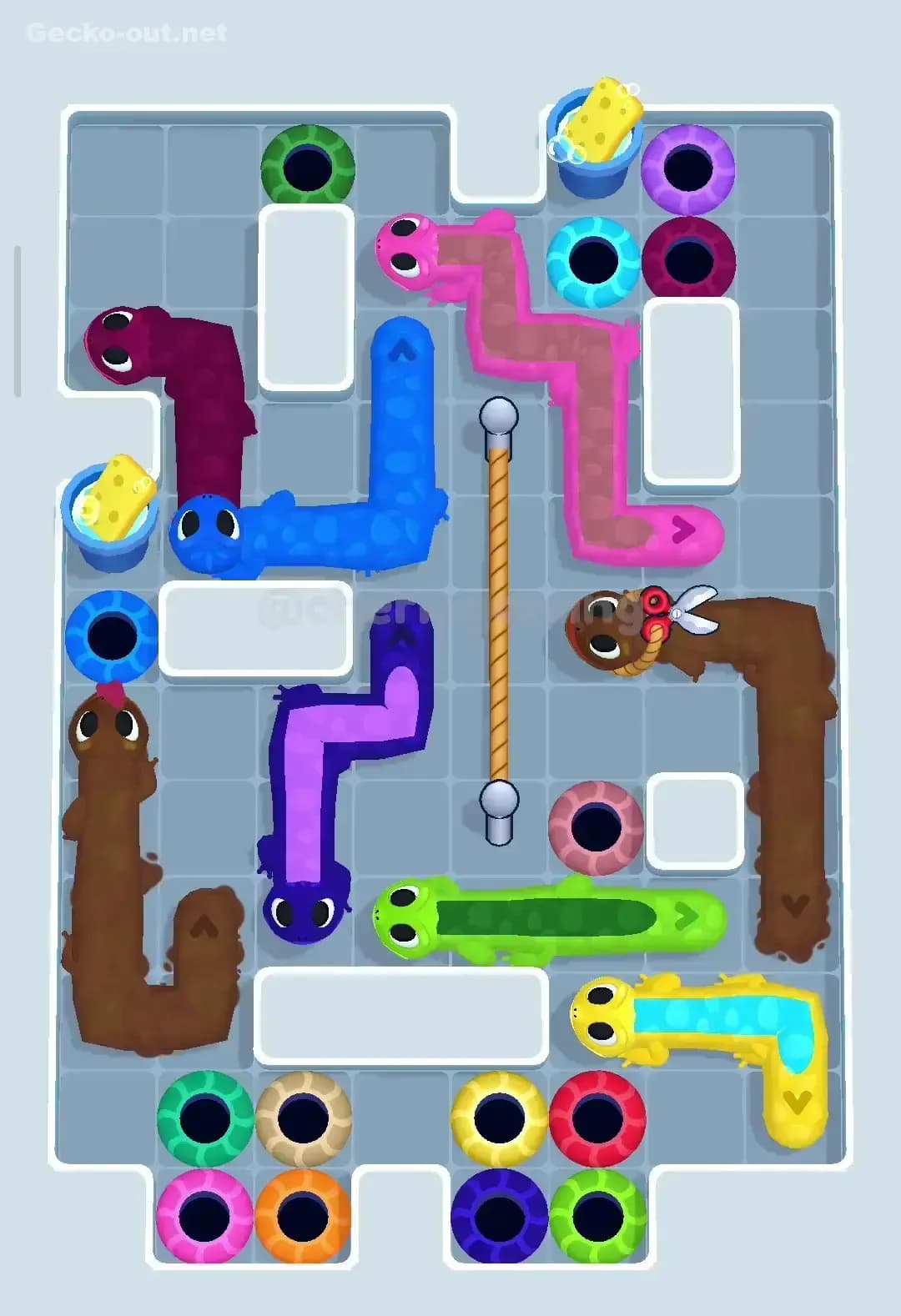
Gecko Out Level 255 Solution Walkthrough | Gecko Out 255 Answer
How to solve Gecko Out level 255? Get step by step solution & cheat for Gecko Out level 255. Solve Gecko Out 255 easily with the answers & video walkthrough.
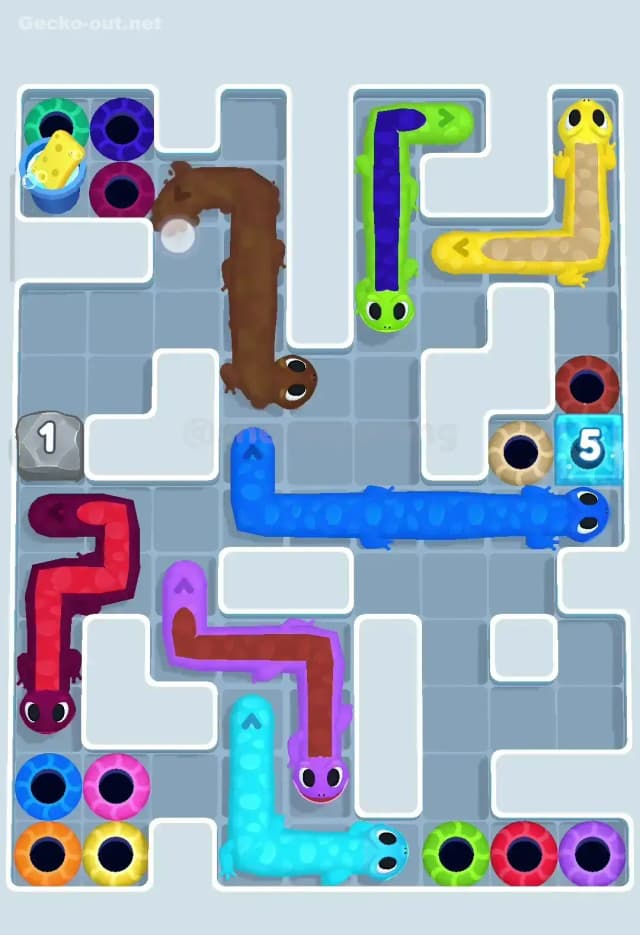
Gecko Out Level 255: Board Layout, Rules, and Win Condition
Starting Board: Geckos, Colors, and Obstacles
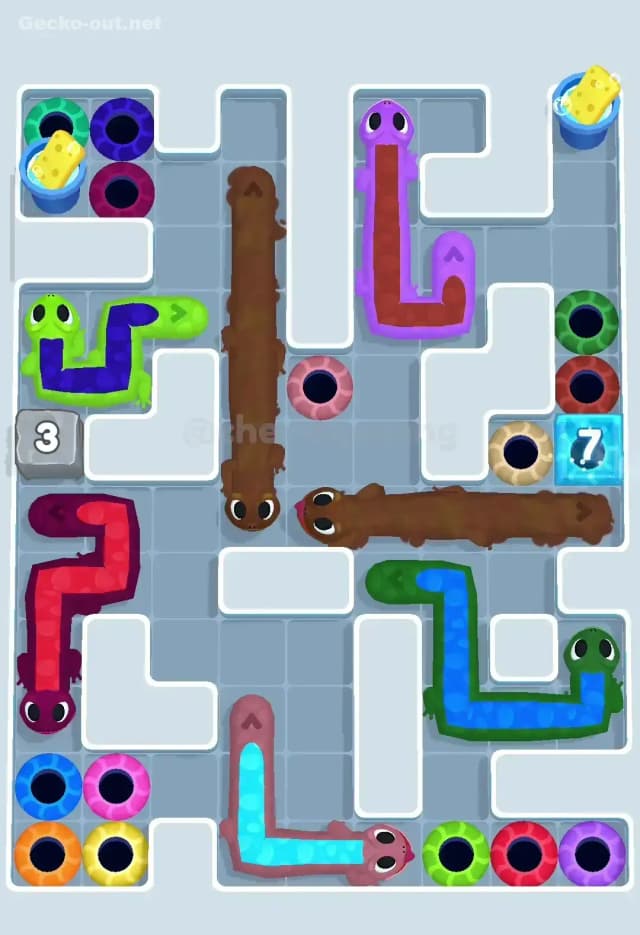
In Gecko Out Level 255 you’re dropped into a very cramped maze with a lot going on at once. You’ve got several single geckos in bright colors (green, blue, cyan, red, purple) plus a “gang” of two extra‑long brown geckos stretched across the middle of the board. Those two browns form a giant T in the center and immediately feel like a traffic jam waiting to happen.
The exits are grouped into colored clusters rather than spread evenly. There’s a three‑hole cluster in the top‑left, another cluster in the bottom‑left, and another set on the right side. A couple of single holes sit in the middle lanes. Matching the geckos to their same‑colored rings is straightforward; the real problem is carving safe paths through the tight corridors without blocking something you’ll need later.
Two special obstacles define Gecko Out 255:
- A grey toll block marked
3on the left edge. Three different geckos must pass through it before it permanently opens into a normal tile. - A blue icy block marked
7near the right‑side exits, freezing one of the holes. Until the block “counts down” (or you meet the required condition, depending on your version), you can’t use that exit, so you must plan around it.
Because gecko bodies follow the exact line you draw from the head, every little wiggle you add becomes a future wall. In Gecko Out Level 255 the space is so narrow that one sloppy curve can literally lock half the level.
Win Condition, Timer, and Why Pathing Matters
The win condition in Gecko Out Level 255 is the usual: every gecko has to slither into a matching‑color hole before the strict timer hits zero. If even one gecko is still on the board when time runs out, you’re forced to restart.
The timer and drag‑path movement combine into a specific challenge:
- You can’t just brute‑force paths and undo. There isn’t enough time for lots of experiments.
- Long geckos, especially the brown gang, magnify mistakes. A single wrong bend means their bodies block multiple corridors at once.
- Because exits are clustered, you often route two or three geckos past the same choke point. If you don’t think about order, the early ones will block the later ones.
So Gecko Out 255 is less about twitch reflexes and more about drawing clean, minimal paths in a smart order.
Pathing Bottlenecks and Logical Traps in Gecko Out Level 255
The Main Bottleneck: The Brown Gang Corridor
The single biggest bottleneck in Gecko Out Level 255 is the brown gang in the middle. One brown gecko runs vertically down the center; the other lies horizontally, nose‑to‑tail with it. Together they cut the board into quadrants.
If you move them too early, their long bodies snake through the cramped tunnels and seal off exits for the shorter geckos. If you leave them totally still, though, they block the direct lanes that your green, blue, and red geckos need to cross from one side of the board to the other. The whole level basically revolves around shifting those browns just enough, at the right moments, to open “windows” for other geckos without trapping yourself.
Subtle Problem Spots You Need To Notice
A few less obvious traps in Gecko Out 255:
- The toll block (
3) on the left side. If you send the wrong gecko through first and park its body just past the gate, it becomes a permanent barricade for everyone else who still needs to cross. - The narrow right‑side lane next to the icy
7block. It looks like a convenient parking lot, but if you leave a long gecko there, the lane to two different exits is basically gone. - The top‑left pocket of exits. It’s tempting to dump your first completed geckos up there and forget about it, but that pocket doubles as a passageway for one of the later geckos. Fill it too early and you’ll realize, painfully late, that one color can’t reach its hole.
When the Level Starts To “Click”
The first few times I played Gecko Out Level 255, I kept drawing beautiful, winding paths… that instantly turned into concrete walls for everyone else. It felt unfair until I realized the trick: this level rewards boring, straight lines and careful staging.
The moment it clicked was when I stopped trying to free whichever gecko was nearest its exit and instead treated the board like a sliding‑block puzzle. Once I decided: “short outer geckos first, brown gang last, and never waste a central tile on parking,” the layout suddenly made sense and the exits fell like dominoes.
Turn-by-Turn Path Strategy to Beat Gecko Out Level 255
Opening: First Targets and Safe Parking
In the opening of Gecko Out Level 255, ignore the brown gang entirely. Your first goal is to clear space around them.
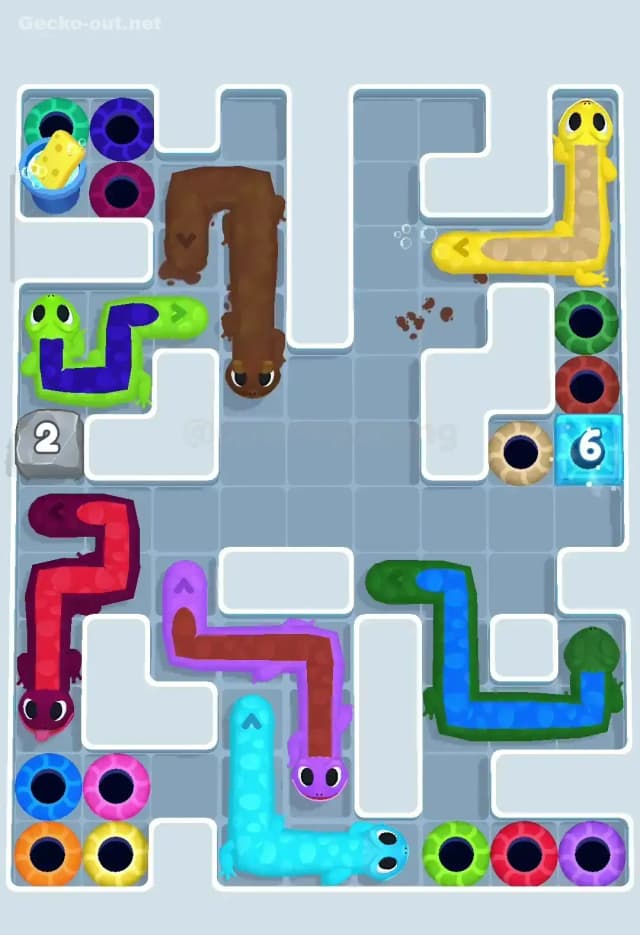
- Start with the shorter geckos on the bottom and right edges (the blue/green U‑shaped and the cyan L‑shaped one). Route them toward their exits using the outer walls, keeping their bodies tight and straight. Try to avoid crossing the central column where the vertical brown sits.
- Use one of these short geckos to pass through the
3toll block from left to right (or right to left, depending on your route). Keep its tail trailing directly behind its head so you don’t leave a spiral that clogs the gate. - “Park” any gecko that isn’t ready to exit in open rectangles: for example, the open floor patch below the horizontal brown or the lower‑right corner pocket. You want them tucked in corners, not stretched across central corridors.
By the time the opening is done, you should have: at least one gecko already home, two ticks counted on the toll gate, and plenty of breathing room on the lower half of the board.
Mid-game: Keeping Lanes Open and Repositioning Long Geckos
Mid‑game is when Gecko Out 255 feels the tightest. This is where you juggle lanes and reposition the browns.
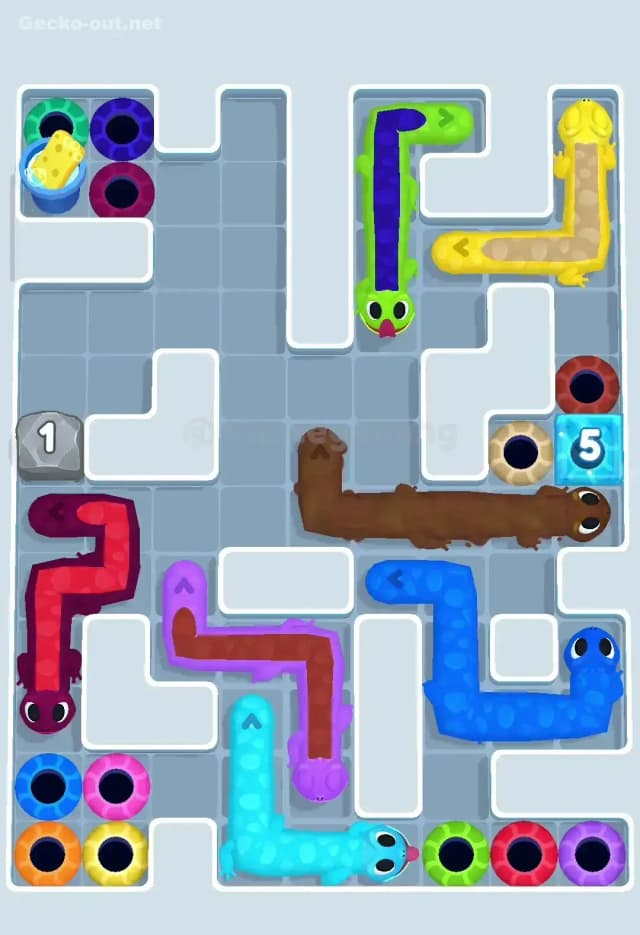
- Use a third short or medium gecko (often the red one on the left) to pass through the toll block and complete the
3requirement. Once it opens, that left corridor becomes a key highway. - Now make the first controlled shift with the brown gang. Nudge the vertical brown slightly up or down so there’s a clean corridor for another color to sneak through. Draw the brown’s path as straight as possible; treat each turn as precious.
- Alternate: brown adjustment → one non‑brown gecko exits or reaches its staging area → brown returns to a neutral position. Don’t leave the brown body draped diagonally across multiple junctions unless you’re immediately sending it home.
- As you clear more exits, pull the purple and top‑left geckos into play. Route them through the newly opened lanes, again hugging walls and avoiding spirals.
The main mindset: every move you make with a long gecko must actively serve two jobs—open a lane, and either finish that gecko or park it somewhere harmless.
End-game: Exit Order and Beating the Timer
End‑game in Gecko Out Level 255 usually comes down to the last two or three geckos, including at least one of the brown gang. By now the icy 7 block is unfrozen or irrelevant, and the board is more open.
- Prioritize any gecko whose exit lies behind another gecko’s body. For example, if a brown needs to cross the middle to reach a right‑side ring, send the non‑brown that shares that lane first.
- Finish the brown gang next. Draw a deliberate, almost boring path from each brown head directly to its exit, using as few side tiles as possible. Because their bodies are so long, once they’re committed you want them leaving the board, not making extra laps.
- If you’re low on time, don’t panic and start scribbling. You’ll usually save more seconds by pausing half a beat, visualizing the straightest possible path, and drawing it cleanly than by undoing panicked mistakes.
When it works, the last brown gecko slides into place and the board suddenly empties in a really satisfying cascade.
Why This Path Order Works in Gecko Out Level 255
Using Head-Drag Pathing To Untangle the Knot
Gecko Out Level 255 is basically a knot made of gecko bodies. The path order above works because it respects the “body follows head” rule:
- Short geckos move first, creating minimal, low‑impact trails.
- The brown gang only moves when those trails are already tucked against walls, so their huge bodies don’t accidentally slice the board in half.
- Exits that share corridors are taken in an order that leaves the critical hallways empty for as long as possible.
You’re not fighting the mechanic; you’re using it. By drawing tidy, predictable paths, you’re effectively rearranging blocks in a sliding puzzle rather than doodling random snakes.
Timer Management: When To Think and When To Move
In Gecko Out 255, the timer punishes indecision more than planning. My rule is:
- First 5–10 seconds: don’t move anything. Scan the board, pair each gecko with its exit, and mentally mark the key corridors you must keep clean.
- Middle phase: move decisively but not frantically. Once you commit to a path, draw it in one clean motion.
- Final seconds: focus only on geckos that can actually reach their holes. If a parked gecko is safe and not blocking anyone, ignore it until the end or until the route is obvious.
Boosters: Optional, Not Required
You can beat Gecko Out Level 255 without any boosters. They’re nice safety nets, though:
- An extra‑time booster helps if you like to double‑check paths before drawing them.
- A “hammer” or ice‑breaking tool (if your version has it) can clear the frozen
7exit earlier, but that mostly just makes the right‑side routing more forgiving—it’s not mandatory. - Hints can be useful once to see the intended order of one tricky pair (often a brown plus a neighbor), but don’t rely on them; they won’t teach you the overall lane‑preserving logic.
Mistakes, Fixes, and Logic You Can Reuse in Other Gecko Out Levels
Common Mistakes in Gecko Out Level 255
-
Moving the brown gang first.
Fix: Always start with the small outer geckos. Treat the browns as movable walls that you only shift when you know exactly why. -
Parking in choke points.
Fix: Never leave a gecko body lying across the center column or the narrow right‑side lane. Park in corners or dead‑end pockets instead. -
Overdrawing paths.
Fix: Draw paths like subway lines, not scribbles. Fewer bends equal more future options. If you feel yourself tracing a spiral, cancel and rethink. -
Ignoring the toll block requirement.
Fix: Intentionally plan which three geckos will pass through the3block, and keep that gate clear until the third one crosses. -
Rushing the final exits.
Fix: In the last 10 seconds of Gecko Out 255, it’s better to take one clean, winning path than two messy, blocking ones. Take a breath, then draw.
Reusing This Logic in Other Knot-Heavy Levels
The habits that solve Gecko Out Level 255 carry over beautifully to later knot‑heavy, gang‑gecko, or frozen‑exit stages:
- Always identify the “wall geckos” (the longest ones) and postpone moving them until you understand the board.
- Use toll gates and warning holes as planning anchors—decide early which geckos will interact with them.
- Favor wall‑hugging, low‑bend routes for early moves so central tiles stay flexible for end‑game rescues.
Once you start thinking of geckos as sliding blocks instead of snakes, most tricky Gecko Out levels become much clearer.
Final Encouragement
Gecko Out Level 255 feels brutal at first because every mistake is so visible, but it’s absolutely beatable once you slow down, map your exits, and respect the brown gang’s power to block the board. Stick to short geckos first, move the long ones with purpose, and keep those center lanes clean. After a run or two with this approach, you’ll watch Gecko Out 255 go from “impossible knot” to a very satisfying, very solvable puzzle.