Gecko Out Level 1064 Solution Walkthrough | Gecko Out 1064 Answer
How to solve Gecko Out level 1064? Get step by step solution & cheat for Gecko Out level 1064. Solve Gecko Out 1064 easily with the answers & video walkthrough.



Gecko Out Level 1064: Board Layout, Rules, and Win Condition
Understanding the Starting Board
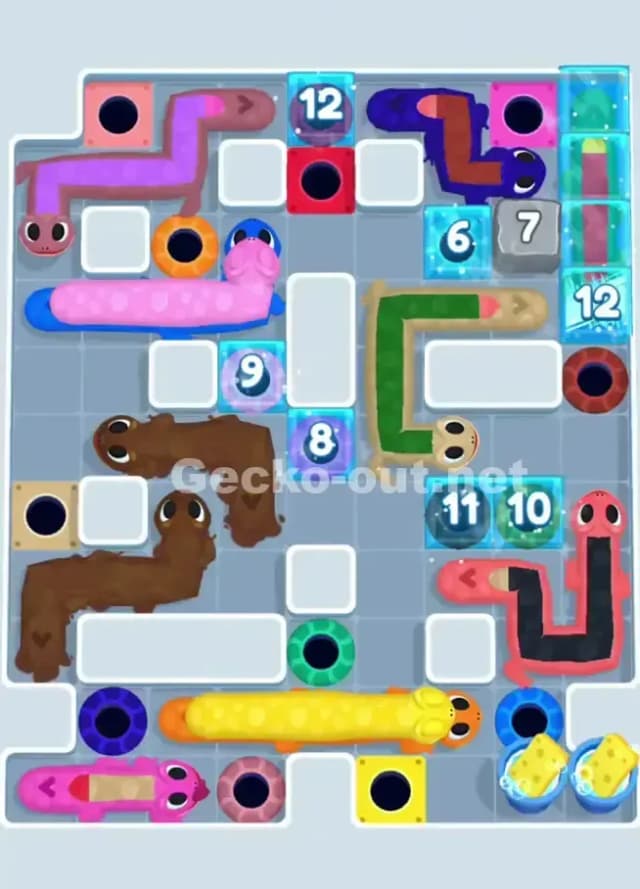
Gecko Out Level 1064 is a crowded, multi-colored puzzle that demands careful sequencing. You're managing seven distinct geckos: a pink long-bodied gecko, a brown two-segment gecko, a yellow extended gecko, a magenta short gecko, a purple-and-brown gecko, a green-bodied gecko, and a red compact gecko. Each has its matching colored hole somewhere on the board, often tucked behind walls, frozen exits marked with icy blue tiles, or positioned at awkward angles that make direct routing nearly impossible. The board itself is dense with white blockers (impassable walls), narrow corridors, and what appears to be a toll gate or locked exit system that'll require careful timing to navigate. The 12-move timer displayed on-screen means you can't afford to waste turns repositioning or getting stuck in a dead-end path.
The Win Condition and Timer Pressure
Your mission in Gecko Out Level 1064 is straightforward: drag each gecko's head through a valid path so its body follows, and land it safely in its matching-colored hole before the timer reaches zero. The challenge isn't just finding a path—it's finding paths that don't create traffic jams. Because the body follows the exact route you drag, a poorly planned first move can trap three other geckos behind an immovable knot. The timer adds real pressure; you'll need to solve this level with almost no margin for error, which means you must think two or three moves ahead before you start dragging anything.
Pathing Bottlenecks and Logical Traps in Gecko Out Level 1064
The Central Corridor Nightmare
The biggest chokepoint in Gecko Out Level 1064 is the central vertical corridor running down the middle-right portion of the board. This narrow lane is where the yellow long gecko and the purple-brown gecko both want to go, but they can't occupy the same space. If you send the yellow gecko down first without a clear exit path, you'll block the purple gecko entirely and waste precious moves trying to untangle them. The solution is identifying which gecko must go through this corridor and which one can be routed around the perimeter—but here's the kicker: the perimeter paths are even longer and require you to plan several moves in advance so you don't paint yourself into a corner.
Three Subtle Problem Spots
First, the magenta gecko in the upper-left area looks like it has a clear shot to its hole, but the path requires you to navigate around the pink gecko's body without overlapping it. Move the pink gecko even slightly wrong, and you'll block the magenta's entire route. Second, the green gecko's hole is in the lower-middle section, but reaching it means threading through a narrow gap between white blockers—one miscalculation and you'll have to restart. Third, the red gecko is tucked in the bottom-right corner with what looks like a straightforward exit, but the frozen tile system near it means you can't just drag it anywhere; you have to respect the ice mechanic and only move it when the frozen exit is clearly passable.
My First Reaction to This Level
Honestly, when I first loaded Gecko Out Level 1064, I felt that familiar spike of frustration. Seven geckos, a tiny timer, and a board that looks like someone took a Tetris puzzle and scrambled it on purpose. But then I realized something: every gecko does have a valid path. The puzzle isn't impossible—it's just asking you to be surgical about the order. Once I identified that the yellow gecko had to move first (because it's the longest and most likely to block others), the rest started clicking into place. That "aha" moment came when I stopped trying to optimize every move and instead focused on clearing corridors one at a time.
Turn-by-Turn Path Strategy to Beat Gecko Out Level 1064
Opening: Prioritize the Long Geckos First
Start by moving the yellow long gecko. Why? Because it occupies the most board real estate and is the most likely to accidentally block three other geckos if left in a bad position. Drag its head downward through the bottom corridor, curving it carefully around the wall obstacles, and land it in its yellow hole at the bottom-right area. This single move clears a huge amount of space and gives you breathing room for the other five geckos. While the yellow gecko is moving, park the pink gecko firmly against the left edge by dragging it toward its hole without fully committing it to exit yet—you want it ready but not locked so you can adjust if needed. The brown two-segment gecko should be moved next, routing it through the left side of the board toward its hole; because it's shorter and more flexible, it's less likely to block others, so you have more room for error.
Mid-Game: Keep Critical Lanes Open and Reposition Systematically
Once the long geckos are mostly clear, focus on the purple-brown gecko. This one lives near the central corridor, so before you move it, make absolutely sure the yellow gecko has fully exited. Drag the purple-brown gecko's head upward and then rightward, hugging the wall carefully, and guide it toward its matching hole in the upper-right quadrant. The magenta gecko should follow soon after, but only after you've confirmed that the pink gecko isn't blocking its path. The key mistake here is moving the magenta gecko and then realizing the pink gecko is in the way—you'll waste a turn backing up. Instead, do a quick mental trace: if I move magenta in this direction, will it collide with pink? If yes, move pink first. This kind of "collision prediction" is what separates a win from a frustrating loss in Gecko Out Level 1064. The green gecko is trickier because its hole is nestled in a constrained area; wait until the central corridor is mostly clear before committing to that path, because if you move green too early, you might accidentally trap it against other geckos that haven't exited yet.
End-Game: Exit Order and Last-Second Crisis Management
By the time you're down to the final two or three geckos, the timer is probably flashing. The red gecko should be one of the last to move because its corner position and frozen-exit mechanics make it less flexible than the others. The final gecko exiting should be whichever one has the clearest, most direct path—this minimizes the risk of a last-second mistake. If you're critically low on time (say, two moves left on the timer), don't panic and rush random paths; instead, take one deliberate second to trace the exact route you're about to drag. A single misclick now means a complete restart. If you find yourself truly stuck with no valid moves left, that's your cue that you made an earlier mistake—but don't beat yourself up; Gecko Out Level 1064 is designed to punish tiny sequencing errors, and recognizing the mistake means you'll do better next attempt.
Why This Path Order Works in Gecko Out Level 1064
How Head-Drag Pathing Untangles the Knot
The genius (and terror) of Gecko Out Level 1064 is that the body follows the exact path the head traces. This means if you drag a gecko's head in a wide, sweeping arc, its body must also occupy every cell in that arc—nothing shortcuts or teleports. This mechanic is actually your ally if you think about it correctly. By moving the longest geckos first and routing them on wide arcs away from the center, you actually create space for shorter geckos to use the now-cleared central corridors. It's the opposite of tightening a knot; it's systematically removing the longest threads first so the remaining threads have room to move. When you move the yellow gecko on that bottom-left-to-bottom-right arc, you're not just moving one gecko—you're removing an obstacle that was blocking paths for the purple-brown, magenta, and red geckos. This cascade effect is what makes the solution elegant instead of chaotic.
Timing: When to Pause and When to Commit
The timer in Gecko Out Level 1064 is a psychological tool as much as a mechanical constraint. Don't move at panic speed, but don't overthink every detail either. Before each gecko move, give yourself five seconds to mentally trace the path: head location, intended route, exit hole position, and any obstacles in between. If you see a potential collision, pause and handle it. Once you commit to dragging, don't second-guess yourself midway; let the path play out. If it's wrong, you'll learn instantly and can adjust on the next attempt. The sweet spot is moving with confidence but not recklessness. Gecko Out Level 1064 rewards players who can make quick, deliberate decisions.
Booster Usage: Optional but Helpful at Crunch Time
Gecko Out Level 1064 doesn't strictly require boosters if you execute the path order perfectly, but if you're down to the final gecko and the timer is visibly low, an extra-time booster is a reasonable safety net. A hammer-style tool isn't necessary here because you're not breaking through walls; you're simply routing around them. A hint booster might help if you're genuinely stuck, but I'd recommend trying the strategy above first—the puzzle is solvable with pure logic. Save boosters for when you're certain you have the right plan but just need a few more seconds to execute it cleanly.
Mistakes, Fixes, and Logic You Can Reuse in Other Gecko Out Levels
Five Common Mistakes and How to Fix Them
Mistake 1: Moving short geckos first. Players often grab the magenta or red gecko first because they're visually "simpler," but this leaves long geckos still occupying space and blocking corridors. Fix: Always scan for the gecko occupying the most cells and move it first.
Mistake 2: Not accounting for body length during path planning. You drag the head, but the body is still connected; a path that looks clear for the head might not be clear for the entire body. Fix: Before dragging, trace the full body path mentally, not just the head's destination.
Mistake 3: Sending a gecko to its hole before clearing the corridor. You find the hole early and excitedly drag the gecko toward it, only to discover another gecko is now blocking the exit path. Fix: Plan the full sequence first, exit holes second.
Mistake 4: Ignoring the frozen-exit mechanics. Tiles marked with ice can't be occupied until the exit is "unlocked" (or they're natural blockers). Dragging a gecko onto frozen terrain is a dead end. Fix: Identify all frozen exits before you start and treat them as temporary walls.
Mistake 5: Losing track of time and rushing the final moves. With two geckos left and three moves on the timer, panic sets in and you start dragging randomly. Fix: Gecko Out Level 1064 tests composure as much as logic; breathe, commit to one clear path, and move deliberately.
Reusing This Logic on Similar Levels
This "longest-gecko-first, clear-corridors-second" strategy scales beautifully to other gang-gecko or multi-body levels. Whenever you encounter a board with geckos of varying lengths and tight corridors, ask yourself: which gecko is occupying the most space right now? Move that one first. The same principle applies to levels with frozen exits or locked gates—clear the longest obstacles before attempting to use narrow passages. You'll find that this simple mental framework cuts through the chaos and turns a seemingly impossible puzzle into a solvable sequence.
Final Encouragement
Gecko Out Level 1064 is unquestionably tough. It demands forward thinking, spatial reasoning, and the discipline not to panic when the timer is flashing. But it's absolutely beatable, and the moment you nail it, you'll feel the satisfying click of a puzzle solved perfectly. The key is remembering that every gecko has a valid exit path; your job is simply to find the sequence that lets them all use those paths without colliding. Approach Gecko Out Level 1064 as a logic puzzle, not a reflex challenge, and you'll come out victorious.