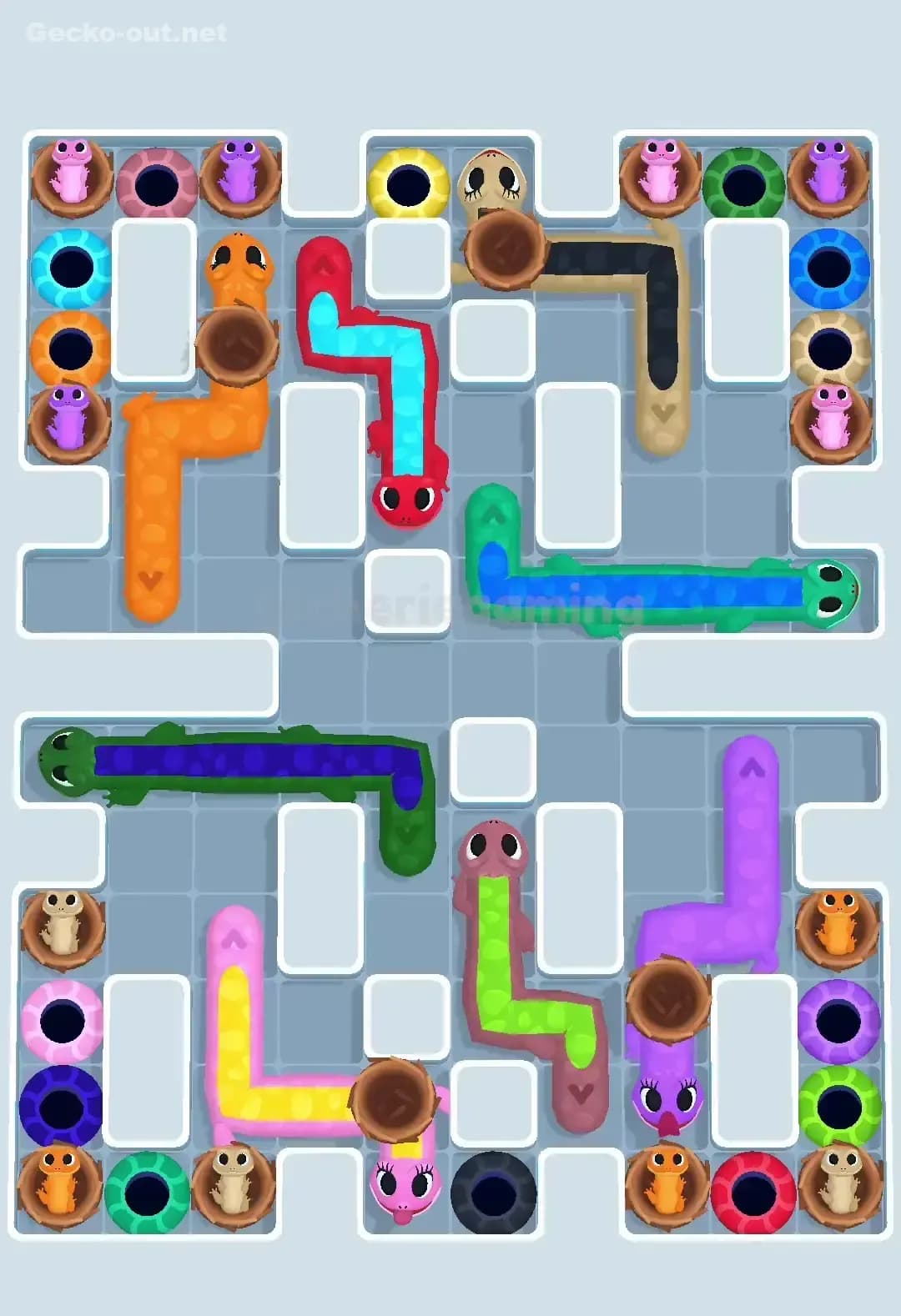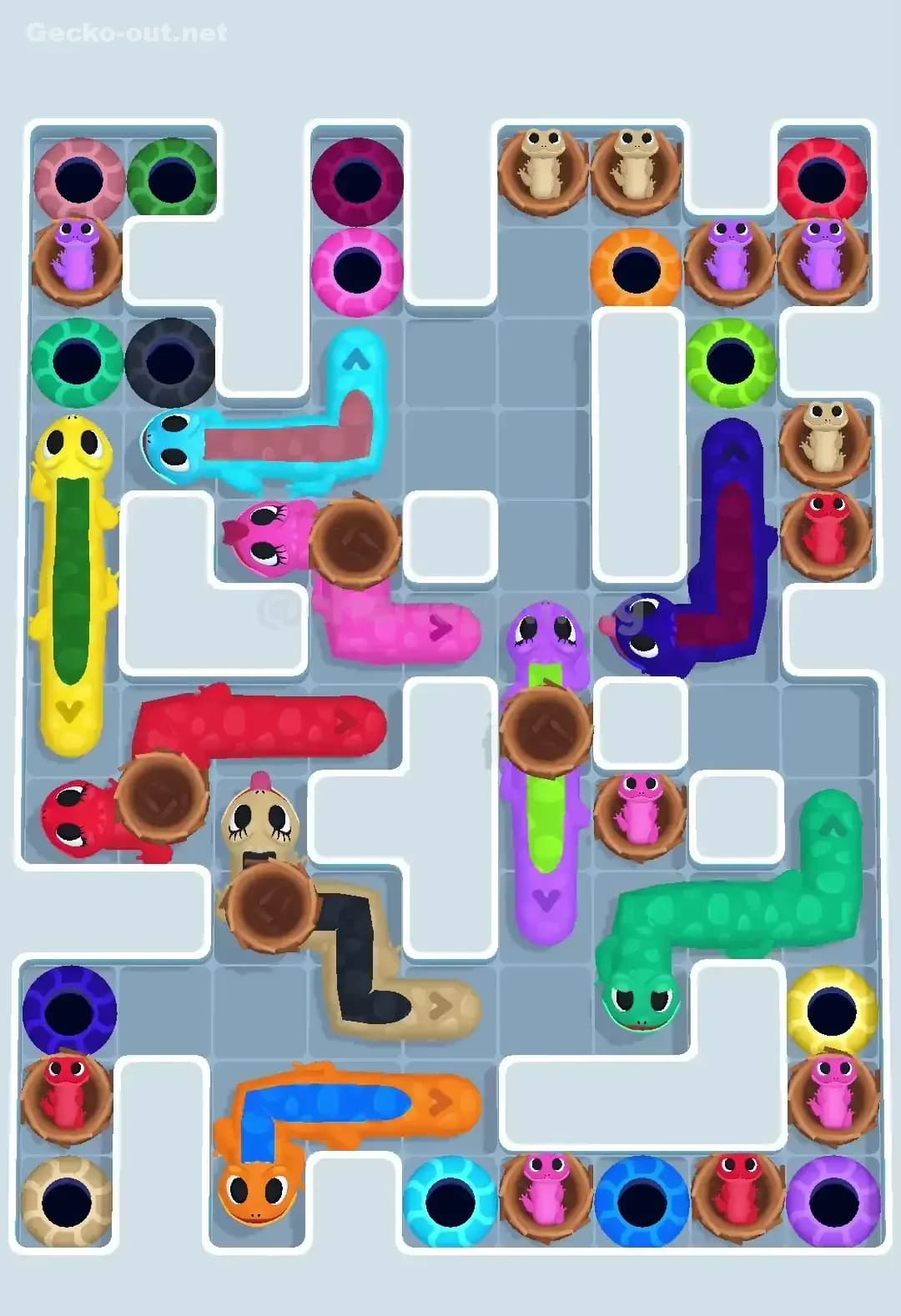
Gecko Out Level 622 Solution Walkthrough | Gecko Out 622 Answer
How to solve Gecko Out level 622? Get step by step solution & cheat for Gecko Out level 622. Solve Gecko Out 622 easily with the answers & video walkthrough.
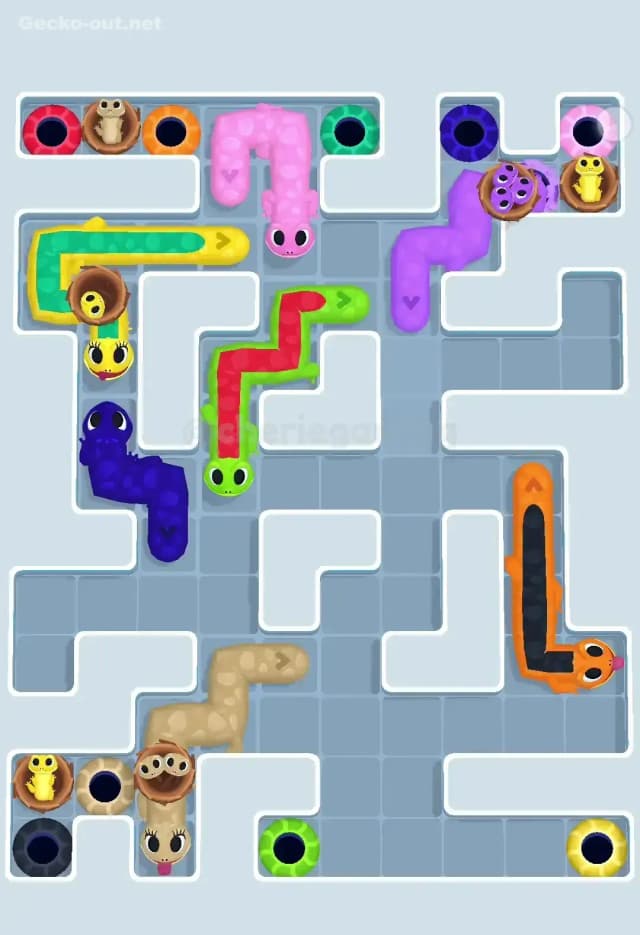
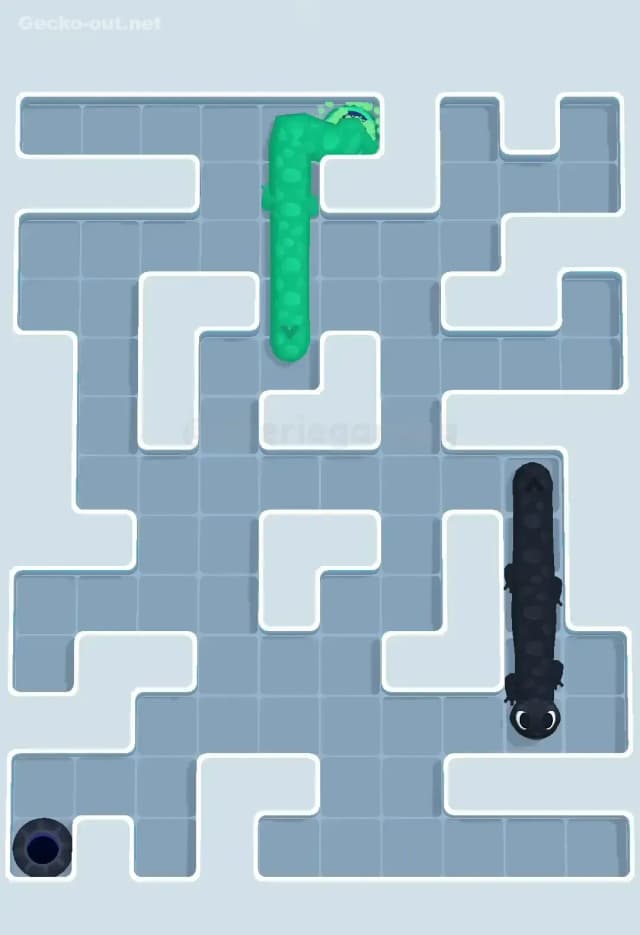
Gecko Out Level 622: Board Layout, Rules, and Win Condition
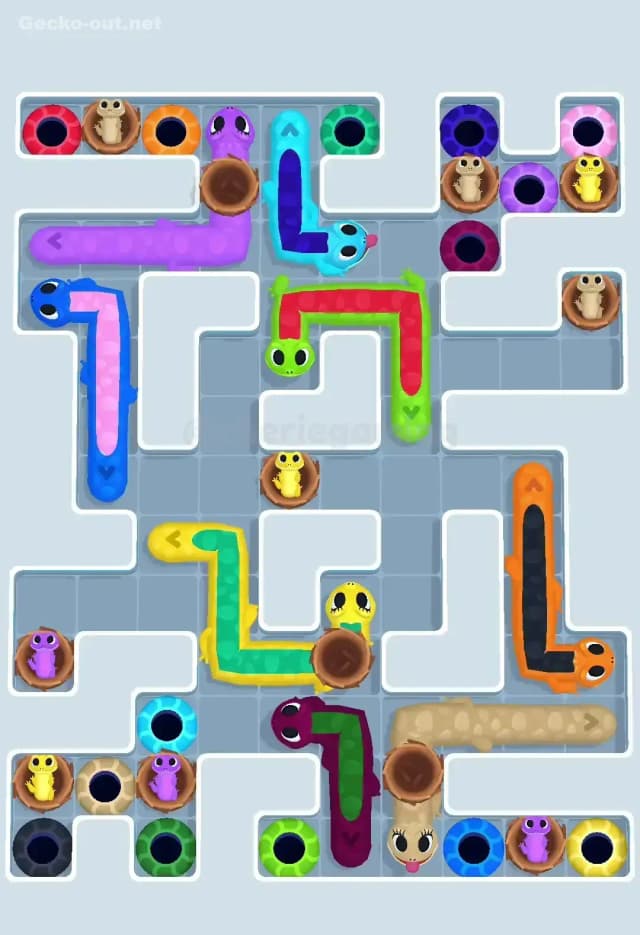
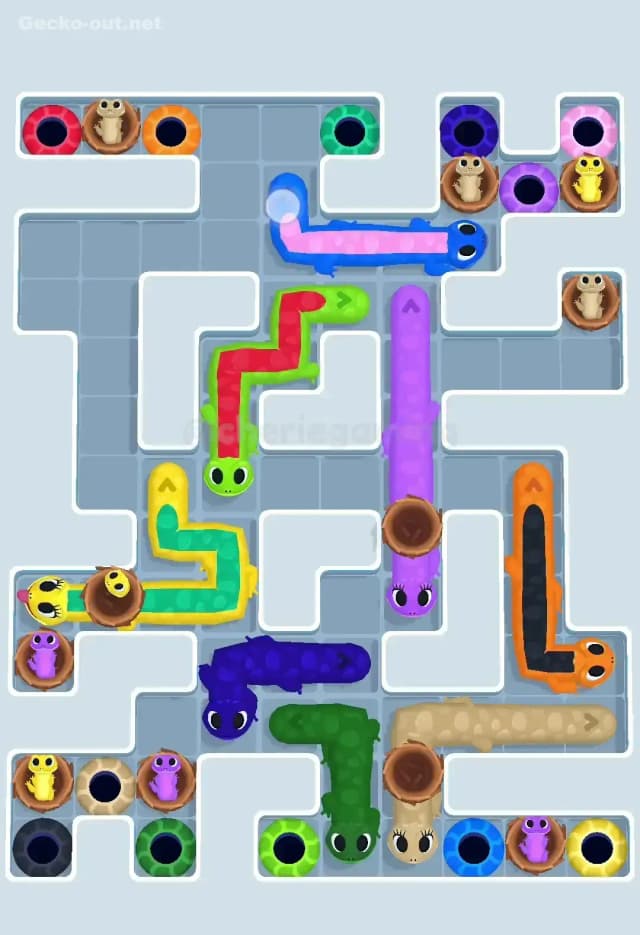
The starting layout in Gecko Out 622
In Gecko Out Level 622 you’re dropped into a tall, maze‑like board packed with long, twisty geckos. You’ve got a full rainbow of colors here: purple, cyan, blue, green, red, yellow, orange, beige, and a dark maroon gecko curled near the bottom. Most of them already stretch around corners, so the board looks “half solved” but is actually a huge knot: the bodies snake through narrow corridors and share the same lanes to reach their matching holes.
The exits are mostly around the edges. Along the top are several colored holes clustered together, plus some “warning” dark holes that are easy to mis-aim into if you’re rushing. More exits sit in the lower left and the entire bottom edge, again mixed with dark warning holes. A long orange gecko hugs the right side vertically, a beige one runs horizontally across the lower middle, and a big red‑and‑green gecko twists around the central area; these three are the backbone of the knot in Gecko Out 622.
Rules and how the timer shapes the challenge
The win condition in Gecko Out Level 622 is the usual one: every gecko must reach a hole with a ring that matches its body color before the timer runs out. You drag a gecko’s head to draw a path; when you release, its body follows that path exactly, segment by segment. Geckos can’t overlap walls, each other, or blocked exits, and you can’t cross a path you’ve already laid down with another gecko.
What makes Gecko Out 622 stressful is how the strict timer interacts with the maze. The corridors are so tight that drawing one greedy path can permanently block the last few exits. You don’t have time to experiment on every attempt, so you need a clear plan: which gecko moves first, where you “park” them temporarily, and which lanes absolutely must stay open until the end.
Pathing Bottlenecks and Logical Traps in Gecko Out Level 622
The main choke corridor
The single biggest bottleneck in Gecko Out Level 622 is the right‑hand side where the tall orange gecko lives. That vertical corridor is the only clean highway that connects the bottom half of the board to the cluster of exits near the top right. The beige gecko in the lower middle and the dark maroon gecko near the bottom both want to use that route, but the orange body fills almost every tile there.
If you commit the orange gecko too early, it locks in a wall of body segments and the central geckos lose their way out. The real trick is treating the orange gecko as a movable barrier: you nudge it just enough to create space, use that gap to send smaller geckos through, and only in the end do you slide it into its final exit.
Subtle problem spots that waste runs
First, the top center cluster of exits is deceptively dangerous. You’ve got bright colored holes mixed with dark warning holes; drag a purple or cyan gecko up there with a sloppy path and it’s easy to land in the wrong ring. Because the path is long, mis‑aiming at the last second wastes a huge chunk of timer.
Second, the lower-left corner features several short geckos and exits crammed together. It’s tempting to solve that cluster last because it “looks easy,” but their bodies can protrude into the central lane if you drag them casually. That extra tile or two can completely block the way for the big red‑and‑green gecko coming through the middle.
Third, the beige horizontal gecko in the lower middle is a quiet villain. Its body cuts across the board, and any awkward parking spot for it will split the bottom area into two dead zones. In Gecko Out 622, you want beige either fully solved or neatly aligned along a wall, never lying diagonally through the central corridor.
When the solution starts to click
I’ll be honest: Gecko Out Level 622 feels chaotic at first. You clear one gecko, and suddenly another one has no route, so you restart and try a different order, only to jam the orange one or misplace the red‑and‑green giant. The frustration usually peaks when you’re consistently getting “one gecko left” as the timer hits zero.
The moment it started to make sense for me was when I stopped thinking “which gecko can I solve now?” and instead asked “which lanes must still be empty for the endgame?” Once I treated the orange and beige geckos as movable walls and respected the central vertical lane, the rest of the paths fell into place. Gecko Out 622 becomes much more manageable when you see it as traffic control, not a series of isolated color matches.
Turn-by-Turn Path Strategy to Beat Gecko Out Level 622
Opening: safe early clears and parking spots
In the opening of Gecko Out Level 622, focus on short, local moves that don’t disturb the big geckos. Start with the small geckos in the lower-left cluster whose exits are only a few tiles away. Draw tight, direct paths into their matching holes, hugging the local walls so their bodies don’t spill into the central column.
Next, look at the top row geckos that can reach exits with minimal movement, especially the purple and cyan ones. Nudge them straight into their matching top exits, but be precise so you don’t accidentally route through a dark warning hole. While doing this, avoid dragging across the central vertical corridor; that lane has to remain open for the larger mid‑board geckos later.
Use “parking” to your advantage: for example, you can pull the beige gecko slightly so its body runs flush against the bottom wall, freeing the middle while not yet sending it to its exit. Same idea with the red‑and‑green gecko—bend it neatly around corners so it forms a tidy L‑shape hugging walls instead of zigzagging through the middle.
Mid-game: preserving lanes and moving the long bodies
The mid‑game of Gecko Out Level 622 is where most runs succeed or fail. Your goal now is to clear geckos whose exits lie deep in shared corridors without sealing off critical paths. Start using the right‑hand side carefully: slide the orange gecko up just enough to open a gap, then send the maroon and beige geckos through that gap to their exits when the line is clear.
When you move long geckos like the red‑and‑green one in the center, always preview the final body shape. Ask yourself: after I release, will this body wall off a hole or a corridor I still need? If the answer’s yes, undo and redraw a path that hugs the outer edges instead. It’s often better to take a slightly longer route that stays tight to walls than a short route that slices the board in half.
Also, keep an eye on exits stacked near each other. In Gecko Out 622, several geckos share the same general area but different colored holes. Try to send the one with the most awkward body angle first; the simpler, shorter gecko can usually squeeze through later, while the long one can’t.
End-game: exit order and managing low time
By the end-game, you should have the short geckos cleared and only the biggest bodies remaining—typically the red‑and‑green, orange on the right, and maybe beige or maroon if you saved them. The recommended order in Gecko Out Level 622 is: central giants → horizontal beige → vertical orange last. That keeps the right-side corridor usable until you truly no longer need it.
When you’re down to the final two geckos, pause for a second even if the timer is low. Visualize each body’s final position and confirm that solving one doesn’t trap the other outside its exit. Then draw confidently; the timer is tight but forgiving enough if you don’t redraw paths multiple times.
If you’re very low on time and still have two long geckos left, prioritize the one with the more complex route. Usually that’s the one that needs to weave around corners instead of going almost straight. If a booster gives extra seconds, this is the point where using it makes the difference between “almost” and a clean win on Gecko Out 622.
Why This Path Order Works in Gecko Out Level 622
Using path-follow rules to untangle the knot
This plan for Gecko Out Level 622 exploits the fact that bodies follow heads exactly. By solving short, local geckos first, you place their bodies in harmless side corridors where they don’t affect global routing. Then, when you move the long ones, you deliberately run their bodies along walls and outer edges, so each finished gecko shrinks the available space without cutting off any remaining exit.
Because you treat the orange and beige geckos as temporary barriers instead of rushing them out, you’re effectively “drawing” new walls to steer later paths. The knot gets looser with each move instead of tighter, and you never have to redraw a path because another gecko’s body blocks it after the fact.
Balancing thinking time vs. speed
To manage the timer in Gecko Out 622, I like a rhythm: think longer at the start of each phase, move fast once decided. Spend 20–30 seconds in the opening just reading the board, planning which exits share lanes, and spotting your bottleneck corridors. After that, commit to your sequence and draw paths briskly without second‑guessing every move.
Whenever you reach a new “phase” (for instance, when only the long geckos remain), pause again for a quick mental reset. Those small planning breaks save more time than they cost, because you avoid long, doomed attempts where the last gecko clearly can’t reach its hole.
Boosters: optional but where they help
Boosters in Gecko Out Level 622 are helpful but not required. An extra‑time booster is the most generally useful if you’re still learning the route; popping it just before the end‑game gives you breathing room to think through the last two or three geckos. Hammer‑style blockers or freeze tools aren’t really needed here, since the level is about lane management more than single-tile obstacles.
If you do use a hint booster, use it early to confirm which gecko should go through the right‑side corridor first. That’s the one piece of ordering logic that can feel unintuitive when you’re starting out on Gecko Out 622.
Mistakes, Fixes, and Logic You Can Reuse in Other Gecko Out Levels
Common mistakes and how to fix them
- Solving the orange right‑side gecko too early. Fix: keep it partially parked until nearly all other geckos that need that corridor are gone.
- Letting small geckos sprawl into the central lane. Fix: draw their paths tight to local walls, especially in the lower-left cluster.
- Dragging into the wrong colored hole in the top cluster. Fix: slow down near the end of a path; zoom your eyes onto the ring color, not just the location.
- Parking the beige gecko diagonally across the middle. Fix: whenever you move beige, make sure its body ends up flush against the bottom wall or already in its exit.
- Redrawing paths mid‑drag repeatedly. Fix: plan the full route mentally first, then draw in one clean motion to save timer.
Reusing this logic in other tricky levels
The strategy from Gecko Out Level 622 transfers really well to other knot‑heavy Gecko Out levels. Anytime you see one super‑long gecko in a single‑tile corridor, assume it should move late and act as a temporary wall in the meantime. When exits cluster near warning holes, always solve them with deliberate, precise paths rather than rushed flicks.
On levels with “gang” geckos or frozen exits, the same principles apply: clear the short, local geckos first, protect shared lanes for as long as possible, and use the body‑follows‑head rule to park long geckos in harmless positions against walls. This mindset turns seemingly impossible tangles into a series of controlled traffic moves.
Final encouragement for Gecko Out 622
Gecko Out Level 622 looks brutal, and it absolutely can be if you play it reactively. But with a clear lane‑first plan, a calm opening, and a structured end‑game order, it becomes a satisfying puzzle instead of a frustration loop. Stick to the idea of preserving the right‑side corridor, parking big geckos smartly, and solving clusters in a logical order, and you’ll see Gecko Out 622 go from “no way” to “done” in just a few focused attempts.