Gecko Out Level 647 Solution Walkthrough | Gecko Out 647 Answer
How to solve Gecko Out level 647? Get step by step solution & cheat for Gecko Out level 647. Solve Gecko Out 647 easily with the answers & video walkthrough.
Gecko Out Level 647: Board Layout, Rules, and Win Condition
Understanding the Starting Board
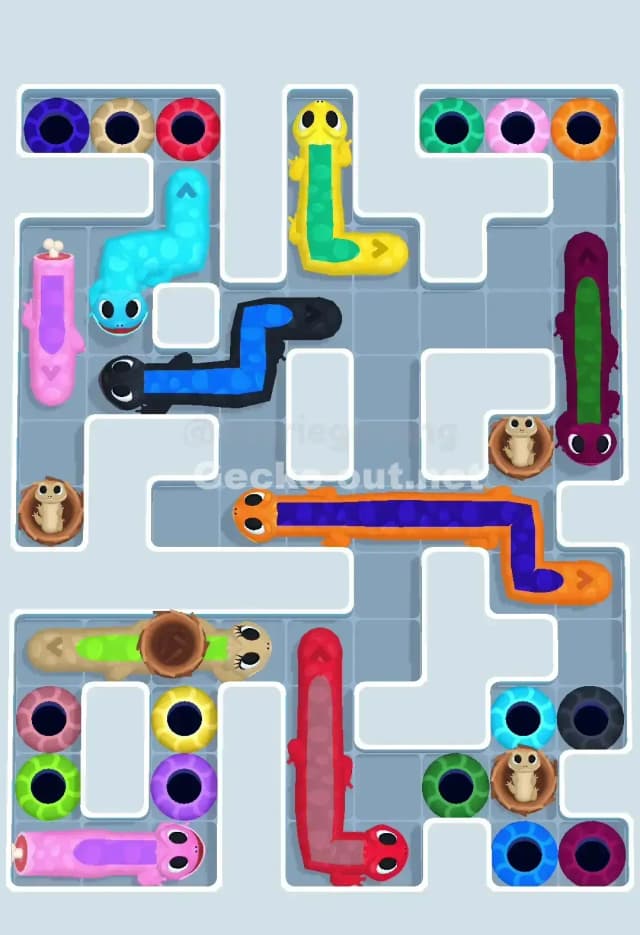
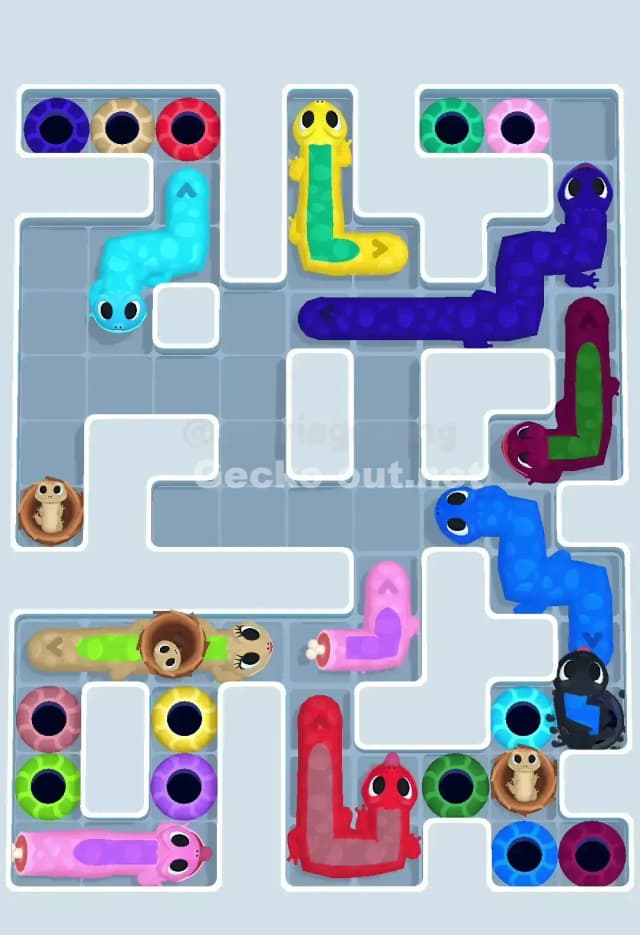
Gecko Out Level 647 is a genuinely complex puzzle that'll test your spatial reasoning right from the start. You're looking at seven geckos scattered across an intricate, maze-like grid with multiple color-coded exit holes positioned strategically around the board. The geckos themselves vary dramatically in size and body structure—some are compact and nimble, while others are long, segmented creatures that take up significant board real estate. You've got cyan, blue, orange, pink, tan, red, and yellow geckos all competing for escape routes, and the board layout includes numerous white walls creating tight corridors and choke points that'll make your pathing decisions absolutely critical.
The exit holes—colored to match each gecko—are clustered in specific zones: some exits sit in the top corners, others line the bottom edges, and a few are tucked along the right side. This asymmetrical distribution means you can't simply "rush" in one direction; instead, you'll need to choreograph each gecko's departure carefully so their paths don't collide or deadlock the board.
The Win Condition and Timer Pressure
Here's the core challenge: all seven geckos must reach their matching-colored holes before the timer expires. You drag each gecko's head along your chosen path, and its body automatically follows that exact route—no shortcuts, no teleporting. The timer in Gecko Out Level 647 is tight enough to punish hesitation but forgiving enough that a logical sequence won't leave you frantically dragging at the last second. If even one gecko is still on the board when time runs out, you fail the entire level. This means you can't afford to get stuck repositioning a single gecko for the last thirty seconds; you need a plan that flows smoothly from first gecko to last.
Pathing Bottlenecks and Logical Traps in Gecko Out Level 647
The Central Corridor Chokepoint
The biggest bottleneck in Gecko Out Level 647 is the central horizontal corridor running through the middle-left side of the board. The blue gecko, with its long, serpentine body, currently occupies a significant chunk of this space, and moving it early is non-negotiable if you want to free up lanes for other geckos. If you leave the blue gecko sitting there while trying to route other creatures around it, you'll find yourself in an impossible knot where three or four other geckos are blocked from their exits. This single gecko is the linchpin of the entire puzzle—move it wrong, and you've wasted precious seconds. Move it right, and suddenly half the board opens up.
Subtle Problem Spots to Watch
The first trap is the pink gecko on the bottom-left: it's a long, bulky creature that looks like it wants to exit straight ahead, but its natural path overlaps with where you'll need to route the tan gecko's head in the mid-game. If you commit the pink gecko to its obvious exit too early, you'll box yourself in. The second trap is the red gecko at the bottom-center—its exit hole is directly above it, which seems convenient, but reaching that hole requires a precise, narrow curve that can't overlap with the orange/blue lower-right corridor you'll be using for other escapes. The third trap is the green exit hole on the right side: it's isolated and accessible only through a tight, single-width passage. If you route any long gecko through that area without planning ahead, you'll create a traffic jam that costs you crucial seconds.
The Frustration That Clicks Into Clarity
I'll be honest—Gecko Out Level 647 feels like chaos on your first attempt. You'll drag a gecko halfway across the board, realize its path blocks two others, undo, and then spiral into second-guessing yourself. But here's the moment it clicked for me: I stopped thinking about "getting each gecko out" individually and started thinking about "clearing lanes in reverse order." Once I identified the blue gecko as the traffic director, everything else fell into place. The frustration wasn't the puzzle's fault—it was that I was solving it backwards, trying to save the hardest path for last instead of clearing it first.
Turn-by-Turn Path Strategy to Beat Gecko Out Level 647
Opening: Clear the Central Bottleneck First
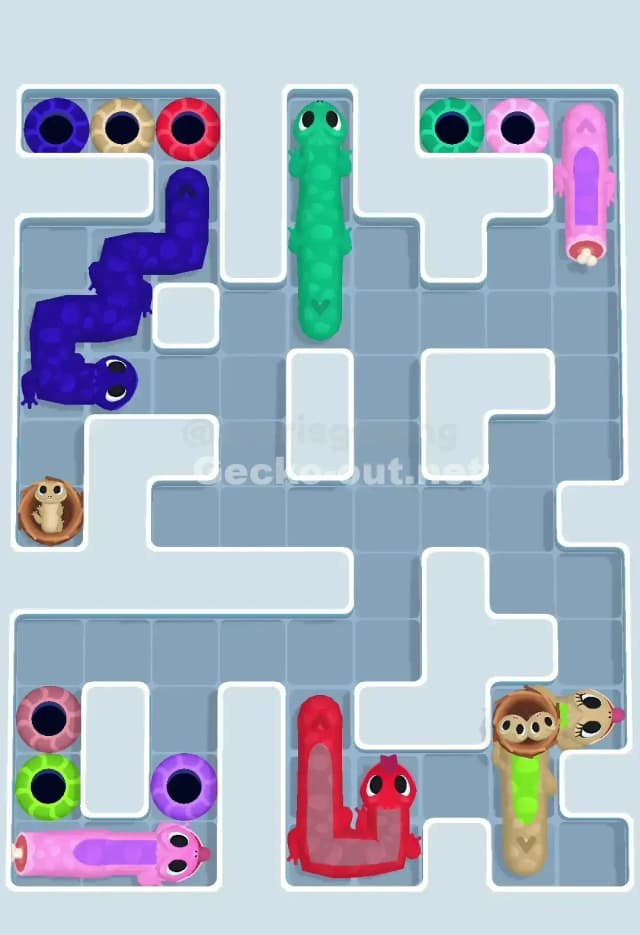
Start by moving the blue gecko out immediately—don't overthink this. Drag its head down and to the right, carefully threading it through the bottom corridor toward the blue exit hole in the lower-right area. This move serves a dual purpose: it physically removes the longest obstacle from the board's central artery, and it signals to your brain that you're committing to a specific exit pattern. Once the blue gecko is gone, you'll visually see how much space you've reclaimed. Next, tackle the cyan gecko on the left side—it's trapped in a corner and needs to escape via the cyan exit in the top-left region. Route its head upward and slightly left, hugging the wall carefully. These two early moves set the tone; you're not panicking, and you're solving the hardest spatial problems when your mental energy is fresh.
Mid-Game: Reposition Long Geckos and Protect Key Lanes
After the blue and cyan geckos are out, the yellow gecko in the center-top becomes your next priority. It's a bulky, vertical creature, and its yellow exit hole is in the top-right. Drag its head to the right, then downward along the eastern wall, then back up and into its exit. Yes, this path is long and loopy—that's intentional, because it clears the center of the board without interfering with the remaining geckos. Now comes the critical middle phase: move the orange gecko next. It's the large, looping creature at the bottom-center, and its exit is orange in the top-right area. This path will seem to overlap with the yellow gecko's trajectory, but since yellow is already gone, you have a clear corridor. Route orange upward along the right side, keeping it tight against the walls to maximize room for others.
With those four geckos escaped, you have three left: pink, red, and the two small tan/brown creatures. Here's where patience matters. The pink gecko on the bottom-left needs to go down and around toward its pink exit in the top-right corner. Don't rush this—visualize the exact path before you drag it, because any mistake here will cost you five to ten seconds in repositioning. The red gecko is next: its red exit is at the bottom-center, and mercifully, it's one of the shortest routes left on the board. Finally, the two small tan/brown creatures have exits in the left and bottom corners respectively—they're quick wins that you can execute in rapid succession since they're small and agile.
End-Game: Execute the Final Exits with Confidence
You're down to the last gecko or two, and the timer is still friendly. Don't panic and rush; instead, verify each path once more in your mind before dragging. The small geckos are forgiving because they don't need much space, but a sloppy path on the second-to-last gecko can still mean last-second scrambling. As you execute the final gecko's exit, you should notice the board is nearly empty—this is your confidence check. If you're managing the timer well, you should finish with ten to fifteen seconds remaining. If you're running low on time (under five seconds), it's a sign your mid-game sequencing wasn't optimal, not that the level is impossible.
Why This Path Order Works in Gecko Out Level 647
Head-Drag and Body-Follow Logic Untangle, Not Tighten
The secret to Gecko Out Level 647 is understanding that when you drag a gecko's head, its body commits to that exact spatial footprint. If you move the blue gecko out first, its body stops occupying the central corridor, and you've genuinely freed up lanes for everyone else. This is different from, say, moving a gecko partway and parking it in a "safe" corner—that's not truly clearing space; you're just deferring the problem. By moving the longest, most entangled geckos first, you're using their initial departure to physically reshape the board state, making subsequent moves exponentially easier. Each successful exit reduces the complexity of the remaining puzzle exponentially, which is why a clear sequence is so much faster than trial-and-error repositioning.
Pacing: When to Pause and When to Move
Gecko Out Level 647's timer is about fifty seconds or so—enough time for a methodical solution, but not enough to be careless. I recommend pausing for three to five seconds between each gecko to visually trace the next path in your mind. Ask yourself: "Does this gecko's exit lane overlap with anyone still on the board?" If yes, you're moving too early. If no, commit and drag confidently. The worst thing you can do is drag hesitantly, second-guess halfway, undo, and drag again—that eats time without reducing the puzzle's complexity. Conversely, you shouldn't pause longer than five seconds per gecko; if you're uncertain after that, you're likely overthinking. Trust your spatial instincts, execute, and move on.
Boosters: Optional, Not Required
For Gecko Out Level 647, boosters like extra time or a hint are completely optional. A time-booster might give you a safety net if you're new to the level, but the puzzle is absolutely beatable in the standard timer if you follow this sequence. I'd skip the booster on your first successful run—it feels more satisfying, and you'll learn the board layout more thoroughly without the crutch. Save boosters for truly stuck moments, not for preemptive insurance.
Mistakes, Fixes, and Logic You Can Reuse in Other Gecko Out Levels
Five Common Mistakes and Their Fixes
Mistake One: Moving the long geckos last, assuming they're "flexible" and can adapt to remaining space. Fix: Long geckos are obstacles, not solutions. Move them early and often—they open the board.
Mistake Two: Trying to route the pink gecko straight to its exit without considering the tan gecko's interference. Fix: Always scan for long-body geckos that might be in your intended path, even if they're not currently blocking it.
Mistake Three: Leaving a gecko "parked" in a corner while you move others, then forgetting how to extract it later. Fix: Avoid dead-ends. Every gecko should have a direct, unambiguous path to its exit, or you're setting up a time-sink.
Mistake Four: Dragging paths too loosely, creating unnecessary curves that waste board space. Fix: Every pixel matters in Gecko Out Level 647. Hug walls, minimize loops, and use tight turns whenever possible.
Mistake Five: Panicking when the timer hits twenty seconds and making sloppy moves on the last two geckos. Fix: If you're following the sequence above, you should have at least ten seconds remaining. If you don't, you veered off-sequence earlier.
Reusing This Logic on Similar Levels
This approach—identifying the central bottleneck, moving long/entangled geckos first, protecting key lanes, and executing smaller geckos last—works beautifully on any Gecko Out level with multiple long-bodied geckos and tight corridors. If a future level has a frozen gecko or locked exit, adjust by moving that gecko even earlier, before any non-frozen gecko that might block its thaw path. If you encounter gang-linked geckos in a later level, treat them as a single unit and move them as one. The core principle remains: clear the board's constraints first, then handle the flexible pieces.
Final Encouragement
Gecko Out Level 647 is genuinely challenging—it's designed to make you think spatially and plan ahead—but it's absolutely beatable without luck or boosters. You now have a sequence that works, an understanding of why it works, and a set of mental tools you can apply to similar puzzles. Take your time on your first successful run, trust the process, and you'll see that aha moment when all seven geckos are home and the timer is still running. That's the reward for precision planning, and it's worth every second of effort.