Gecko Out Level 782 Solution Walkthrough | Gecko Out 782 Answer
How to solve Gecko Out level 782? Get step by step solution & cheat for Gecko Out level 782. Solve Gecko Out 782 easily with the answers & video walkthrough.
Gecko Out Level 782: Board Layout, Rules, and Win Condition
Starting Board: Geckos, Colors, and the Initial Chaos
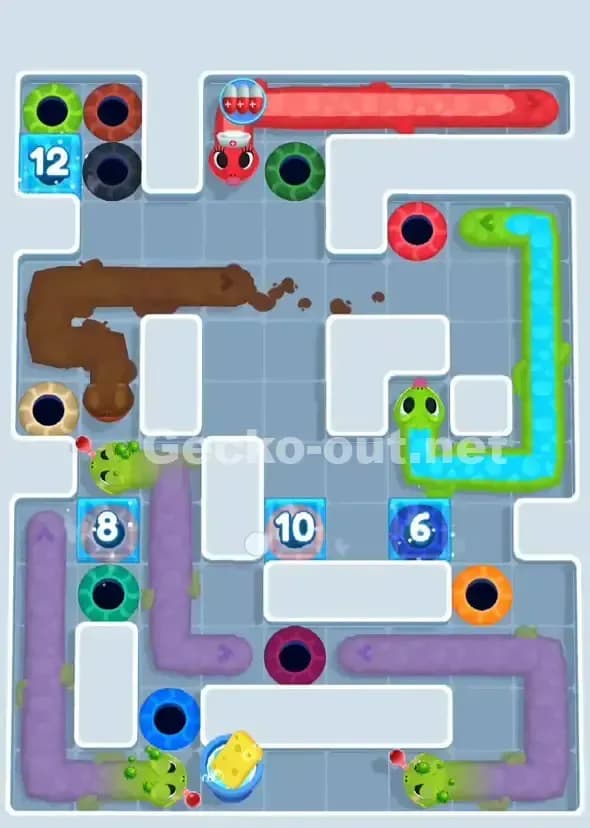
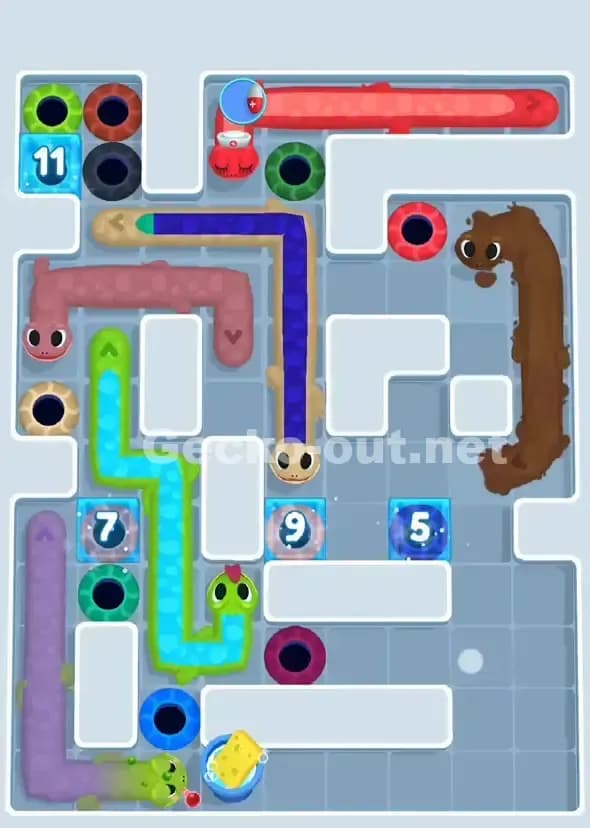
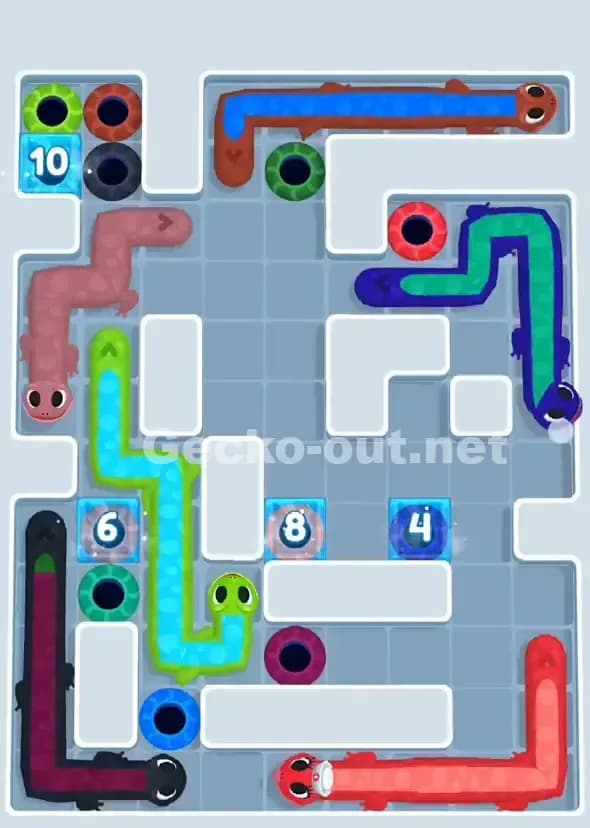
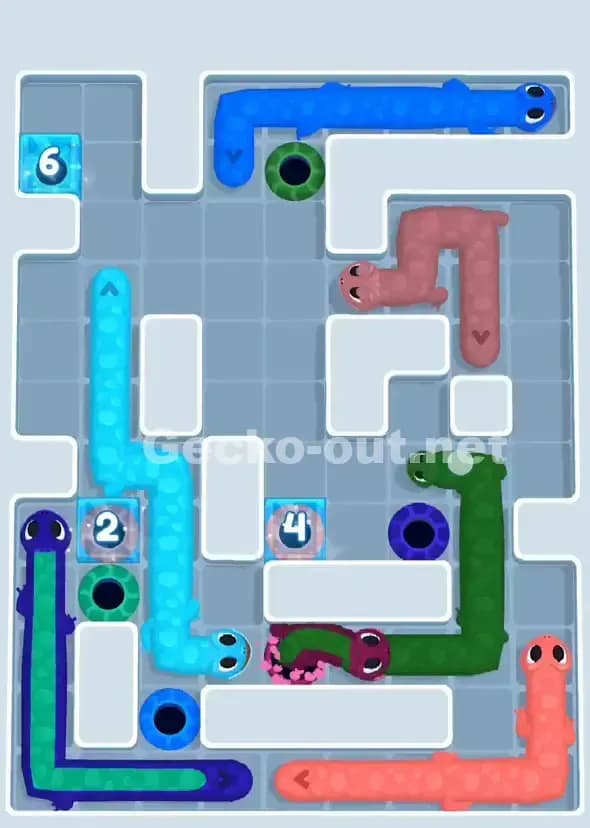
Gecko Out Level 782 throws you into a puzzle with six geckos spread across a cramped, wall-heavy grid. You've got a red gecko in the top-left area, a green gecko nearby, a brown gecko hugging the left side, a cyan gecko positioned on the right, plus orange, blue, and additional colored geckos scattered throughout the lower half. The board is carved up by white walls that create narrow corridors and isolated chambers—this isn't a wide-open space where you can just drag anything anywhere. There's a 12-second timer counting down, which sounds generous until you realize that every drag-path takes time to execute, and miscalculations can eat your clock faster than you'd expect. The goal is straightforward: guide each gecko's head to create a body-path that leads to its matching-colored hole, and do it before the timer hits zero.
Win Condition and Timer Pressure
You win Gecko Out Level 782 when all six geckos have escaped through their respective holes. The timer is your real adversary here, not the walls themselves. Because movement is drag-based and the body follows the exact path your head traces, you can't just "queue up" moves—you have to commit to each path, watch it execute, and then plan the next one. If even one gecko is still on the board when the timer expires, the level resets. This means you can't afford to overthink every single move, but you also can't afford to be reckless and create a tangled mess that takes longer to untangle than it would have taken to plan correctly the first time.
Pathing Bottlenecks and Logical Traps in Gecko Out Level 782
The Critical Bottleneck: The Center-Right Corridor
The single biggest choke point in Gecko Out Level 782 is the narrow vertical passage on the right side of the board, where multiple geckos need to pass through to reach their holes. If you send a long gecko down that corridor first without thinking, you'll block shorter geckos from following, and you'll waste precious seconds having to backtrack or reroute. The cyan gecko's body is particularly long and serpentine, and if it occupies that corridor while you're trying to move the orange gecko, you're in trouble. The key insight is that this isn't a "first come, first served" corridor—it's a puzzle piece that demands sequencing. You need to move shorter geckos or those with simpler paths through tight spaces first, leaving the corridor clear for the longer bodies to snake through later.
Subtle Trap 1: The Brown Gecko's Trapped Position
The brown gecko starts on the left side, and its exit hole is in the lower-left chamber. Sounds simple, right? Wrong. The brown gecko is boxed in by walls on multiple sides, and the only viable path forces you to drag its head downward and then navigate a series of tight turns. If you don't plan this path carefully, the body will collide with the white walls or overlap with other geckos that are still moving. This gecko needs to be handled early, but not first—you need to clear a specific corridor below it before you drag it down, or you'll create a traffic jam.
Subtle Trap 2: Overlapping Red and Green Paths
The red and green geckos are both near the top-left, and their exit holes are in completely different zones. The red gecko needs to exit to the right, while the green gecko needs to go down and around. If you drag the red gecko first without a clear mental picture of where the green gecko will go, you might block the green gecko's only viable path. This is a classic "gang gecko" problem where two bodies can accidentally trap each other.
Subtle Trap 3: The Blue Gecko's Deep Position
The blue gecko is tucked in the lower portion of the board, surrounded by walls and other geckos. Its hole is nearby, but reaching it requires a precise path that doesn't interfere with the orange, red, or the other geckos you've already moved. It's not the hardest individual move, but by the time you're moving the blue gecko, the board is crowded, and mistakes cost time.
That Frustrating Moment
Honestly, when I first looked at Gecko Out Level 782, I felt that familiar spike of frustration—six geckos, a 12-second timer, and walls everywhere. It felt like a traffic jam waiting to happen. But then it clicked: I realized that the solution wasn't about moving geckos fast; it was about moving them in the right order. Once I identified that the center-right corridor was the true bottleneck and that I needed to clear the lower-left chamber before touching the brown gecko, the whole puzzle suddenly felt solvable. The panic melted, and I could see a clear sequence.
Turn-by-Turn Path Strategy to Beat Gecko Out Level 782
Opening: Clear the Exits First, Park Geckos Safely
Start by moving the cyan gecko from the right side. Its path is relatively clear and doesn't interfere with anyone else. Drag its head down and around to its cyan exit hole on the lower-right portion of the board. This move accomplishes two things: it frees up board space and clears part of the critical right-side corridor for other geckos later. Once the cyan gecko is out, you've got breathing room.
Next, move the blue gecko. It's positioned in the lower-center area, and its blue hole is nearby. Drag its head on a path that avoids the white walls and other stationary geckos. This doesn't take long, and it further opens up the lower half of the board. You're now four geckos down (wait, we've only moved two—I mean two out, with four still on the board), and you've established a rhythm.
Mid-Game: Untangle the Top-Left, Navigate the Brown Gecko
Once the lower half is clear, focus on the brown gecko. Drag its head downward from its starting position, navigate around the walls in the left chamber, and carefully guide it to its brown hole without cutting across the paths you've already cleared. This move requires precision because the brown gecko is long and the corridors are tight, but you've already cleared the exits below, so its body won't collide with anything.
Now tackle the green gecko. Drag its head from the top-left downward and then around to its green exit. The key here is making sure its path doesn't overlap with the red gecko's body, which is still on the board. Think of the green gecko's exit as "yours to claim" before you move the red gecko, because the red gecko is trickier and longer.
End-Game: Red, Orange, and Final Exits
With cyan, blue, brown, and green out of the way, you're left with red and orange. The red gecko is a long, winding body, and its exit is on the right side. Drag its head carefully—this is where you use the now-open corridor you've been protecting. The body will follow your path exactly, so trace a route that uses the cleared space efficiently. Don't rush; precision here saves you from having to restart.
Finally, move the orange gecko. By this point, the board should be nearly empty, and its path to the orange hole should be straightforward. Drag its head and watch the body follow. With just one gecko left, there's no risk of collision, but time is likely running low (you're probably at 3–5 seconds remaining), so move with confidence.
Why This Path Order Works in Gecko Out Level 782
Head-Drag Logic and Body-Following Mechanics
The reason this sequence works is rooted in how the game's physics operate. When you drag a gecko's head, the body follows the exact path you traced—it doesn't take shortcuts or adjust itself. This means that if you drag the green gecko's head in a way that crosses where the brown gecko's body will later be, you've created a collision that forces you to redo both moves. By moving shorter or simpler geckos first, you establish a baseline of "safe zones" on the board. Each successful escape clears real estate and removes a body that could otherwise tangle with a longer gecko later. The cyan and blue geckos are the easiest wins, and they directly unblock the spaces that the brown and green geckos need. The brown gecko, once the lower chamber is clear, has a dedicated path with no interference. The green gecko, moving third or fourth, can use the top-left-to-middle corridors without worrying about bodies below blocking it. And the red and orange geckos, left for last, inherit a mostly empty board where their longer bodies can unfold without tangling.
Timer Management: Pausing vs. Committing
Here's the tension: you've got 12 seconds, and that sounds tight. But here's the truth—you should not pause and re-examine the board after every move. Instead, use the very first 2–3 seconds to scan the entire level and identify the sequence I've outlined. Once you've locked in cyan → blue → brown → green → red → orange, move with confidence. Each drag takes about 1.5–2 seconds to execute, so six moves should take roughly 9–12 seconds if you're decisive. If you second-guess yourself mid-move or pause between each gecko to re-plan, you'll run out of time. The solution to Gecko Out Level 782 is to think fast at the start and then act decisively.
Boosters: Optional, But the Hammer Could Save You
Gecko Out Level 782 can be beaten without boosters if you execute the sequence correctly. However, if you find yourself at 3–4 seconds with one gecko left to move and its path is uncertain, the extra time booster is worth using. The hammer booster (if available) isn't necessary here because there are no frozen geckos or locked exits blocking you—the puzzle is about sequencing, not brute-force removal of obstacles. I'd recommend trying Gecko Out Level 782 twice without boosters first; if you fail both times due to timer issues (not pathing mistakes), then deploy extra time on your third attempt.
Mistakes, Fixes, and Logic You Can Reuse in Other Gecko Out Levels
Mistake 1: Moving the Red Gecko Too Early
Many players grab the red gecko first because it's visible and they assume "first gecko, first exit." Instead, the red gecko is long and its path interferes with green and brown if you're not careful. Fix: Always map the top-left cluster (red, green, and brown) visually before moving any of them. Commit to moving green and brown first, then red.
Mistake 2: Blocking the Right-Side Corridor
Dragging a long gecko through the center-right corridor before shorter geckos have exited is a classic jam-up. Fix: Identify your "critical corridors" early (in Gecko Out Level 782, it's the right-side vertical passage). Move geckos that don't need that corridor first. In other levels, look for bottlenecks and ask, "Which gecko must use this space, and which can go around?"
Mistake 3: Ignoring Wall Geometry
The white walls in Gecko Out Level 782 aren't just obstacles—they define the only valid paths. Beginners sometimes drag a gecko's head on a path that looks right but requires the body to phase through a wall, which causes a collision. Fix: Before dragging, trace the path visually with your finger or cursor. Make sure every segment of the body's route is actually traversable. In gang-gecko levels, this skill becomes crucial.
Mistake 4: Rushing the Brown Gecko Without Clearing Below
The brown gecko's position is deceptive. Players often drag it too early, thinking it's "trapped" and needs to escape immediately. Instead, the brown gecko will jam if geckos are still moving in the chamber below. Fix: Always clear the chamber beneath a gecko before dragging a gecko that exits into that chamber. This principle applies to any multi-chamber level.
Mistake 5: Misjudging the Cyan Gecko's Path
The cyan gecko is long and curves, which can make it tricky if you try to drag it in one sharp motion. Fix: Instead of one long swipe, think of the cyan gecko's head-drag as a series of gentle curves. Let the body follow naturally, and don't force sharp right angles.
Reusable Logic for Other Levels
This approach—identify bottlenecks, move simple geckos first, park them safely, clear chambers, then handle complex geckos—works on any level with tight corridors and multiple geckos. Gang-gecko levels benefit especially, because you'll avoid creating overlaps by sequencing smartly. Frozen-exit levels demand the same logic: clear the path to the frozen exit last, after every gecko that doesn't need it has left. Toll-gate levels want you to move high-cost geckos early so you don't waste precious time on cheaper ones. Once you've beaten Gecko Out Level 782, you'll have internalized this hierarchy of movement, and later puzzles will feel less chaotic.
Final Encouragement
Gecko Out Level 782 is tough, no question. It feels unfair at first—the timer, the walls, the six geckos all needing safe passage. But it's absolutely beatable with a clear plan and a bit of nerve. The solution isn't hidden behind a trick or a booster; it's right there in the board layout, waiting for you to recognize the sequence. Trust your instincts, move decisively, and remember: cyan out, blue out, brown out, green out, red out, orange out. Execute that flow, and you'll watch Gecko Out Level 782 crumble.