Gecko Out Level 711 Solution Walkthrough | Gecko Out 711 Answer
How to solve Gecko Out level 711? Get step by step solution & cheat for Gecko Out level 711. Solve Gecko Out 711 easily with the answers & video walkthrough.
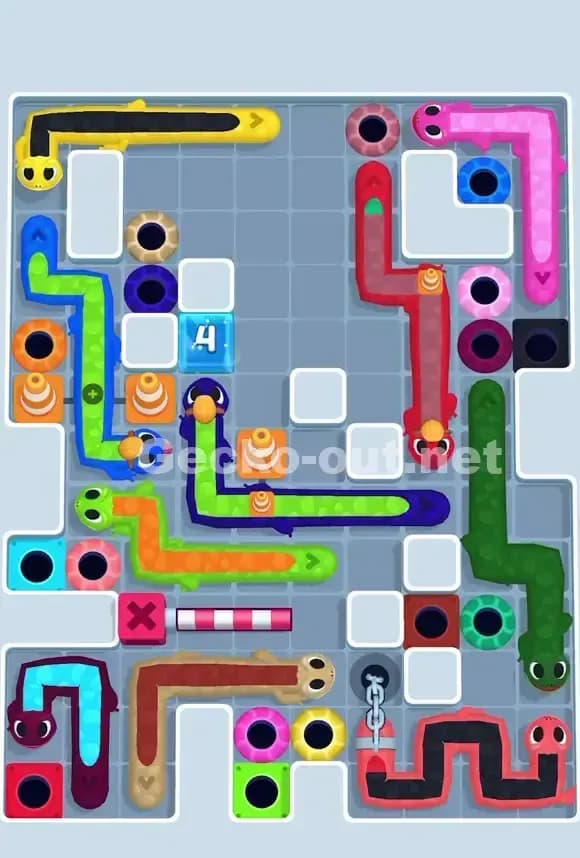
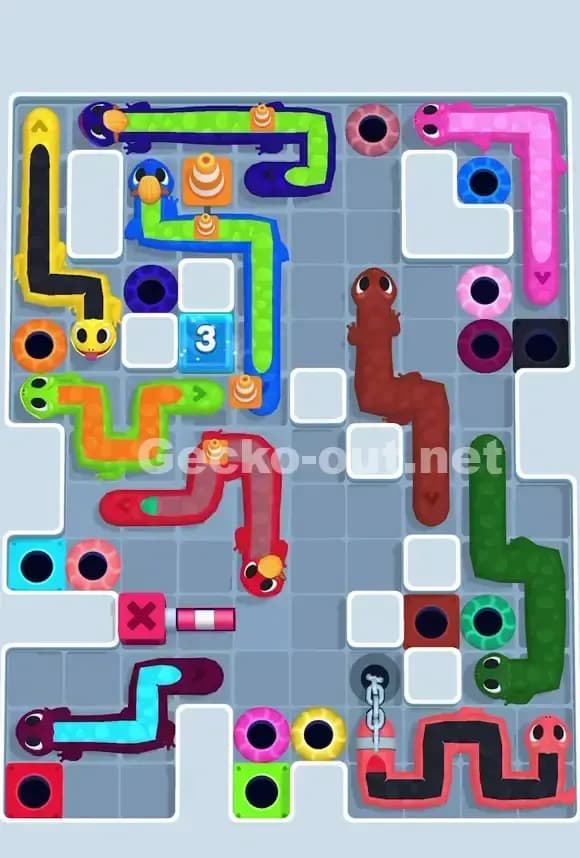

Gecko Out Level 711: Board Layout, Rules, and Win Condition
Starting Board: Geckos, Colors, and Major Obstacles
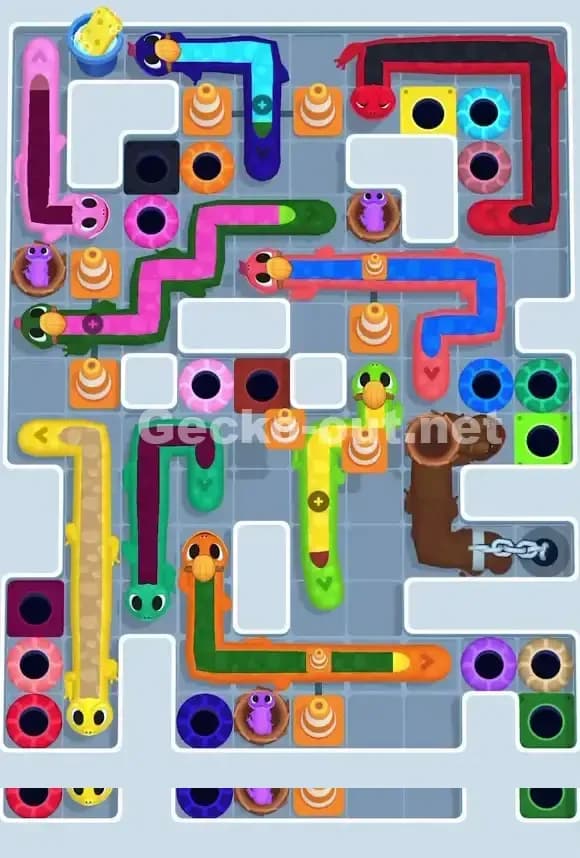
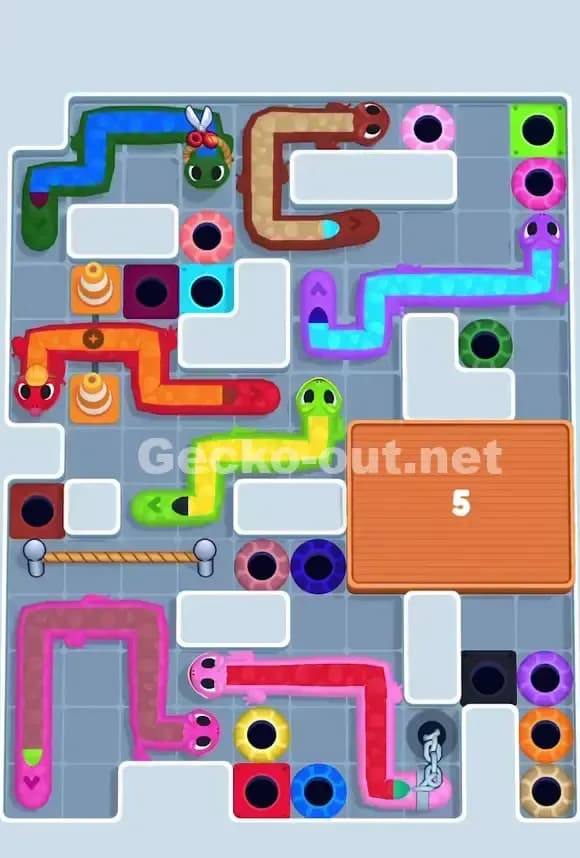
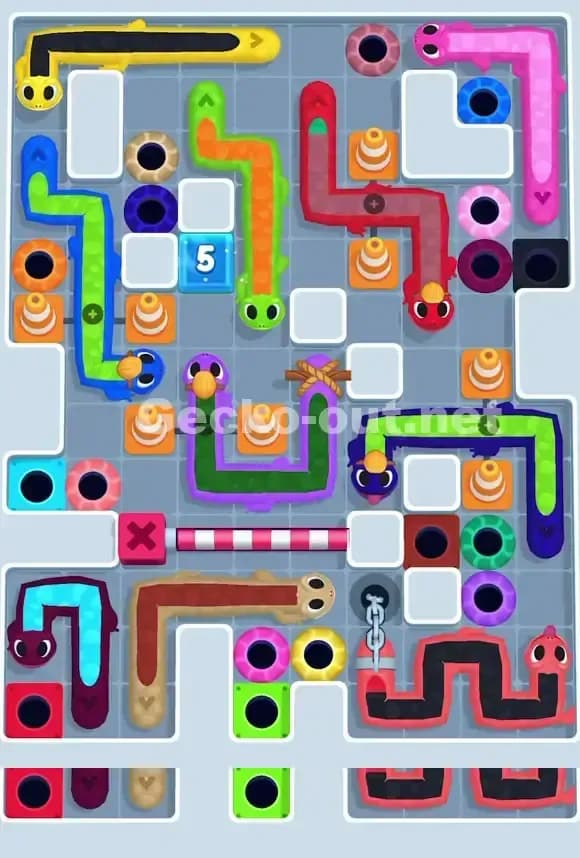
Gecko Out Level 711 is a densely packed puzzle with eight geckos spread across the board in five distinct colors: yellow, blue, green, red, and purple. The board itself is a maze of white walls, colored gang-gecko chains, and toll gates marked by orange concentric circles. You've got a cyan exit pair in the lower left, a pink exit on the upper right, red exits scattered across the middle and bottom sections, green exits on the lower right, and a blue exit on the upper right. What makes this level genuinely challenging is that almost every gecko is connected to at least one other gecko as a gang, meaning they move as a single unit. Additionally, several toll gates block key corridors, and the timer starts at just 5 minutes—though it feels shorter because every path requires deliberate planning.
The board layout forces you to think three or four moves ahead. White walls create natural choke points, and the gang connections mean that moving one gecko inadvertently positions another. You'll notice the yellow head gecko in the top-left corner is part of a long L-shaped chain, the blue and cyan pair huddle near the lower left, the green and orange geckos form multi-part chains in the center and right side, and the red geckos are scattered with one forming a tight pair. The win condition is simple: get all eight geckos (or five color groups, counting gangs) into their matching-colored holes before the timer hits zero. Fail to move one gecko out, and you restart.
The Timer and Path-Based Movement Challenge
The timer in Gecko Out Level 711 isn't forgiving, but it's fair if you move decisively. Each gecko's body follows the exact path you drag its head along—you can't cheat physics or skip tiles. This means a long gecko with three or four body segments takes several seconds to drag to its exit, and if you've miscalculated the path, you're locked into that animation. The challenge isn't mechanical skill; it's logical sequencing. You must clear the board in the right order so earlier geckos don't clog corridors that later geckos need.
Pathing Bottlenecks and Logical Traps in Gecko Out Level 711
The Central Corridor Choke Point
The single biggest bottleneck in Gecko Out Level 711 is the central vertical corridor running through the middle of the board. This narrow passage connects the upper-middle section to the lower-middle section and is where three different gang chains need to pass through at various points. The green-orange gang, in particular, is a long serpentine chain that, if moved carelessly, will block this corridor for 3–4 seconds. If the red gang or another gecko also needs to pass through before the green chain fully exits, you've created a deadlock. This is why the opening move is so critical: you must deliberately route the longest geckos first and ensure they clear the main arteries before you commit shorter geckos to the same paths.
Toll Gate Timing and the Purple Gecko Trap
The orange toll gates (marked with concentric circles) scattered across the board aren't walls—they're slowdown zones. When a gecko crosses a toll gate, it pauses momentarily. In Gecko Out Level 711, there's a particularly nasty toll gate near the center that forces the purple gecko to take a longer detour if you want to avoid congestion. Many players instinctively drag purple directly toward its hole, only to realize it's passing through a toll gate while another gecko is also navigating that same area. The fix is to delay the purple gecko entirely until the corridor is clear, or to route it through the upper path, even though it's longer.
The Gang Connection Surprise
Here's a subtle trap that catches most first-time players: when you move one gecko in a gang, the others follow along the same path, but their heads don't drag—their bodies are pulled. This means if you drag the head of the blue gecko in the lower-left pair, the cyan gecko gets dragged alongside, and if there's a wall or another gecko blocking the cyan gecko's body position, the entire chain gets stuck and the drag fails. In Gecko Out Level 711, the cyan-blue pair is tight enough that you have limited flexibility. You absolutely must clear the space directly to the right and below them before attempting to move either one, or you'll waste precious seconds on failed attempts.
The Frustration Point and the Breakthrough
I won't lie—my first two attempts at Gecko Out Level 711 were chaotic. I was trying to move geckos as fast as possible, dragging the yellow head down a corridor without realizing the red gang was queuing up behind it, resulting in a collision and a restart with only two minutes left on the clock. The breakthrough came when I forced myself to pause for thirty seconds, map out which gecko absolutely had to leave first (the yellow and blue gangs, because they're the longest), and then commit to moving. Once I accepted that a 30-second pause at the start would save 2 minutes of backtracking, the level went from frustrating to manageable.
Turn-by-Turn Path Strategy to Beat Gecko Out Level 711
Opening: Yellow First, Then Blue
Start by moving the yellow head gecko in the top-left corner. Don't drag it straight down toward its exit at the bottom; instead, curve it clockwise around the white walls, exiting it into the yellow hole in the bottom-right area. This takes roughly 12–15 seconds of careful dragging, but it accomplishes two things: it clears the top-left corner entirely, and it removes the longest single chain from the board. Once yellow is out, immediately move the blue gang (the blue head with the cyan body attached at the lower left). Drag the blue head down and to the right, following the corridor that yellow just vacated. Park the cyan gecko's exit hole (the cyan exit pair at the lower left) second; pull the blue head all the way to the blue exit on the upper right. This is a long drag, but the board is now cleaner.
After yellow and blue are out, pause and assess. You've bought yourself breathing room. The central corridor is now passable, and the lower-left quadrant is emptied entirely.
Mid-Game: Untangling the Center
Once yellow and blue are gone, tackle the green-orange gang next. This is the serpentine chain in the center-right of the board. The green head should be dragged counterclockwise, away from the toll gates, toward the green exit on the lower right. This gecko is long, so expect 10–12 seconds of dragging. The orange body segments follow along, and since there's no direct orange exit needed (orange is a toll gate marker, not a gecko color in this puzzle, though double-check your screenshot), the orange "gecko" segments are actually part of the green gang. Once the green gang is clear, the central corridor opens significantly.
Next, move the purple gecko from the center-bottom area. Drag its head upward and to the left, curving around the white walls and avoiding the toll gates. The purple exit is on the upper right, so this is another moderately long drag. Key point: do not drag purple through the center corridor while any other gecko is still moving through it. Sequence is everything here.
End-Game: Red Geckos and the Final Rush
By the time you've moved yellow, blue, green, and purple, you should have roughly 1.5 to 2 minutes remaining if you've been efficient. The red geckos are scattered, and there are multiple red exit holes, so you have flexibility in which red gecko reaches which red hole. There are at least two red geckos visible, possibly more if some are gang-connected. Drag them to their respective red exits in whichever order makes physical sense—generally, the red gecko closest to a red hole should go first, since that's the quickest exit.
If you're running low on time (below 45 seconds), don't panic. Look for the shortest remaining gecko and the shortest remaining path to its hole. A short gecko might only take 3–4 seconds to drag, so even with 30 seconds left, you might have time to clear two more. Commit fully; hesitation is your enemy at this stage.
Why This Path Order Works in Gecko Out Level 711
Head-Drag Sequencing Untangles the Knot
The genius of this approach is that you're removing the biggest obstacles first. In Gecko Out Level 711, yellow and blue are the longest geckos, so they consume the most board space and create the most bottlenecks when moving. By dragging them out first, you're essentially pulling the knot apart from the outside in. Once they're gone, shorter geckos (green, purple, red) have cleaner paths and fewer collision risks. The body-follow rule means every gecko leaves a "path scar" on the board briefly, but once they're fully out of their holes, that space is reclaimed. This order maximizes reclaimed space before you attempt tighter maneuvers.
Timer Management: Pause vs. Commit
In the opening 30 seconds, pause. Really look at the board. Identify the five groups (or however many color groups you see) and their exit holes. Trace each path mentally. This pause buys you confidence and prevents the panic-dragging that leads to failed attempts and timer waste. Once you've committed to a path (dragging a gecko's head), don't interrupt yourself. Let the animation finish. Stopping mid-drag or trying to correct a path wastes time more than getting it "wrong" and dealing with the consequence. If a path truly doesn't work (a gecko is genuinely blocked), accept the restart and apply what you learned.
Booster Strategy: Optional, Not Mandatory
Gecko Out Level 711 can be beaten without boosters if you follow this sequence. However, if you find yourself with 20 seconds remaining and three geckos still on the board, an extra time booster (+30 seconds) is a valid safety net. Similarly, a hint booster at the very start can reveal the exit layout faster, saving you mental-mapping time. But don't rely on these. The puzzle is solvable with pure logic. Treat boosters as a second chance, not a primary strategy. If you're consistently using boosters on Gecko Out Level 711, revisit your path order—you're likely moving in the wrong sequence.
Mistakes, Fixes, and Logic You Can Reuse in Other Gecko Out Levels
Common Mistake #1: Moving the Longest Gecko Last
Problem: Players often move shorter geckos first, thinking they're "easier." Then, when the longest gecko (yellow or blue) needs to exit, there's no clear path left, and it gets stuck.
Fix: Always identify the longest gecko and move it first, regardless of its exit location. A longer drag is easier to plan than a congested corridor.
Common Mistake #2: Ignoring Gang Connections Until It's Too Late
Problem: Dragging a gecko and discovering it's attached to another gecko mid-drag causes failed attempts and frustration.
Fix: Before you touch any gecko, trace every connection. If blue is attached to cyan, move them as a unit, not separately. Plan the exit for both from the start.
Common Mistake #3: Using Toll Gates as Shortcuts
Problem: Toll gates slow geckos down. Players sometimes assume they can route geckos through toll gates to "save space." In reality, they're just adding time and congestion.
Fix: Avoid toll gates if there's an alternate path. In Gecko Out Level 711, the toll gates near the center should be skirted, not crossed.
Common Mistake #4: Dragging Without Checking Exit Holes
Problem: Moving a gecko only to discover the exit hole is blocked by another gecko or a wall.
Fix: Always look at where you're dragging a gecko before you start the drag. Trace the full path mentally, including the final position of the gecko's head at the exit hole.
Common Mistake #5: Panicking in the Final Minute
Problem: With 60 seconds left and two geckos remaining, players make rushed, sloppy drags that fail and burn time.
Fix: The last 90 seconds are when you move slowest and most deliberately. Rushing is a trap. Take your time, get it right, and accept that you might need a booster if time is genuinely low.
Applying This Logic to Similar Levels
Gecko Out Level 711's lesson—sequence by size and untangle from the outside in—works on any level with multiple gang geckos and a tight timer. Whenever you see a board with long chains and narrow corridors, identify the longest gecko first, move it completely clear, and then reassess the board. The principle is universal: complexity dissolves when you remove variables systematically. Additionally, any level with toll gates should use the same "avoid and re-plan" strategy. Don't assume a marked zone is a good route just because it's marked.
The Encouraging Truth About Gecko Out Level 711
Gecko Out Level 711 is tough—no question. The density of geckos, the gang connections, and the tight timer can make it feel impossible on your first few attempts. But it's absolutely beatable with a clear plan and calm execution. The puzzle has exactly one optimal sequence (or maybe two, depending on flex points), and once you find it, you'll cruise through with 30–45 seconds to spare. The breakthrough moment comes when you realize that a 30-second pause at the start and deliberate, confident drags (rather than panicked, quick ones) are faster overall. You've got this. Plan the path, trust the sequence, and drag decisively.