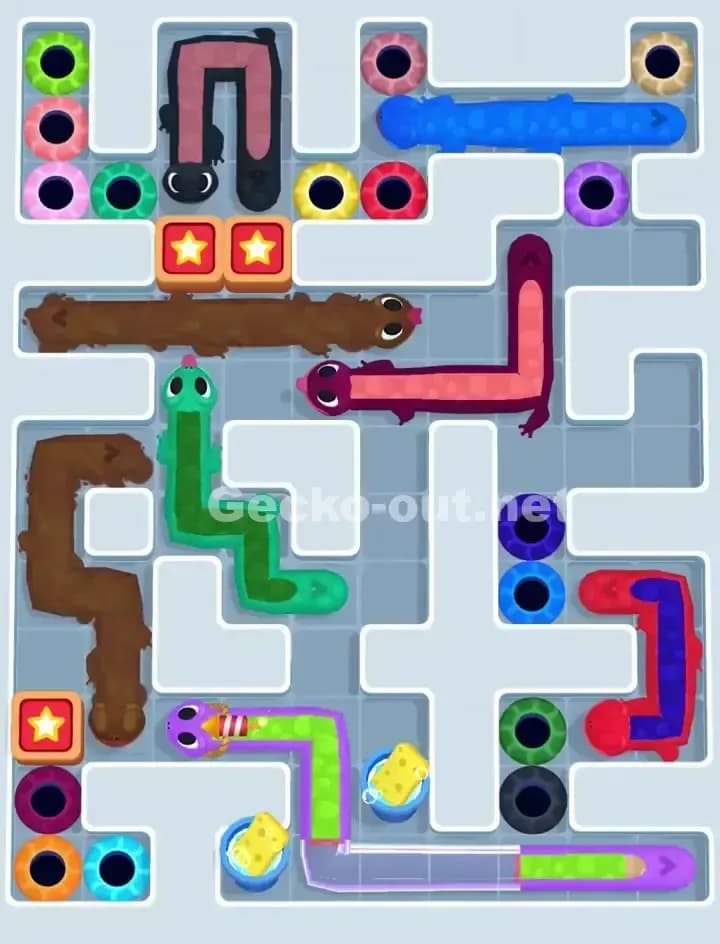
Gecko Out Level 1021 Solution Walkthrough | Gecko Out 1021 Answer
How to solve Gecko Out level 1021? Get step by step solution & cheat for Gecko Out level 1021. Solve Gecko Out 1021 easily with the answers & video walkthrough.
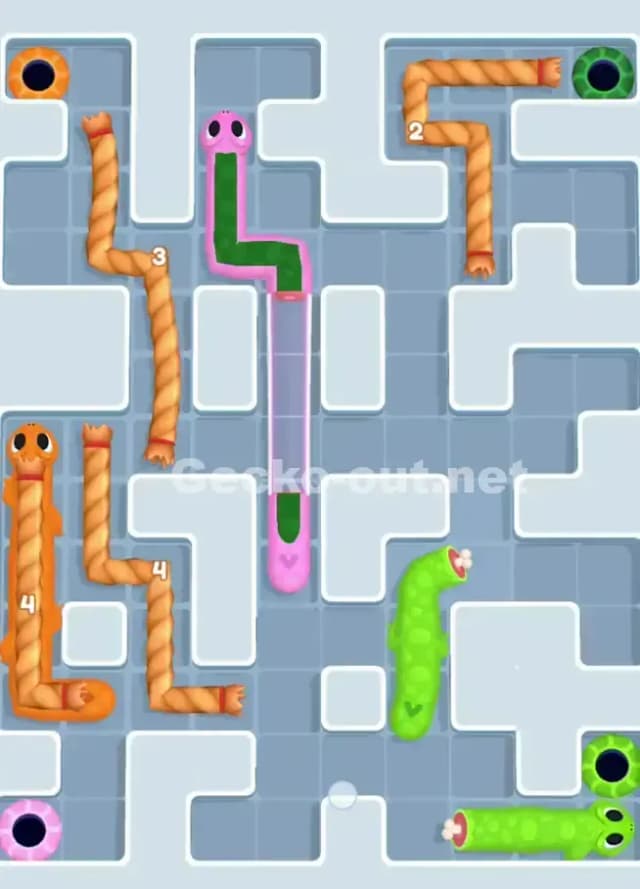
Gecko Out Level 1021: Board Layout, Rules, and Win Condition
Understanding the Starting Board
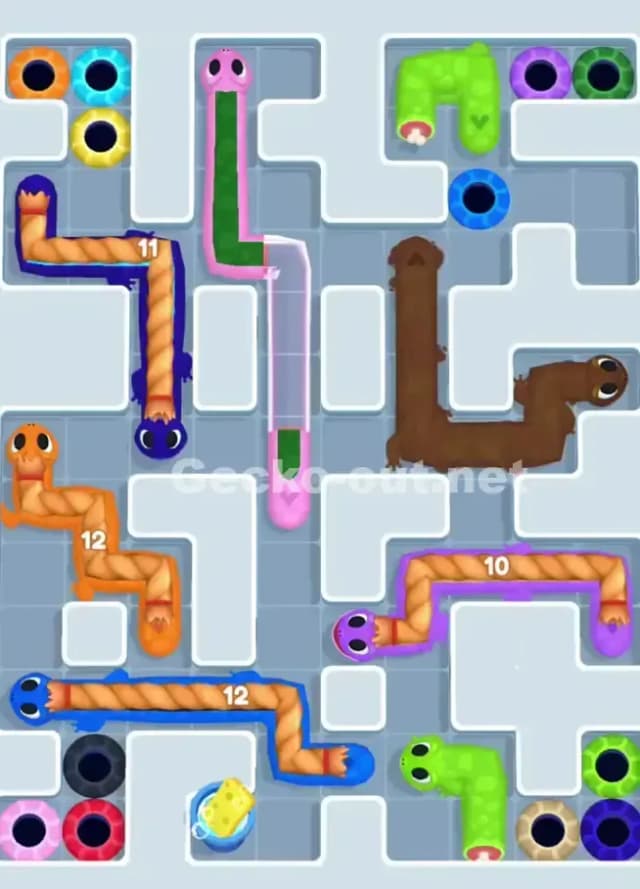
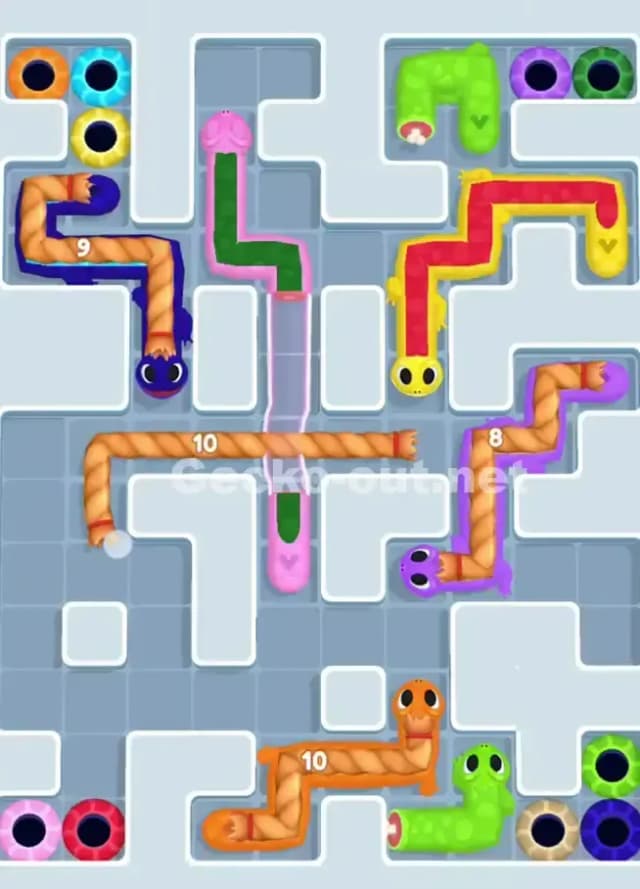
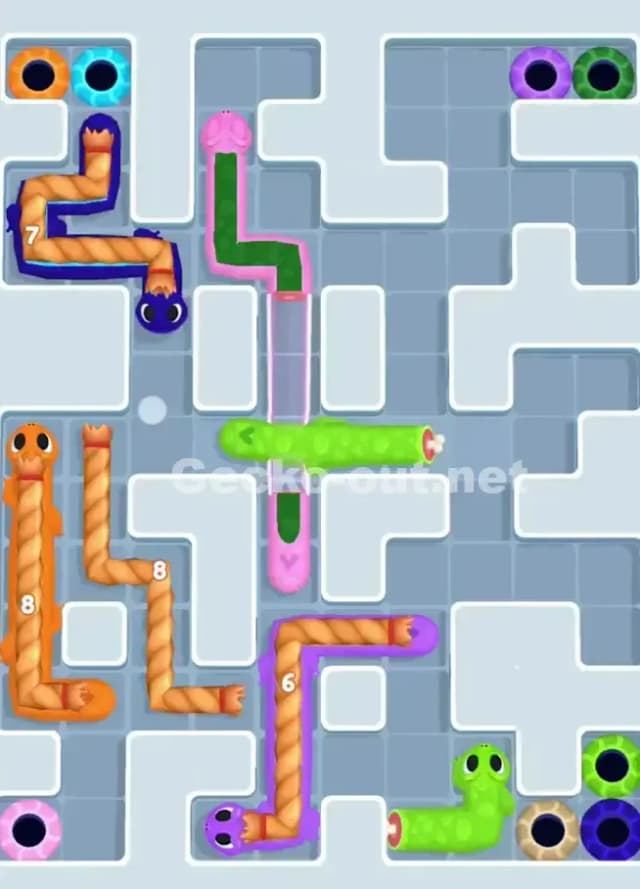
Gecko Out Level 1021 is a maze-heavy puzzle with eight geckos of varying lengths crammed into a tight, interconnected grid. You've got colorful long-bodied geckos (orange, blue, pink, brown, and lime green) scattered across the board, plus shorter color-matched heads waiting to link up or already attached to their bodies. The board itself is a labyrinth of gray pathways with white walls creating narrow corridors and dead-end rooms. At the top left sits an orange gecko head next to a cyan one; the yellow gecko waits below them. On the right side, you'll spot purple and green heads at the top, and at the bottom, there's a jam of pink, red, blue, and lime-colored geckos all competing for very limited exit space. Each gecko must reach a hole of its exact color, and the timer is unforgiving—you've got roughly two minutes to choreograph all eight escapes simultaneously.
The Win Condition and Why the Timer Matters
To beat Gecko Out Level 1021, every single gecko head must be dragged into its matching-color hole before the countdown hits zero. The twist is that your drag path determines the entire body's route, and bodies can't overlap walls, other gecko segments, or blocked exits. This means you can't just race geckos out one by one; you have to plan multi-gecko sequences so that early exits don't trap later ones. The timer forces you to work with confident, deliberate strokes rather than slow trial-and-error, which makes reading the board layout in the first ten seconds absolutely critical.
Pathing Bottlenecks and Logical Traps in Gecko Out Level 1021
The Central Choke Point: The Pink Gecko and the Bottom Corridor
The single biggest bottleneck in Gecko Out Level 1021 is the pink gecko's path through the central-lower section. This long, winding pink body occupies the middle-left area of the board and has very limited exit routes. If you don't move the pink gecko out early, it'll block access to the bottom corridor where several other geckos (blue, orange, and lime) also need to pass. I found that committing to pink's exit in the first 20 seconds actually opens up a domino of easier moves for everyone else. It's counterintuitive—moving the longest gecko first seems risky—but it's the key to unlocking the rest of the puzzle.
Subtle Problem Spot #1: The Orange Gang at the Bottom Left
The bottom-left corner harbors two orange geckos stacked together (labeled 12 in the image). They're not linked as a true "gang," but they occupy the same tight corner and share very similar exit paths. If you drag one carelessly, you'll pinch the other against a wall. You need to separate them mentally: the top orange must exit via one route while the bottom orange takes a completely different path. Miss this distinction, and you'll waste thirty seconds untangling them.
Subtle Problem Spot #2: The Lime-Green Gecko's Narrow Escape
The lime-green gecko on the right side of the board has a deceptively short body but is wedged into a room with only one viable exit corridor. That corridor also feeds into the zone where the blue and purple geckos exit. If you route the lime gecko greedily and don't leave it a clean lane, it'll collide with the blue gecko mid-drag, causing both to jam. The solution is to move lime green late—after blue and purple have cleared—so it has a wide-open highway.
My Honest Reaction to the Difficulty
When I first looked at Gecko Out Level 1021, I felt that familiar flutter of dread: too many geckos, too many walls, too little time. I tried brute-forcing the first three moves, and by move four, I had created a tangled mess where a brown gecko's tail was blocking a pink gecko's head. Then I stopped, took a breath, and traced each gecko's path with my finger on the screen without dragging. That's when it clicked—the pink gecko had to go first, not because it's the longest, but because it's the lock holding everyone else in place. Once pink escaped, the board suddenly felt spacious.
Turn-by-Turn Path Strategy to Beat Gecko Out Level 1021
Opening: Pink Gecko and Upper Orange First
Start by dragging the pink gecko's head downward and to the left, following the corridor toward its matching pink exit hole. Don't rush; trace the exact path you need it to follow, making sure the body doesn't clip any walls on the way. This move takes about 8–12 seconds but frees up the entire central section. Immediately after (within 5 seconds), tackle the orange gecko head at the top left. Drag it around the corner into its orange hole. These two moves are your setup; they transform the board from a locked maze into an open puzzle.
Mid-Game: Reposition Long Bodies and Keep Lanes Open
Next, you'll address the blue gecko at the bottom left. This long fellow has a convoluted path through the lower corridor. Drag its head steadily upward and to the right, following the winding gray pathway until it reaches the blue exit in the center area. As you do this, keep an eye on the yellow gecko—its path intersects with blue's in one tight spot. Time the yellow gecko's exit for immediately after blue clears, so yellow can slide through without collision.
Now it's time to handle the two orange geckos at the bottom left corner. You've got maybe 45 seconds left on the timer. Drag the top orange first, routing it around the bottom of the board and up toward its exit on the left side. Then, without delay, drag the lower orange along a different path—it'll swing around the edges of the board to reach the same orange exit. These two moves require precision but aren't time-consuming if you've already cleared the central corridor.
End-Game: Purple, Green, and Brown in Rapid Succession
With roughly 30 seconds remaining, focus on the purple gecko and the two green geckos at the top right. The purple gecko should exit through the magenta/purple hole on the left-center area. Drag its head left and slightly down; its long body will snake through the now-open corridors smoothly. Next, grab one of the green geckos and route it to its matching exit—green geckos on this level typically have clearer paths since you've removed other blockers.
Finally, attend to the brown gecko on the right side. It's a mid-length body with a relatively direct route to a brown hole if the board is clear. If you're under 15 seconds and feel the heat, don't overthink it—just drag the brown head straight toward its exit and trust the path you've already validated.
Why This Path Order Works in Gecko Out Level 1021
How Head-Drag Pathing Untangles the Knot
The order I've outlined (pink → orange → blue → yellow → bottom oranges → purple/green → brown) works because it respects the body-follow rule. When you drag pink out early, its long body vacates the center, creating space for shorter geckos like yellow to move without collision. Each subsequent move assumes the previous one is complete—no overlaps, no "temporary" blocking. This is the opposite of real-world untangling, where you might have to move objects back and forth. In Gecko Out Level 1021, once a gecko is out, it's gone for good, so you're gradually shrinking the occupied space on the board rather than shuffling it around.
When to Pause and When to Commit
I recommend pausing for the first 10–15 seconds of Gecko Out Level 1021 to trace the two or three most critical paths (pink, orange, blue) with your finger. Then commit: start dragging without second-guessing. Pausing mid-puzzle to reconsider is a timer killer. If you've identified pink as the lock and you know its path is clear, drag it. Trust the mental work you did up front. Conversely, don't pause after every single gecko; keep momentum by having the next move planned while the current gecko is exiting.
Boosters: Optional, But Time-Add Is Useful Here
Gecko Out Level 1021 is tough enough that a Time+ booster (adding 30 extra seconds) becomes tempting. Honestly? It's not strictly necessary if you execute the path order above, but it's reasonable insurance if you're prone to hesitation or if you flub one drag and need recovery time. I'd skip it on the first attempt and only deploy it after a near-miss. The Hint booster is less useful here because the solution is about execution, not discovery—you won't gain much by being told which gecko to move next if you're already anxious about the timer.
Mistakes, Fixes, and Logic You Can Reuse in Other Gecko Out Levels
Mistake #1: Moving Long Geckos Last
Problem: Players often save the longest gecko (pink, in this case) for the end, thinking it'll be easier once the board is cleared. Fix: Move the longest gecko first if it's blocking critical pathways. A long gecko taking up center space is a bottleneck; removing it early is almost always optimal. Reuse: On any level with a "gang" of geckos or a locked central corridor, identify the longest occupant and prioritize it.
Mistake #2: Not Pre-Planning Exit Sequences
Problem: Players drag a gecko and then decide where the next one goes, leading to collisions. Fix: Before you drag anything, mentally walk through the first 3–4 moves in order. Know which gecko exits second, third, and fourth. Reuse: This 10-second mental investment saves 30 seconds of trial-and-error on any packed level.
Mistake #3: Dragging Paths Too Slowly or Hesitantly
Problem: Uncertain drags often veer off course or clip walls, requiring restarts. Fix: Once you've traced a path, drag with confidence and fluidity. A smooth, decisive drag is less likely to catch a wall corner than a cautious, stop-and-start drag. Reuse: On all timed Gecko Out levels, slow movement is the enemy; practice smooth drags on easier levels so muscle memory carries you through hard ones.
Mistake #4: Forgetting That Bodies Can Block Exits
Problem: Players drag a gecko's head to the exit but don't ensure the body has a clear path, so the tail gets stuck in a wall. Fix: Always trace the entire path from head to tail, not just the head position. Reuse: This is universally true in Gecko Out games; the exit hole accepts the head, but the body must clear walls entirely.
Mistake #5: Underestimating the Timer
Problem: Players don't realize how fast 120 seconds disappears and second-guess themselves halfway through. Fix: Accept that Gecko Out Level 1021 is a race. Move with urgency, not panic. Execute your plan at speed. Reuse: On any level with eight or more geckos, assume the timer is tighter than it feels and work accordingly.
How This Logic Transfers to Similar Levels
If you encounter another Gecko Out level with frozen exits, gang geckos, or multi-colored obstacles, use this same framework: identify the bottleneck, move it early, keep lanes open, and execute rapidly. The specific gecko colors and exit positions change, but the principle of unlocking the knot by removing the lock first remains universal.
Conclusion: Gecko Out Level 1021 Is Tough, But You've Got This
Gecko Out Level 1021 is genuinely challenging—it combines timer pressure, a crowded board, and path-planning complexity. But it's absolutely beatable once you see pink gecko as the key that unlocks everything else. Take those first 10 seconds to read the board, commit to the path order I've outlined, and move with steady confidence. You'll watch the board open up like a flower, geckos will exit in clean succession, and you'll hit that timer with geckos to spare. The first attempt might feel overwhelming, but the second or third time, you'll recognize the pattern and execute it flawlessly. That's the beauty of Gecko Out Level 1021—it rewards planning and punishes hesitation, but once you've solved it once, the solution is yours forever.