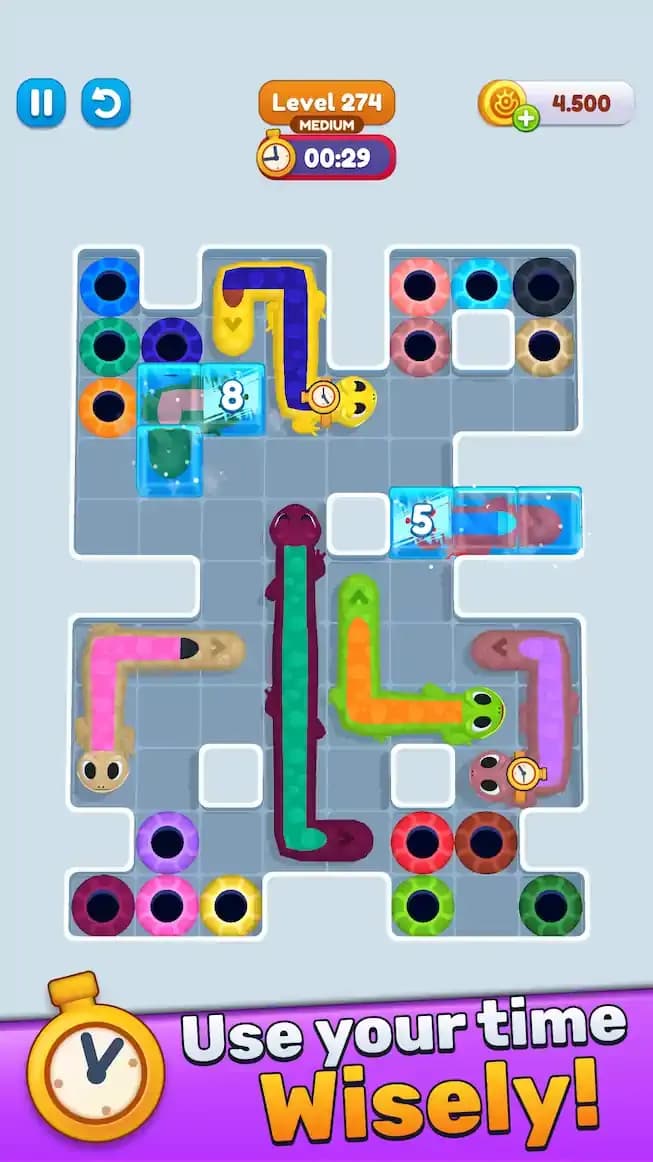
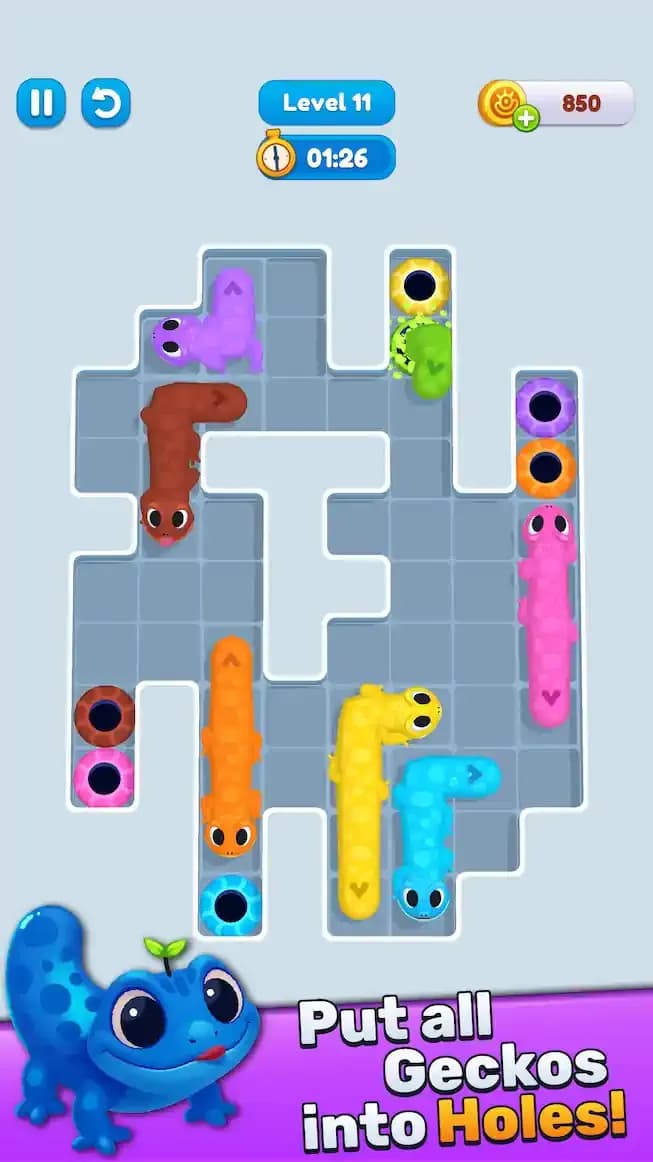
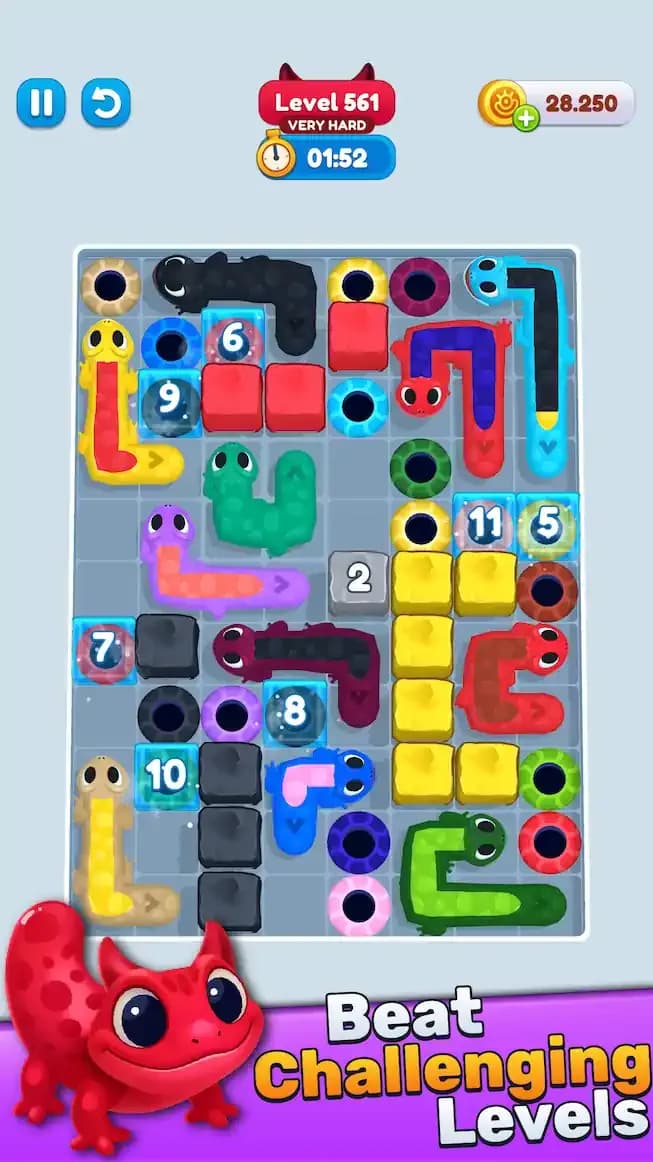
Obstacles are where Gecko Out stops being a cozy drag-the-lizard game and turns into a real puzzle grinder. The basic premise stays the same: you drag geckos by the head or tail into their matching colored holes before the timer runs out, and if time ends or you run out of valid doors, you lose the level and a life.
But the moment the game starts throwing ice, chains, keys, bombs, and weird “gecko-with-a-hole-on-its-back” gimmicks at you, the entire mental model shifts. You’re not just shoving traffic through exits anymore—you’re solving layered constraints under time pressure.
This article is all about that second phase of the game: understanding what each obstacle really does to the board, and how to think like the designer so you stop feeling ambushed by new mechanics and start enjoying the chaos.
How the Board Actually Works – Timer, Space, and Pressure
Let’s ground the basics so the obstacles make sense:
- Objective: Drag each gecko into a hole of the same color.
- Win condition: Every gecko reaches a matching hole before the timer runs out; you earn coins when you succeed.
- Fail condition: Time expires or you’ve boxed yourself into a position where no correct doors remain.
The obstacles don’t change those rules; they just:
- Restrict movement (gates, color paths, straight-line geckos).
- Delay access (ice, stones, locked geckos, frozen holes).
- Hide information (hidden geckos, masked geckos, color-changing holes).
- Add side objectives (cleaning dirty geckos, healing sick ones, escorting tools like scissors or carriers).
So when a level feels “impossible,” it’s usually not because the board is unfair; it’s because two or three of those categories are stacked on top of each other and your brain is still trying to play “vanilla Gecko Out.”
The Full Obstacle Bestiary (Without Drowning You in Icons)
The official obstacle list is long: stacked geckos, frozen geckos and holes, keys and locks, rocks and crates, colored paths, linked geckos, movable boxes, sliding gates, permanent holes, bombs, fireworks, medics and sick geckos, hollow geckos you can slide through, and exotic things like Carrier and Rope Carrier geckos that literally carry mechanics on their backs.
Rather than memorise every icon, it’s more useful to group them by what they do to your planning:
- Layered bodies: Stacked, multi-stacked, matryoshka, sliced, connected, tail-first-only geckos.
- Resource gates: Stones, crates, colored stones, frozen geckos, frozen holes, locks & keys, rope carriers.
- Information puzzles: Hidden geckos, masked geckos, multi-color holes.
- Spatial control: Color paths, movable boxes, sliding gates, permanent holes, worker cones, sleeping platforms.
- Urgency modifiers: Bomb geckos, time-bonus carriers, fireworks that clear starred blocks.
- Utility characters: Dirty geckos and buckets, medic & sick pairs, mother & baby geckos, hollow geckos, carrier-style geckos.
When you see a new obstacle, ask yourself: Which bucket is this in? Once you know whether it’s blocking space, hiding info, or costing “charges” to clear, it stops feeling random.
Linked Bodies – Obstacles That Move When You Move
These are the ones that make the board feel like a knot.
Connected, Tail-Stick, and Straight Geckos
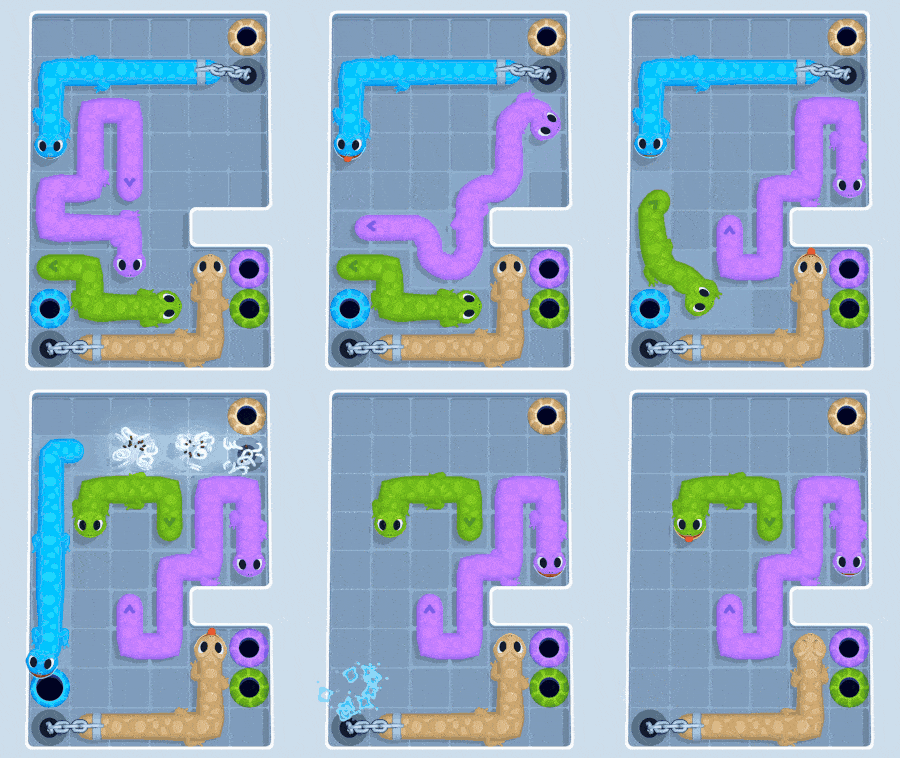
- Connected Geckos are literally chained segments; moving one affects the entire body. You need to slot every part into holes one by one, which means you can’t just clear the head and forget the tail.
- Tail Stick Geckos only enter holes head-first, which sounds minor but kills a lot of “lazy” lineups—if you approach a hole from the wrong direction, that path is dead.
- Straight Geckos only move in the direction of their arrows. They’re basically sliding blocks: you’re solving “how do I line this up with its hole along that one axis?”
With all three, your priority becomes alignment over “just getting closer.” If a move brings the gecko physically nearer but destroys the angle, it’s a bad move.
Tied, Mother, Worker, and Rope-Carrier Geckos
- Tied Geckos need to be put into holes to break their chains. Until that happens, they’re space-occupying obstacles and future movers.
- Mother Geckos must collect their baby geckos first; if you send her home too early, you’ve bricked the level.
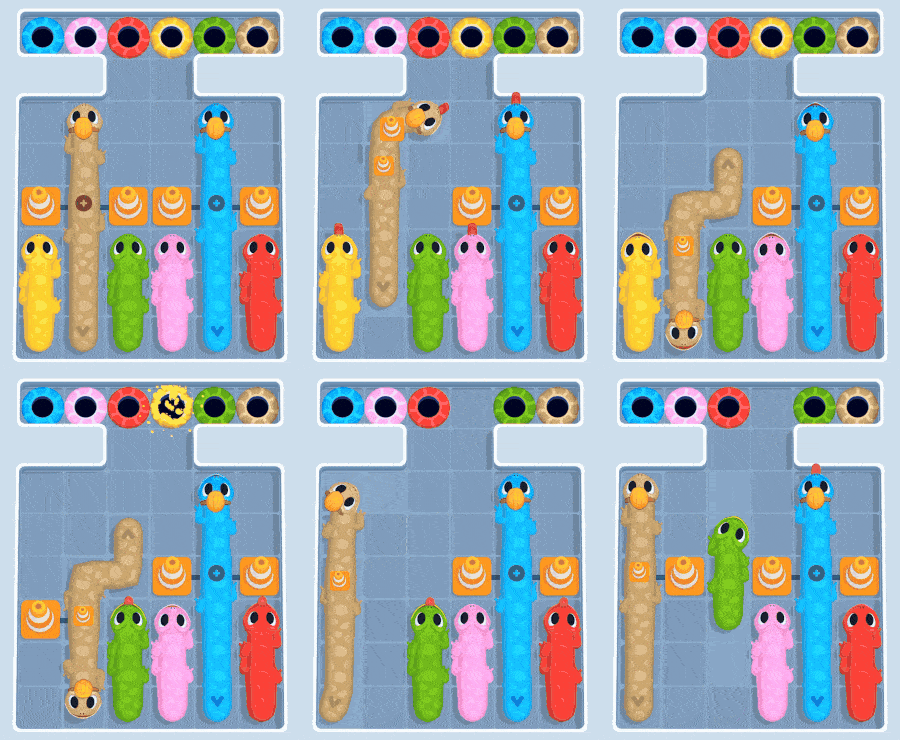
- Worker Geckos place cones on nearby tiles, turning open grid into mini-walls and reshaping the board as they move.
- Rope Carrier Geckos carry a rope that becomes its own objective when you send them into their hole: you free the rope, then have to satisfy the number printed on it by sending more geckos home.
These are sequence obstacles. They punish you for acting too early. You want to treat them like puzzle switches:
“What must happen before I cash this gecko in?”
If you mis-order them, no amount of mechanical skill will save you.
Ice and Hidden Info – Obstacles That Lock Your Options
These are the “you can’t play with this yet” mechanics, and they’re easy to misread.
Frozen Geckos, Frozen Holes, Stones, Crates, Colored Stones
All of these work on a similar principle: a number of geckos must reach holes to break them. Frozen geckos and frozen holes show counters; rocks, crates, and colored stones require a quota of geckos (sometimes of a specific color) to be placed before they disappear.
That means:
- They’re sinks for your “gecko budget.”
- You can’t just greedily finish every easy gecko; some are effectively “spent” to pay for breaking terrain.
In practice, you:
- Count how many clears you must spend on stones/ice.
- Check if that still leaves enough matching doors for every remaining body.
- Decide which geckos are “payment” and which are “VIPs” you must protect.
Hidden and Masked Geckos, Multi-Color Holes
- Hidden Geckos only reveal their color after you send a certain number of geckos home.
- Masked Geckos hide their color and force you to test holes until they fit.
- Multi-Color Holes change color each time they’re filled; you clear one color layer to expose the next.
These are pure information puzzles. The big mindset shift:
- Don’t immediately “solve” every mystery gecko.
- Use the rest of the board to constrain possibilities first.
- If there’s only one color that can reach a certain door, that door basically “claims” the hidden gecko for you.
Board Control – Gates, Boxes, Permanent Holes, Fireworks and Time
Now we’re into obstacles that reshape the grid itself.
- Color Paths only allow geckos of the same color to travel along them, turning chunks of the board into “lanes” controlled by specific colors.
- Movable Boxes slide in the direction of their arrows when dragged and can either unblock routes or create new choke points.
- Sliding Gates open only after enough geckos reach their holes. Once open, they change the topology of the board—sometimes turning a dead area into the key corridor.
- Permanent Holes keep a gecko on the board permanently once filled, so you’re choosing where to place an immovable wall.
- Worker Geckos dropping cones as they move gradually fill the map with hazards.
- Firework Geckos clear starred blocks when placed, effectively detonating a chunk of obstruction.
Throw Time Bonus Geckos into that mix—drop them into their holes and you get extra seconds on the timer—and you’ve got a clear design pattern:
The board isn’t static. Your moves literally sculpt the level.
That’s why the official tips tell you to pause before rushing your first move, scan the whole board, and plan your sequence.
If you don’t, you’ll open a gate too early, misplace a permanent hole, or waste a firework in a direction that doesn’t actually liberate the routes you need.
Tool-Triggered Obstacles – Scissors, Dirt, Sleep, Medics & More
Some obstacles basically say: “You need the right specialist.”
- Scissor & Rope: A scissor-carrying gecko needs to reach its hole to cut ropes binding others. This is a classic escort scenario: clear a path for them first, then enjoy the freed snakes.
- Dirty Geckos: They have to hit a bucket before they’re allowed into a normal hole. So bucket tiles are now part of your routing graph.
- Sleeping Geckos: They sit on movable platforms; you drag the platform to line them up with holes. It’s a sliding puzzle inside your main puzzle.
- Medic & Sick Geckos: The medic needs to reach the sick geckos first; only then does the puzzle fully open up.
All of these encourage a simple but important habit:
Identify the “linchpin” gecko at the start of the level.
Ask yourself, “Which piece, once solved, makes everything else easier?” That’s the one you route first, even if its path isn’t the easiest mechanically.
Urgency and Risk – Bombs, Time Bonuses, and Lives
Two mechanics directly mess with your pulse:
- Bomb Geckos need to be sent home before their individual timer expires. Let them tick down and the level blows up, regardless of how well you were doing.
- Time Bonus Geckos add seconds when placed, effectively converting gecko routes into extra breathing room.
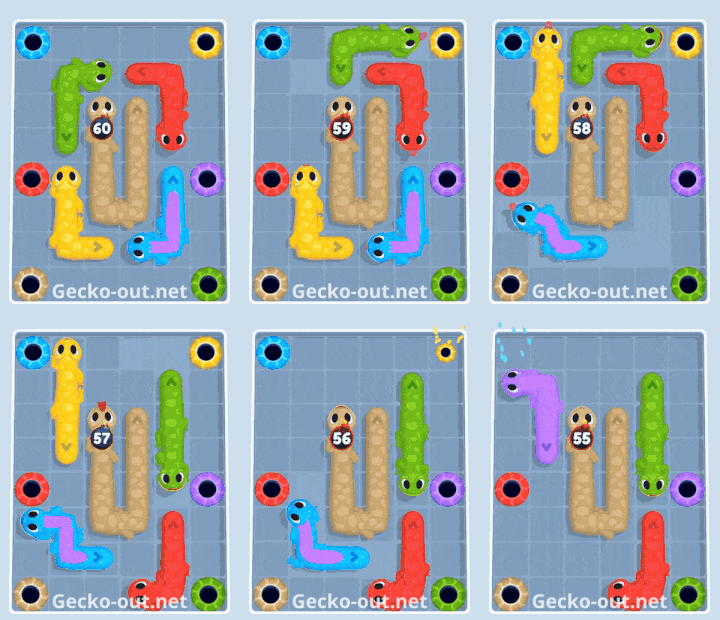
Combined with the global level timer and the fact that running out of time costs you a life (with regeneration or refills as your recovery options), these geckos turn the game into risk management:
- Do you stabilise the board first, then grab the bonus?
- Or do you sprint for the bomb/clock and accept a slightly worse layout afterwards?
I usually treat bombs as non-negotiable (first priority) and time bonuses as opportunistic (grab them when the path aligns with your main plan).
How Obstacles Change Your Puzzle Logic
On early levels, you can get away with playing “What can I move right now?”
Once obstacles pile up, you need to switch to:
“What must happen, and in what order, to leave a solvable endgame?”
That means:
- Planning backwards. Imagine the last gecko leaving the board. Where can that realistically be? Ensure you don’t block that scenario with permanent holes or worker cones.
- Protecting VIPs. Some geckos can pay for stones, ice, or colored stones. Others are required to clear weird paths or trigger fireworks in specific directions. Knowing which is which is half the puzzle.
- Front-loading board changes. Things like gates, fireworks, stones, and crates literally change the shape of the level. You usually want those resolved before the more fragile routing problems.
The devs even spell it out: every level is beatable without boosters, and your real tools are taking your time, scanning the whole board, and thinking a few moves ahead.
Expert Strategies for Obstacle-Heavy Levels
Here’s how I actually approach “oh no” boards.
1. Use the Pre-Move Planning Phase
Before you drag anything:
- Identify bombs, keys, medics, scissors, carriers—those are priority pieces.
- Track obvious quotas: frozen tiles, stones, crates, colored stones.
- Spot permanent holes and worker cones: where will the map get worse over time?
That 5–10 seconds of “doing nothing” is often the difference between a clean solve and a scramble.
2. Prioritise Space-Creating Moves
When in doubt:
- Moves that open corridors (gates, fireworks, destroyed stones, cleared crates) are worth more than easy exits.
- Moves that consume doors without changing the board (sending an already-free gecko through a very accessible door) are often traps.
If you’re choosing between “clear a bomb gecko that frees a lane” and “finish a random short gecko just because it’s there,” take the bomb every time.
3. Respect Mixed Mechanics
The nastiest levels combine:
- A timed threat (bomb / low overall timer).
- A quota mechanic (frozen holes, stones, colored stones).
- A sequence piece (mother/babies, medic/sick, rope carriers).
On those, I mentally order my priorities:
- Avoid instant loss (bomb timer, global timer if it’s super low).
- Unlock new space (gates, fireworks, stones that are clearly chokepoints).
- Resolve sequence pieces in the right order.
- Only then “clean up” easy geckos.
4. Know When to Reset
The official tips even recommend stepping away and replaying tough levels with a fresh eye.
If you’ve:
- Spent your time bonus geckos badly,
- Used a permanent hole in a corridor you now desperately need, or
- Triggered a worker or rope carrier in a way that floods important lanes,
then resetting is often faster than trying to salvage an unsalvageable board.
Common Mistakes Players Make with Obstacles
I keep seeing (and making) the same errors:
- Dragging the “key log” gecko too soon. You move a scissor / medic / rope carrier gecko before the path is safe, and suddenly the board is worse than before.
- Tunnel vision on one color. Color paths and multi-color holes bait you into solving “all reds” or “all blues,” but the real bottleneck is usually a single gate or stone blocking multiple colors.
- Over-clearing the board. You happily cash in every easy gecko, then realise you don’t have enough bodies left to break stones, thaw ice, or satisfy colored stones.
- Panicking under bombs. You see the bomb timer and start doing “anything that moves,” which usually means wrecking your endgame layout instead of calmly routing the bomb first.
If you can spot yourself doing any of these, that’s a sign you need to slow down and play more like a turn-based puzzler, less like a twitch game.
Putting It All Together – Turning Chaos into a Clean Exit
Once you’ve internalised what the obstacles actually do, most “unfair” levels suddenly become readable:
-
Read the board: Identify bombs, time bonuses, quota tiles, gates, and sequence characters.
-
Group obstacles mentally: Is each thing about space, info, or resources? Treat them accordingly.
-
Plan backwards from the endgame: Don’t place permanent stuff or worker cones where they will trap your final geckos.
-
Execute in layers:
- Stabilise time (bombs, critical bonuses).
- Reshape the board (stones, crates, fireworks, gates).
- Resolve sequences (mothers, medics, carriers).
- Clean up the remaining “vanilla” routes.
It’s still going to be spicy—this game absolutely leans into puzzle pain—but once you understand the obstacle vocabulary, the difficulty feels deliberate instead of random. And honestly? That’s when Gecko Out stops being a casual time-killer and starts feeling like a proper, crunchy puzzle box.